Project plan
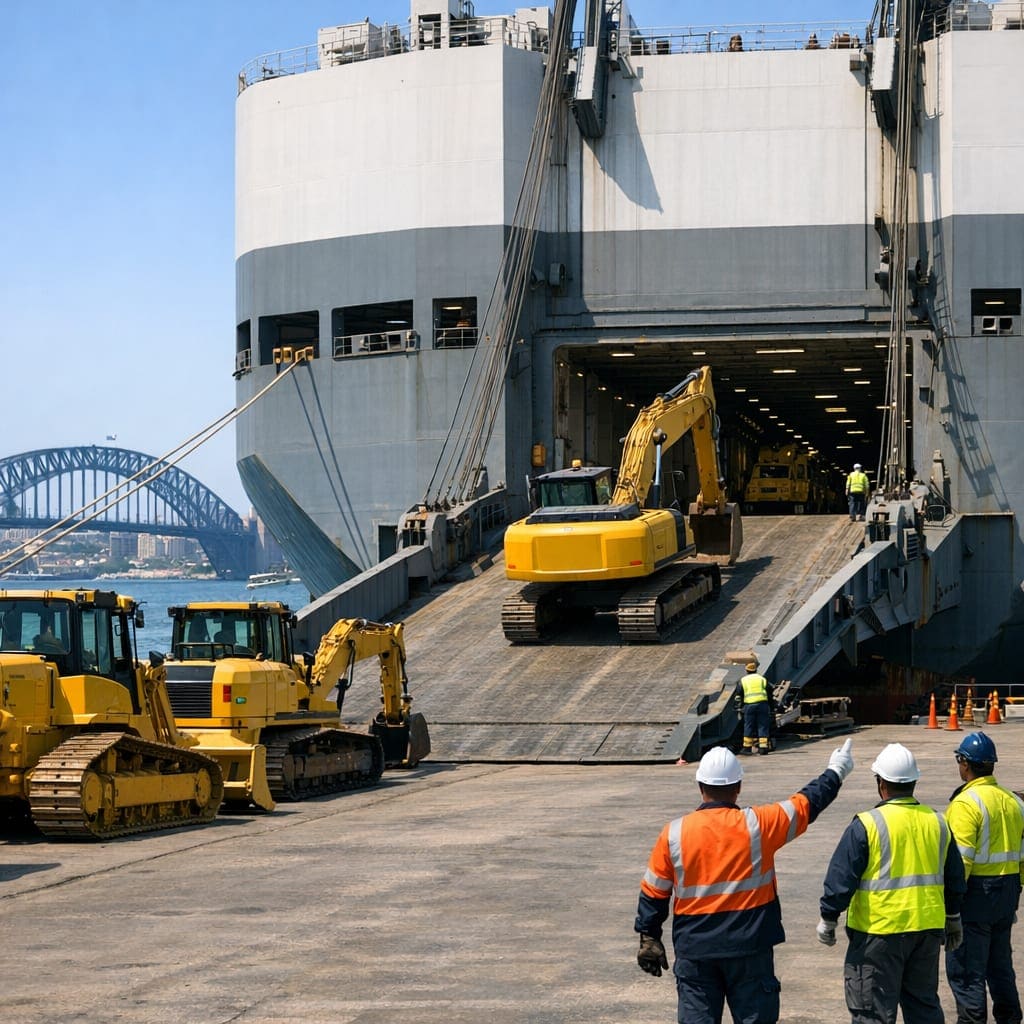
Project plan: a construction fleet to Australia
A fleet of excavators, loaders, dozers and graders for an Australian project can sail RoRo from Jacksonville to Melbourne in 30 to 32 days or to Brisbane in 36 to 39[1]; every used machine must arrive free of soil and seeds[2], and machines shipped between 1 September and 30 April on flat racks or as breakbulk must be treated for stink bugs before they sail[3].
This is a project plan, not a record of a completed job. It shows how we would plan the move from the published carrier, port and regulatory data cited below; the manufacturer’s drawings replace every assumption once we have them.
The plan, step by step
- 01
Inventory the fleet
Each machine’s serial number, hours, weight and shipping dimensions go on one list with photos. The list drives the bookings, the AES filings and the cleaning plan.
- 02
Clean to Australian standard
Tracks, belly pans, radiators and buckets are cleaned until no soil, seed or plant material remains, which can mean partly dismantling the machine. A machine that fails inspection is re-cleaned at the importer’s cost[2].
- 03
Treat in season
Between 1 September and 30 April, target goods shipped from the U.S. need stink bug treatment; for flat racks, open tops and breakbulk it is done before the ship sails[3].
- 04
File each machine
Each used machine that drives is filed in AES at least 72 hours before export, and its ITN, serial number and ownership documents go to CBP at the port[5].
- 05
Haul and load
Loads over 102 in wide or 80,000 lb gross travel to the port under a permit from every state on the route[6], and the machines drive aboard the RoRo ship.
- 06
Clear in Australia
The importer’s broker lodges the import declaration, and the Department of Agriculture inspects every used machine on arrival[2].
Machines in this plan
| Model | Weight | L × W × H (transport) | Best method | Preparation |
|---|---|---|---|---|
| CAT 320Hydraulic excavatorSpec source | 49,800 lb (22,600 kg)operating weight | 31 ft 3 in × 9 ft 9 in × 9 ft 9 in (9.53 × 2.98 × 2.96 m) | 40 ft flat rackOut-of-gauge | Ships assembled, blocked and lashed; out-of-gauge surcharge applies (1 ft 11 in / 0.58 m over width, 3 ft 4 in / 1.01 m over height). |
| Komatsu PC360LC-11Hydraulic excavatorSpec source | 78,800 lb (35,748 kg)operating weight | 36 ft 7 in × 10 ft 10 in × 10 ft 9 in (11.15 × 3.29 × 3.29 m) | 40 ft flat rackOut-of-gauge | Ships assembled, blocked and lashed; out-of-gauge surcharge applies (2 ft 11 in / 0.89 m over width, 4 ft 5 in / 1.34 m over height). |
| CAT 950Wheel loaderSpec source | 42,500 lb (19,260 kg)operating weight | 27 ft 3 in × 9 ft 3 in × 11 ft 4 in (8.31 × 2.82 × 3.46 m) | 40 ft flat rackOut-of-gauge | Ships assembled, blocked and lashed; out-of-gauge surcharge applies (1 ft 5 in / 0.42 m over width, 4 ft 11 in / 1.51 m over height). |
| Volvo L120HWheel loaderSpec source | 44,600 lb (20,210 kg)operating weight | 27 ft × 8 ft 9 in × 11 ft 1 in (8.24 × 2.67 × 3.38 m) | 40 ft flat rackOut-of-gauge | Ships assembled, blocked and lashed; out-of-gauge surcharge applies (11 in / 0.27 m over width, 4 ft 8 in / 1.43 m over height). |
| CAT D6Track-type tractor (dozer)Spec source | 48,800 lb (22,130 kg)operating weight | 17 ft 10 in × 8 ft 4 in × 10 ft 6 in (5.44 × 2.54 × 3.19 m) | 40 ft flat rackOut-of-gauge | Ships assembled, blocked and lashed; out-of-gauge surcharge applies (6 in / 0.14 m over width, 4 ft 1 in / 1.24 m over height). |
| CAT 140Motor graderSpec source | 43,100 lb (19,531 kg)operating weight | 33 ft 9 in (10.3 m) × n/a × 11 ft 4 in (3.45 m) | Measured before quoting | The manufacturer does not publish the transport width, so we measure the machine at pickup and confirm the method before you book. |
Sailings from the U.S. to Asia and Oceania
| Destination port | NYK RORO[7]RTW (U.S. West Coast – Asia)RoRo | Höegh Autoliners[1]North America – OceaniaRoRo | Hapag-Lloyd[8]Gemini transpacific servicesContainer |
|---|---|---|---|
| Loads at | Port Hueneme | Baltimore, Jacksonville | Los Angeles, Oakland |
| Yokohama |
| No direct call | Calls; transit not listed |
| Busan | No direct call | No direct call | Calls; transit not listed |
| Xingang (Tianjin) | No direct call | No direct call | Calls; transit not listed |
| Ningbo | No direct call | No direct call | Calls; transit not listed |
| Yantian (Shenzhen) | No direct call | No direct call | Calls; transit not listed |
| Singapore | No direct call | No direct call | No direct call |
| Brisbane | No direct call |
| No direct call |
| Port Kembla | No direct call |
| No direct call |
| Melbourne | No direct call |
| No direct call |
| Auckland | No direct call |
| No direct call |
- NYK RORO: Long Beach and San Diego are discharge-only calls for these ships. Cargo for China, Korea and Australia goes on from Yokohama by feeder. The ships that loaded at Port Hueneme took cargo up to 16 ft 9 in to 17 ft 1 in (5.1 to 5.2 m) high on ramps rated 88 US tons to 165 US tons (80 to 150 t).
- Höegh Autoliners: Three voyages were listed when we checked, each loading Baltimore and then Jacksonville and crossing the Panama Canal.
- Hapag-Lloyd: WC5 sails westbound from Los Angeles and Oakland to Yokohama and Busan; other services in the network run direct from Oakland to Xingang and from Los Angeles to Ningbo and Yantian. Flat racks and open tops ride the same ships when the carrier accepts the cargo.
Duty and GST in Australia
| Country | Import duty | VAT | Other charges | Published by |
|---|---|---|---|---|
| Australia | 5% of CIF (concessions or trade agreements may reduce this) | GST 10% | Luxury Car Tax of 33% on value above the LCT threshold (≈ A$80,567, or ≈ A$91,387 for fuel-efficient vehicles, FY2025–26) | Australian Border Force / Australian Taxation Officechecked June 2026 |
Rules this move has to meet
- Used machinery cleanliness: AustraliaAustralian Department of Agriculture, Fisheries and Forestry
Used machinery must arrive free of soil, seeds and plant or animal material, which can mean partly dismantling the machine to clean hollow and concealed sections. Every consignment is inspected on arrival; a machine with low contamination is re-cleaned at an approved site at the importer’s cost, and a heavily contaminated one can be ordered out of the country.[2]
Applies to: Used machinery and parts shipped to Australia
- Brown marmorated stink bug season: AustraliaAustralian Department of Agriculture, Fisheries and Forestry
Target high-risk goods shipped from the United States between 1 September and 30 April need mandatory treatment, judged by the shipped-on-board date. Flat rack, open top and breakbulk cargo must be treated before it leaves; if untreated, it is refused discharge or sent back. Heat treatment holds 56 °C at the coldest surface for 30 minutes, and for break bulk pieces under 6,610 lb (3,000 kg) 60 °C for 10 minutes.[3]
Applies to: Machinery, vehicles, steel and other listed goods (HS chapters 84, 85 and 87 among them) shipped from the U.S. by sea, 1 September to 30 April
- Used self-propelled vehicles: 72-hour ruleU.S. Customs and Border Protection
U.S. regulations count self-propelled construction and agricultural machinery as vehicles. A used one must be filed in AES at least 72 hours before export, whatever its value or destination, and the ITN, the VIN or serial number and the ownership documents go to CBP at the port of export. Filing after departure is not allowed.[10][5][11]
Applies to: Used machines that drive: excavators, loaders, dozers, tractors, trucks
- Electronic Export Information (15 CFR 30)U.S. Census Bureau
Electronic Export Information is filed in AES for each Schedule B number worth more than $2,500 going to one consignee on one conveyance, and for every vehicle whatever its value. For vessel cargo it is due at least 24 hours before loading; the Internal Transaction Number (ITN) goes to the carrier with the booking.[12][11]
Applies to: Any Schedule B line over $2,500, and every vehicle
- Engines exported without U.S. certification (40 CFR 1068.230)U.S. EPA
New engines and equipment that are not certified to U.S. emission standards may be exported under 40 CFR 1068.230 if they carry a label stating they are solely for export. Selling or offering one to a buyer in the United States voids the exemption, and the machine may only be run in the U.S. to prepare and deliver it for export.[13]
Applies to: New nonroad engines and equipment built for a foreign market
- Federal truck size and weight limits (23 CFR 658)FHWA
On the Interstate system a truck may gross 80,000 lb, with 20,000 lb on a single axle and 34,000 lb on a tandem; on the National Network the load may be 102 in wide. There is no federal height limit: states set 13.6 to 14.6 ft. A load over any of these needs an oversize or overweight permit from every state on the route.[6]
Applies to: Every road move to and from the port
Questions about this plan
How long does a machine take to reach Australia by RoRo?
On the schedule we checked, 30 to 35 days to Melbourne, 33 to 38 to Port Kembla and 36 to 42 to Brisbane from Jacksonville or Baltimore, crossing the Panama Canal.
What happens if a machine fails the Australian inspection?
It is re-cleaned at an approved site at the importer’s cost, and a heavily contaminated machine can be ordered out of the country.
Is this a job you have completed?
No. It is a plan built from published data to show how we would run the move. Send us the fleet list and we will turn it into a quote.
Sources
Every figure on this page comes from the documents below, each checked on the date shown. Carriers and authorities revise them, so we confirm the current figure when we book.
- [1]Höegh Autoliners, Sailing schedule by vessel (as listed 18 Oct 2026), checked October 18, 2026
- [2]Australian Department of Agriculture, Fisheries and Forestry, Cleanliness requirements for imported machinery, checked October 18, 2026
- [3]Australian Department of Agriculture, Fisheries and Forestry, Seasonal measures for brown marmorated stink bug, checked October 18, 2026
- [4]World Bank WITS (UN Comtrade), U.S. exports of HS 842951, 2024, checked October 18, 2026
- [5]U.S. Customs and Border Protection, Exporting used self-propelled vehicles, checked October 18, 2026
- [6]FHWA, Commercial Vehicle Size and Weight Program (23 CFR 658), checked October 18, 2026
- [7]NYK RORO, RTW schedule: Mexico and U.S. West Coast to Asia (week 42, 13 Oct 2026), checked October 18, 2026
- [8]Hapag-Lloyd, Revised WC5 westbound rotation (July 2026), checked October 18, 2026
- [9]Hapag-Lloyd, East-West Service Network (September 2026), checked October 18, 2026
- [10]eCFR, 19 CFR 192.1 Definitions (used self-propelled vehicles), checked October 18, 2026
- [11]U.S. Census Bureau, Foreign Trade Regulations FAQs, checked October 18, 2026
- [12]eCFR, 15 CFR 30.37 Miscellaneous exemptions (Foreign Trade Regulations), checked October 18, 2026
- [13]eCFR, 40 CFR 1068.230 Exempting engines/equipment for export, checked October 18, 2026
Send us the machine and the destination
Give us the model or the measured dimensions and weight. We come back with the method, the sailing and a price, and the figures behind them.