Project plan
Project plan: haul trucks and drill rigs to a copper mine in Chile
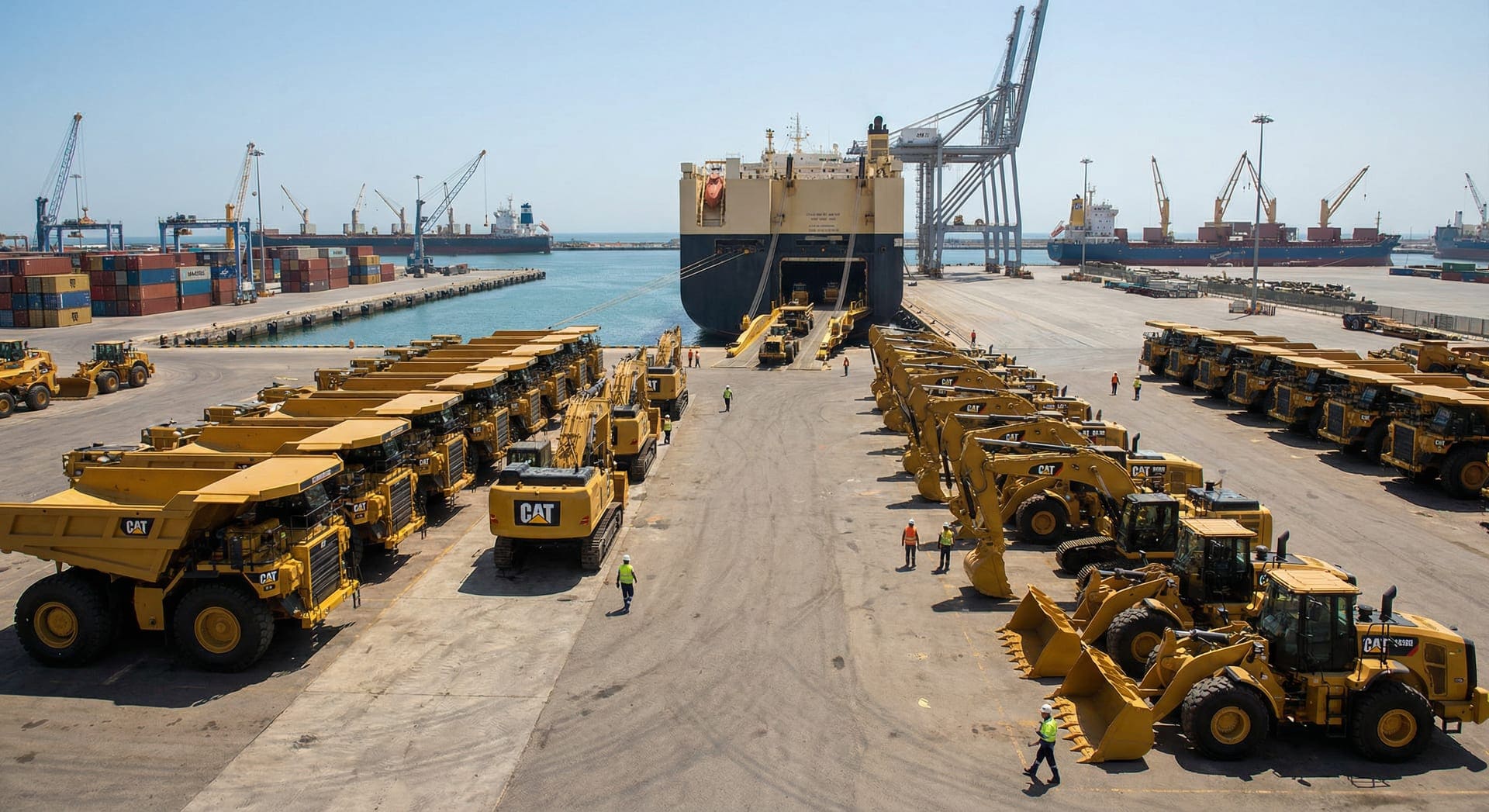
Chile bought $464 million of U.S. off-highway dump trucks in 2024, third after Canada and Australia[1]; trucks and drill rigs that drive can sail RoRo from Jacksonville to San Antonio, Chile, in 16 days[2], while the largest trucks ship in modules on a heavy-lift ship[3].
This is a project plan, not a record of a completed job. It shows how we would plan the move from the published carrier, port and regulatory data cited below; the manufacturer’s drawings replace every assumption once we have them.
The plan, step by step
- 01
Confirm how each machine ships
Each truck and rig is measured as it will ship. A rigid truck usually travels with the dump body off; the largest ship as a chassis, a body, wheels and crates of parts, and the heaviest module decides the ship.
- 02
- 03
Haul to the port
A load over 102 in wide or 80,000 lb gross needs a permit from every state on the route[6]; a haul truck on its trailer is usually over both.
- 04
File 72 hours ahead
A used truck or rig that drives counts as a vehicle: it is filed in AES at least 72 hours before export, and the ITN, serial number and ownership documents go to CBP at the port[5].
- 05
- 06
Clear and deliver
At San Antonio or Iquique the importer’s customs agent clears the machines, and trucks over the road limits travel to the mine under Chilean permits.
Machines in this plan
| Model | Weight | L × W × H (transport) | Best method | Preparation |
|---|---|---|---|---|
| Komatsu HD785-8Rigid dump truckSpec source | 81 US tons (73,800 kg)empty weight | 37 ft × 14 ft 2 in × 18 ft 11 in (11.28 × 4.32 × 5.77 m) | RoRoWhere a RoRo lane serves the destination | Drives on assembled where a RoRo lane serves the destination. |
| Liebherr T 264Mining truckSpec source | 194 US tons (176,000 kg)empty weight | 46 ft 7 in × 28 ft 3 in × 23 ft 6 in (14.2 × 8.62 × 7.17 m) | Breakbulk, in modules | Too large to move whole: dismantled into modules at the site and shipped breakbulk, with an engineered lift and stowage plan. |
| CAT 745Articulated truckSpec source | 73,000 lb (33,110 kg)empty weight | 37 ft 6 in × 12 ft 6 in × 12 ft 4 in (11.43 × 3.8 × 3.76 m) | 40 ft flat rackOut-of-gauge | Ships assembled, blocked and lashed; out-of-gauge surcharge applies (4 ft 7 in / 1.4 m over width, 5 ft 11 in / 1.81 m over height). |
| Epiroc SmartROC D65Surface drill rigSpec source | 50,700 lb (23,000 kg)shipping weight | 40 ft 8 in × 8 ft 2 in × 11 ft 6 in (12.4 × 2.5 × 3.5 m) | RoRoWhere a RoRo lane serves the destination | Drives on assembled where a RoRo lane serves the destination. |
| Sandvik DT922iTunnelling jumboSpec source | 67,200 lb (30,500 kg)operating weight | 49 ft 2 in × 8 ft 2 in × 11 ft 9 in (14.99 × 2.5 × 3.59 m) | RoRoWhere a RoRo lane serves the destination | Drives on assembled where a RoRo lane serves the destination. |
Sailings from the U.S. to South America
| Destination port | NYK RORO[2]MSXRoRo | NYK RORO[2]USCX (via the Panama Canal)RoRo | NYK RORO[7]North–SouthRoRo | Höegh Autoliners[8]Jacksonville – Colombia – PanamaRoRo |
|---|---|---|---|---|
| Loads at | Baltimore, Jacksonville, Newark, Davisville (RI) | Baltimore, Jacksonville, Newark | Freeport | Jacksonville |
| Cartagena | No direct call | No direct call | No direct call |
|
| Santa Marta | No direct call | No direct call | No direct call |
|
| Suape |
| No direct call | No direct call | No direct call |
| Vitória | No direct call | No direct call |
| No direct call |
| Rio de Janeiro | No direct call | No direct call |
| No direct call |
| Santos |
| No direct call | No direct call | No direct call |
| Paranaguá | No direct call | No direct call |
| No direct call |
| Zárate |
| No direct call |
| No direct call |
| San Antonio |
|
| No direct call | No direct call |
| Iquique |
|
| No direct call | No direct call |
| Callao |
|
| No direct call | No direct call |
| Guayaquil | No direct call | No direct call | No direct call | No direct call |
- NYK RORO: Calls the east coast of South America first and goes on to Chile and Peru. Used cargo for Chile is not accepted at Davisville or at the Newark and Red Hook terminals, and two of the ships take no U.S. cargo for the west coast.
- NYK RORO: One voyage was listed when we checked. The ship calls Manzanillo, Panama, and crosses the canal to the west coast.
- NYK RORO: The only Gulf Coast load port among these services. Cargo over 66,100 lb (30 t) is not accepted for transshipment to the west coast of South America.
- Höegh Autoliners: About one voyage a month on the vessel schedule when we checked.
Duty and VAT in Chile
| Country | Import duty | VAT | Other charges | Published by |
|---|---|---|---|---|
| Chile | 6% of CIF; 0% for qualifying US-origin goods under the US–Chile FTA | IVA 19% | An engine-displacement / luxury surcharge can apply to certain vehicles | Servicio Nacional de Aduanas / SIIchecked June 2026 |
Rules this move has to meet
- Used self-propelled vehicles: 72-hour ruleU.S. Customs and Border Protection
U.S. regulations count self-propelled construction and agricultural machinery as vehicles. A used one must be filed in AES at least 72 hours before export, whatever its value or destination, and the ITN, the VIN or serial number and the ownership documents go to CBP at the port of export. Filing after departure is not allowed.[9][5][10]
Applies to: Used machines that drive: excavators, loaders, dozers, tractors, trucks
- Electronic Export Information (15 CFR 30)U.S. Census Bureau
Electronic Export Information is filed in AES for each Schedule B number worth more than $2,500 going to one consignee on one conveyance, and for every vehicle whatever its value. For vessel cargo it is due at least 24 hours before loading; the Internal Transaction Number (ITN) goes to the carrier with the booking.[11][10]
Applies to: Any Schedule B line over $2,500, and every vehicle
- Engines exported without U.S. certification (40 CFR 1068.230)U.S. EPA
New engines and equipment that are not certified to U.S. emission standards may be exported under 40 CFR 1068.230 if they carry a label stating they are solely for export. Selling or offering one to a buyer in the United States voids the exemption, and the machine may only be run in the U.S. to prepare and deliver it for export.[12]
Applies to: New nonroad engines and equipment built for a foreign market
- Engines, vehicles and machinery as hazardous materials (49 CFR 173.220)PHMSA
A machine is regulated as a hazardous material when it carries fuel, a wet, sodium or lithium battery, or other hazardous materials. A tank of flammable liquid fuel such as gasoline is drained to 500 mL or less and closed; a self-propelled machine on diesel may keep its fuel if the tank has room for expansion and the cap is closed. Batteries stay installed and secured, wet batteries upright, with the terminals protected against short circuits.[13]
Applies to: Machines with fuel, batteries or other hazardous materials, by road, vessel or air
- Federal truck size and weight limits (23 CFR 658)FHWA
On the Interstate system a truck may gross 80,000 lb, with 20,000 lb on a single axle and 34,000 lb on a tandem; on the National Network the load may be 102 in wide. There is no federal height limit: states set 13.6 to 14.6 ft. A load over any of these needs an oversize or overweight permit from every state on the route.[6]
Applies to: Every road move to and from the port
Questions about this plan
Which Chilean ports take RoRo cargo from the U.S.?
On the schedules we checked, San Antonio and Iquique, both called by NYK services from Baltimore, Jacksonville and New York.
Is there duty on U.S. mining equipment in Chile?
Chile charges 6% of the CIF value, often 0% for qualifying U.S.-origin goods under the U.S.–Chile Free Trade Agreement, plus 19% VAT on the CIF value plus duty.
Is this a job you have completed?
No. It is a plan built from published data to show how we would run the move. Send us the machine list and we will turn it into a quote.
Sources
Every figure on this page comes from the documents below, each checked on the date shown. Carriers and authorities revise them, so we confirm the current figure when we book.
- [1]World Bank WITS (UN Comtrade), U.S. exports of HS 870410, 2024, checked October 18, 2026
- [2]NYK RORO, MSX/USCX schedule: U.S. East Coast to South America (week 42, 16 Oct 2026), checked October 18, 2026
- [3]SAL Heavy Lift, Fleet list (April 2026), checked October 18, 2026
- [4]Wallenius Wilhelmsen, Cargo handling equipment, checked October 18, 2026
- [5]U.S. Customs and Border Protection, Exporting used self-propelled vehicles, checked October 18, 2026
- [6]FHWA, Commercial Vehicle Size and Weight Program (23 CFR 658), checked October 18, 2026
- [7]NYK RORO, North–South loop schedule: U.S. Gulf, Mexico, Panama and East Coast South America (week 42, 16 Oct 2026), checked October 18, 2026
- [8]Höegh Autoliners, Sailing schedule by vessel (as listed 18 Oct 2026), checked October 18, 2026
- [9]eCFR, 19 CFR 192.1 Definitions (used self-propelled vehicles), checked October 18, 2026
- [10]U.S. Census Bureau, Foreign Trade Regulations FAQs, checked October 18, 2026
- [11]eCFR, 15 CFR 30.37 Miscellaneous exemptions (Foreign Trade Regulations), checked October 18, 2026
- [12]eCFR, 40 CFR 1068.230 Exempting engines/equipment for export, checked October 18, 2026
- [13]eCFR, 49 CFR 173.220 Internal combustion engines, vehicles and machinery (hazardous materials), checked October 18, 2026
Send us the machine and the destination
Give us the model or the measured dimensions and weight. We come back with the method, the sailing and a price, and the figures behind them.