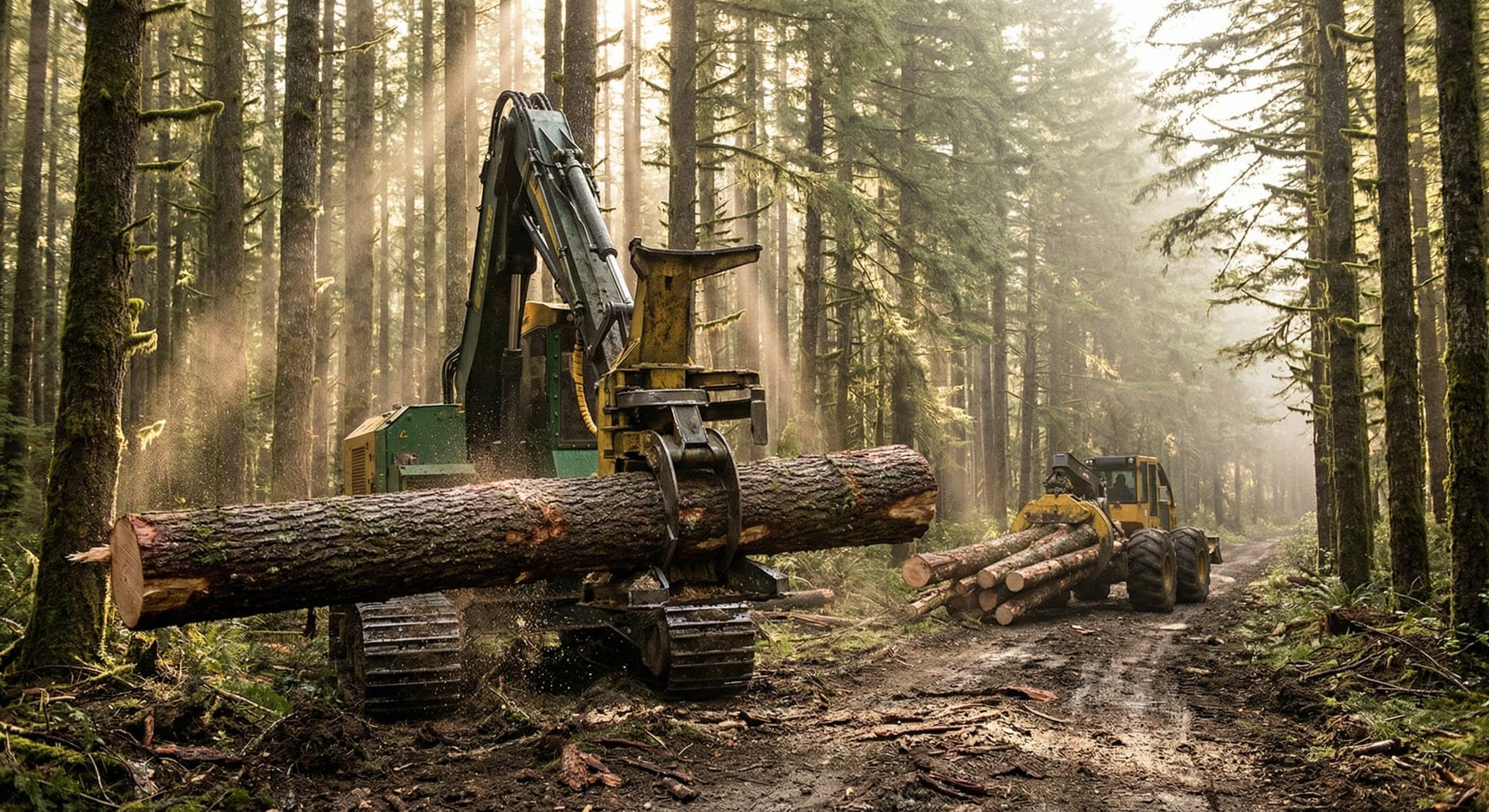
Forestry equipment
Shipping forestry equipment overseas
Forestry machines work in soil, bark and seed, so the destination inspection usually sets the schedule: Australia and New Zealand inspect every used machine on arrival[5][6], and machinery shipped from the U.S. to Australia between 1 September and 30 April on a flat rack or as breakbulk must be treated for stink bugs before it sails[4].
Machine sizes
Ranges across every forestry model in our data whose manufacturer publishes the transport figures: skidders, forwarders, feller bunchers and loaders.
| Class | Weight | Width | Height | Spec sheets |
|---|---|---|---|---|
| Forestry machines | 29,700 lb / 13,472 kg – 74,000 lb / 33,565 kg | 10 ft / 3.06 m – 11 ft 1 in / 3.39 m | 8 ft 10 in / 2.7 m – 12 ft 8 in / 3.85 m |
How forestry machines usually ship
| Method | Use it when | Avoid it when |
|---|---|---|
| RoRo | Wheeled skidders and forwarders that drive aboard, to a port on a RoRo service. | The machine is tracked and the ship or terminal will not take it on its own tracks. |
| Flat rack | Feller bunchers, tracked harvesters and machines over 9 ft 10 in (3 m) wide, going to a port without a RoRo call. | A RoRo service calls the destination and the machine drives. |
| Container | Felling heads, grapples, saws and loaders taken off their carrier, crated or blocked in a box. | The base machine itself: every skidder and forwarder in our data is wider than the 7 ft 8 in (2.34 m) door. |
Container, flat rack, RoRo or breakbulk?
We quote in this order because it is usually cheapest first. Most machines that look too big for a box fit once our crew takes off the bucket, boom, cab or wheels; larger ones are taken further apart across several containers, and pieces too big or heavy for a flat rack or roll trailer go breakbulk.
01Container
- Work needed
- We partially disassemble when needed (bucket, boom, cab, wheels), or take larger machines further apart across several high-cubes and open-tops, then crate, block and lash every part.
- Destinations
- Widest: almost every port worldwide, plus inland delivery by rail.
- Typical cost
- Usually the lowest, with no out-of-gauge surcharges.
- Protection
- Sealed steel box; loose parts and attachments travel locked inside.
- Best for
- Most machines: compact ones as they are, others after partial disassembly, and large ones split across several containers.
02Flat rack
- Work needed
- Ships assembled, blocked and lashed. Surcharges apply when wider than 2.4 m or taller than about 1.95 m.
- Destinations
- Most container ports, on the same vessels as containers.
- Typical cost
- Moderate; rises with every centimetre out of gauge.
- Protection
- Open to the weather; we protect cabs, electronics and hydraulics.
- Best for
- Excavators, dozers and loaders too wide for a container door.
03RoRo
- Work needed
- Drives on assembled; non-runners go on a roll trailer.
- Destinations
- Fewer destinations: regular lanes to Europe, West Africa, the Middle East, Oceania and parts of Latin America.
- Typical cost
- Often competitive for large self-propelled machines where a lane exists.
- Protection
- Below deck, but loose items and attachments cannot ride inside the cab.
- Best for
- Running machines going to a port with regular RoRo sailings.
04Breakbulk
- Work needed
- Lifted aboard piece by piece by ship’s or shore cranes, on its own skids or cradle, then stowed and lashed in the hold or on deck.
- Destinations
- Ports with breakbulk berths and heavy-lift cranes; sailings are booked voyage by voyage.
- Typical cost
- Usually the highest for a single small machine; often the only option for the largest pieces.
- Protection
- In the hold or lashed on deck; we crate, wrap and protect exposed parts.
- Best for
- Pieces too large or heavy for a flat rack or roll trailer: transformers, process modules, mining trucks, crane sections.
Common models and how they ship
| Model | Weight | L × W × H (transport) | Best method | Preparation |
|---|---|---|---|---|
| Tigercat 620HGrapple skidderSpec source | 43,200 lb (19,595 kg)operating weight | 24 ft 4 in × 10 ft 11 in × 10 ft 4 in (7.42 × 3.33 × 3.15 m) | 40 ft flat rackOut-of-gauge | Ships assembled, blocked and lashed; out-of-gauge surcharge applies (3 ft 1 in / 0.93 m over width, 3 ft 11 in / 1.2 m over height). |
| Tigercat 1075CForwarderSpec source | 60,600 lb (27,500 kg)operating weight | 33 ft 8 in × 10 ft × 12 ft 8 in (10.26 × 3.06 × 3.85 m) | 40 ft flat rackOut-of-gauge | Ships assembled, blocked and lashed; out-of-gauge surcharge applies (2 ft 2 in / 0.66 m over width, 6 ft 3 in / 1.9 m over height). |
| Tigercat 870DTrack feller buncherSpec source | 74,000 lb (33,565 kg)base weight | 18 ft 3 in × 11 ft 1 in × 11 ft 1 in (5.56 × 3.39 × 3.39 m) | 40 ft flat rackOut-of-gauge | Ships assembled, blocked and lashed; out-of-gauge surcharge applies (3 ft 3 in / 0.99 m over width, 4 ft 9 in / 1.44 m over height). |
| Tigercat 234CKnuckleboom loaderSpec source | 33,400 lb (15,130 kg)base weight | 16 ft 1 in (4.9 m) × n/a × 11 ft 7 in (3.53 m) | Measured before quoting | The manufacturer does not publish the transport width, so we measure the machine at pickup and confirm the method before you book. |
| Barko 495MLTruck or trailer-mount loaderSpec source | 29,700 lb (13,472 kg)operating weight | 40 ft 7 in (12.37 m) × n/a × 8 ft 10 in (2.7 m) | Measured before quoting | The manufacturer does not publish the transport width, so we measure the machine at pickup and confirm the method before you book. |
Export and biosecurity rules
Biosecurity rules at the destination decide most forestry shipments; the U.S. filing rules for used vehicles apply to every machine that drives.
- Used machinery cleanliness: AustraliaAustralian Department of Agriculture, Fisheries and Forestry
Used machinery must arrive free of soil, seeds and plant or animal material, which can mean partly dismantling the machine to clean hollow and concealed sections. Every consignment is inspected on arrival; a machine with low contamination is re-cleaned at an approved site at the importer’s cost, and a heavily contaminated one can be ordered out of the country.[6]
Applies to: Used machinery and parts shipped to Australia
- Brown marmorated stink bug season: AustraliaAustralian Department of Agriculture, Fisheries and Forestry
Target high-risk goods shipped from the United States between 1 September and 30 April need mandatory treatment, judged by the shipped-on-board date. Flat rack, open top and breakbulk cargo must be treated before it leaves; if untreated, it is refused discharge or sent back. Heat treatment holds 56 °C at the coldest surface for 30 minutes, and for break bulk pieces under 6,610 lb (3,000 kg) 60 °C for 10 minutes.[4]
Applies to: Machinery, vehicles, steel and other listed goods (HS chapters 84, 85 and 87 among them) shipped from the U.S. by sea, 1 September to 30 April
- Used machinery cleanliness: New ZealandNew Zealand Ministry for Primary Industries
Used machinery must be cleaned inside and out before shipping, and a cleaning certificate for used outdoor machinery reaches MPI before arrival. MPI expects to inspect on arrival, within 12 hours of unloading for breakbulk and open containers, and can require partial or full dismantling. If contamination cannot be removed, the machine may be reshipped or destroyed at the importer’s cost.[5]
Applies to: Used vehicles, machinery and parts shipped to New Zealand
- ISPM 15 wood packagingIPPC, administered in the U.S. by USDA APHIS
Wood packaging and dunnage must be heat-treated to a core temperature of 56 °C for at least 30 minutes, or fumigated, and carry the IPPC mark with the US country code, the facility number and HT or MB. Marked wood can be reused; repaired or remanufactured wood must be treated and marked again.[3]
Applies to: Crates, skids, blocking and dunnage
- Used self-propelled vehicles: 72-hour ruleU.S. Customs and Border Protection
U.S. regulations count self-propelled construction and agricultural machinery as vehicles. A used one must be filed in AES at least 72 hours before export, whatever its value or destination, and the ITN, the VIN or serial number and the ownership documents go to CBP at the port of export. Filing after departure is not allowed.[8][7][9]
Applies to: Used machines that drive: excavators, loaders, dozers, tractors, trucks
- Cargo securement on trucks (49 CFR 393.106 and 393.130)FMCSA
The tiedowns on a load must together have a working load limit of at least half its weight. A machine on wheels or tracks weighing 10,000 lb or more needs at least four tiedowns, fixed as close as practicable to its front and rear or to its designed tie points; buckets and shovels are lowered and secured, and articulated machines are locked so they cannot articulate.[10][11]
Applies to: Machines on wheels or tracks moved by truck, and every other load on a public road
Where U.S. forestry machinery goes
U.S. exports by HS subheading in 2024, as reported by the United States to UN Comtrade. Forestry machines share these subheadings with other farm machinery, so the figures cover both.
| Product | U.S. exports, 2024 | Units | Largest markets, share of value |
|---|---|---|---|
| Other agricultural and forestry machineryHS 843680 | $281 million[1] | 159,212 | Canada 36% · Australia 11% · Mexico 9% · Brazil 6% · Netherlands 4% |
| Parts of agricultural and forestry machineryHS 843699 | $186 million[2] | – | Canada 35% · Australia 7% · Ecuador 4% · Mexico 3% · Chile 3% |
Cleaning a used forestry machine
Bark, needles and soil collect in tracks, belly pans, the radiator core and the boom, and a felling head or grapple holds wood fibre in every joint. Australia inspects every consignment of used machinery and sends a contaminated one to be re-cleaned at the importer’s cost[6]; New Zealand can require partial or full dismantling[5].
We book the wash at a facility near the port, often with guards and belly pans off, then photograph the machine and keep the wash record with the export file. Dunnage used to block the machine is ISPM 15 heat-treated and stamped[3].
Questions about shipping forestry equipment
Can a skidder or forwarder fit in a container?
Not the base machine: the skidders and forwarders in our data are 9 ft 10 in to 11 ft 2 in (3.0 to 3.4 m) wide, more than the 7 ft 8 in (2.34 m) container door. They go RoRo or on a flat rack; felling heads, grapples and parts can go in a container.
Does a used forestry machine need cleaning for New Zealand?
Yes. It must be cleaned inside and out before shipping, with a cleaning certificate sent to MPI before arrival. MPI expects to inspect breakbulk and open containers within 12 hours of unloading and can require dismantling.
When does machinery to Australia need stink bug treatment?
When it is shipped from the U.S. between 1 September and 30 April, judged by the shipped-on-board date. Flat rack, open top and breakbulk cargo must be treated before it sails.
Our Services for Forestry
- Flat Rack Shipping
For tracked and wide forestry machines
- Heavy Haul Trucking
Permitted moves from the yard to the port
- USDA Washing
Cleaning to the standard Australia and New Zealand inspect to
- Export Fumigation
Seasonal treatments required at destination
Equipment We Ship for Forestry
Brands We Specialize In
Sources
Every figure on this page comes from the documents below, each checked on the date shown. Carriers and authorities revise them, so we confirm the current figure when we book.
- [1]World Bank WITS (UN Comtrade), U.S. exports of HS 843680, 2024, checked October 18, 2026
- [2]World Bank WITS (UN Comtrade), U.S. exports of HS 843699, 2024, checked October 18, 2026
- [3]USDA APHIS, Export ISPM 15-compliant wood packaging material, checked October 18, 2026
- [4]Australian Department of Agriculture, Fisheries and Forestry, Seasonal measures for brown marmorated stink bug, checked October 18, 2026
- [5]New Zealand Ministry for Primary Industries, Steps to importing vehicles, machinery, or parts, checked October 18, 2026
- [6]Australian Department of Agriculture, Fisheries and Forestry, Cleanliness requirements for imported machinery, checked October 18, 2026
- [7]U.S. Customs and Border Protection, Exporting used self-propelled vehicles, checked October 18, 2026
- [8]eCFR, 19 CFR 192.1 Definitions (used self-propelled vehicles), checked October 18, 2026
- [9]U.S. Census Bureau, Foreign Trade Regulations FAQs, checked October 18, 2026
- [10]eCFR, 49 CFR 393.106 General requirements for securing articles of cargo, checked October 18, 2026
- [11]eCFR, 49 CFR 393.130 Securement of heavy vehicles, equipment and machinery, checked October 18, 2026
Send us the machine and the destination
Give us the model or the measured dimensions and weight. We come back with the method, the sailing and a price, and the figures behind them.