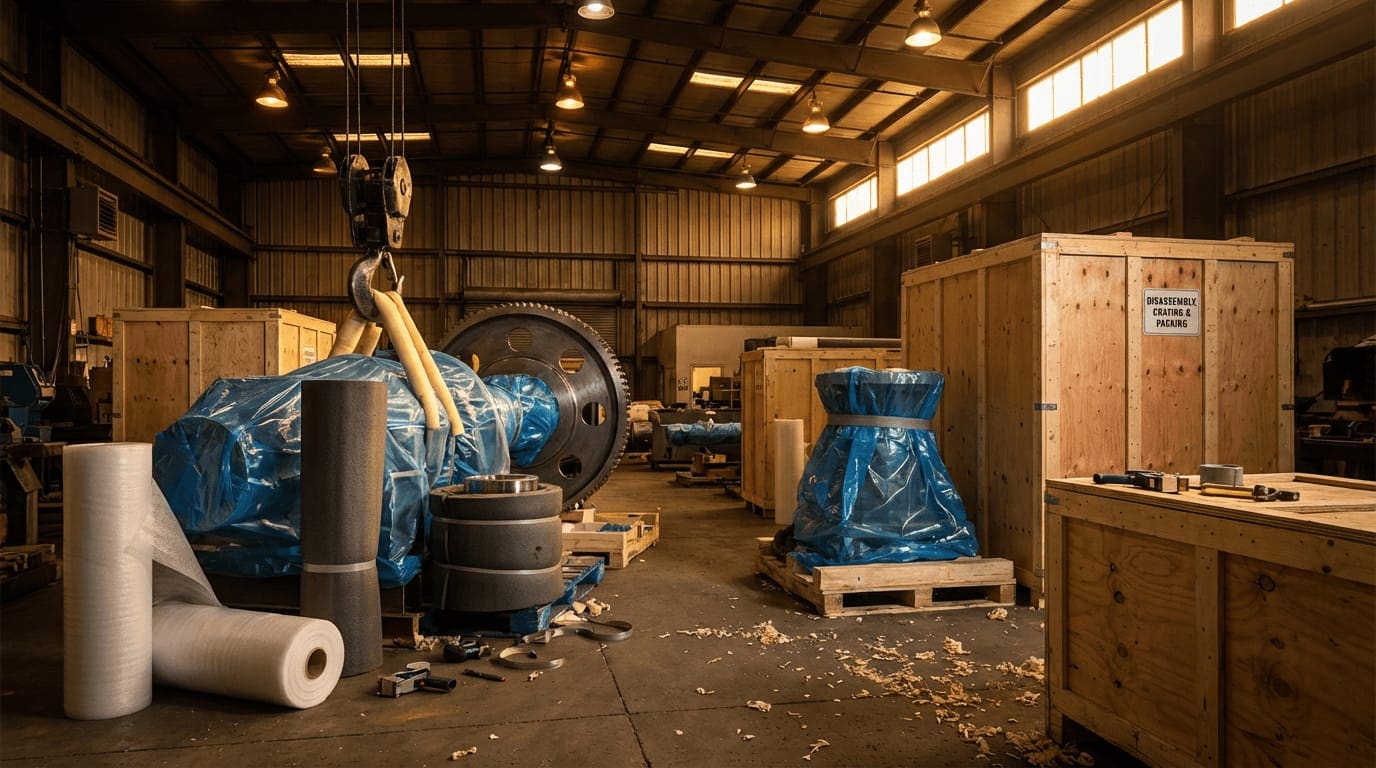
Disassembly and crating
Disassembly, crating and containerization of machinery
Taking off the bucket, cab, counterweight or tracks brings many machines inside a container’s 7 ft 8 in (2.34 m) wide door[1]; the parts are crated in ISPM 15 marked wood[2] and loaded so their weight spreads along the floor[3].
Disassemble or ship whole
| Method | Use it when | Avoid it when |
|---|---|---|
| Disassemble into a container | The machine is just over the door size and the buyer can refit the parts[1]. | Refitting at destination needs specialist crews or tools the buyer does not have. |
| Flat rack, whole | The machine is well over the door size but within a rack’s payload for its footprint. | Removing one part brings it under the door: a container costs less. |
| RoRo, whole | The machine drives and the destination has a RoRo call. | No RoRo ship calls the port. |
Container, flat rack, RoRo or breakbulk?
We quote in this order because it is usually cheapest first. Most machines that look too big for a box fit once our crew takes off the bucket, boom, cab or wheels; larger ones are taken further apart across several containers, and pieces too big or heavy for a flat rack or roll trailer go breakbulk.
01Container
- Work needed
- We partially disassemble when needed (bucket, boom, cab, wheels), or take larger machines further apart across several high-cubes and open-tops, then crate, block and lash every part.
- Destinations
- Widest: almost every port worldwide, plus inland delivery by rail.
- Typical cost
- Usually the lowest, with no out-of-gauge surcharges.
- Protection
- Sealed steel box; loose parts and attachments travel locked inside.
- Best for
- Most machines: compact ones as they are, others after partial disassembly, and large ones split across several containers.
02Flat rack
- Work needed
- Ships assembled, blocked and lashed. Surcharges apply when wider than 2.4 m or taller than about 1.95 m.
- Destinations
- Most container ports, on the same vessels as containers.
- Typical cost
- Moderate; rises with every centimetre out of gauge.
- Protection
- Open to the weather; we protect cabs, electronics and hydraulics.
- Best for
- Excavators, dozers and loaders too wide for a container door.
03RoRo
- Work needed
- Drives on assembled; non-runners go on a roll trailer.
- Destinations
- Fewer destinations: regular lanes to Europe, West Africa, the Middle East, Oceania and parts of Latin America.
- Typical cost
- Often competitive for large self-propelled machines where a lane exists.
- Protection
- Below deck, but loose items and attachments cannot ride inside the cab.
- Best for
- Running machines going to a port with regular RoRo sailings.
04Breakbulk
- Work needed
- Lifted aboard piece by piece by ship’s or shore cranes, on its own skids or cradle, then stowed and lashed in the hold or on deck.
- Destinations
- Ports with breakbulk berths and heavy-lift cranes; sailings are booked voyage by voyage.
- Typical cost
- Usually the highest for a single small machine; often the only option for the largest pieces.
- Protection
- In the hold or lashed on deck; we crate, wrap and protect exposed parts.
- Best for
- Pieces too large or heavy for a flat rack or roll trailer: transformers, process modules, mining trucks, crane sections.
Machines and what comes off
Manufacturer figures for each model, linked in the first column, and the method and work our fit check gives for it.
| Model | Weight | L × W × H (transport) | Best method | Preparation |
|---|---|---|---|---|
| CAT 320Hydraulic excavatorSpec source | 49,800 lb (22,600 kg)operating weight | 31 ft 3 in × 9 ft 9 in × 9 ft 9 in (9.53 × 2.98 × 2.96 m) | 40 ft flat rackOut-of-gauge | Ships assembled, blocked and lashed; out-of-gauge surcharge applies (1 ft 11 in / 0.58 m over width, 3 ft 4 in / 1.01 m over height). |
| Komatsu PC210LC-11Hydraulic excavatorSpec source | 51,200 lb (23,240 kg)operating weight | 31 ft 10 in × 9 ft 9 in × 9 ft 10 in (9.71 × 2.98 × 3 m) | 40 ft flat rackOut-of-gauge | Ships assembled, blocked and lashed; out-of-gauge surcharge applies (1 ft 11 in / 0.58 m over width, 3 ft 5 in / 1.05 m over height). |
| Volvo EC220ECrawler excavatorSpec source | 52,800 lb (23,940 kg)operating weight | 31 ft 9 in × 9 ft 10 in × 9 ft 8 in (9.69 × 2.99 × 2.94 m) | 40 ft flat rackOut-of-gauge | Ships assembled, blocked and lashed; out-of-gauge surcharge applies (1 ft 11 in / 0.59 m over width, 3 ft 3 in / 0.99 m over height). |
| CAT 420Backhoe loaderSpec source | 17,300 lb (7,834 kg)operating weight | 23 ft 6 in × 7 ft 5 in × 12 ft (7.16 × 2.25 × 3.65 m) | 40 ft flat rackOut-of-gauge | Ships assembled, blocked and lashed; out-of-gauge surcharge applies (5 ft 7 in / 1.7 m over height). |
| JCB 540-170 LoadallTelehandlerSpec source | 27,500 lb (12,470 kg)operating weight | 20 ft 10 in × 8 ft × 8 ft 10 in (6.36 × 2.44 × 2.69 m) | 40 ft flat rackOut-of-gauge | Ships assembled, blocked and lashed; out-of-gauge surcharge applies (2 in / 0.04 m over width, 2 ft 5 in / 0.74 m over height). |
| Kubota SVL97-2Compact track loaderSpec source | 11,600 lb (5,250 kg)operating weight | 10 ft 4 in × 6 ft 5 in × 6 ft 11 in (3.14 × 1.96 × 2.12 m) | 20 ft containerFits as is | Ships as it is, blocked and lashed. |
How a machine is taken apart and packed
- 01
Measure and plan
What must come off to pass the door, and the order to remove it.
- 02
Remove and tag
Each part labelled, hydraulic lines capped, fasteners bagged with their part.
- 03
Crate
Crates and skids of ISPM 15 heat-treated, marked wood[2].
- 04
Load
Machine and crates in the box, weight spread along the floor, blocked and lashed[3].
Rules that apply
- ISPM 15 wood packagingIPPC, administered in the U.S. by USDA APHIS
Wood packaging and dunnage must be heat-treated to a core temperature of 56 °C for at least 30 minutes, or fumigated, and carry the IPPC mark with the US country code, the facility number and HT or MB. Marked wood can be reused; repaired or remanufactured wood must be treated and marked again.[2]
Applies to: Crates, skids, blocking and dunnage
- SOLAS verified gross mass (VGM)IMO
Since 1 July 2016 the shipper must give a signed verified gross mass for each packed container, found by weighing the packed unit or by adding the weighed cargo, lashing and dunnage to the container tare. The carrier needs it before the stowage plan is drawn up; without it the container is not loaded.[4]
Applies to: Every packed container, flat rack and open top
- Engines, vehicles and machinery as hazardous materials (49 CFR 173.220)PHMSA
A machine is regulated as a hazardous material when it carries fuel, a wet, sodium or lithium battery, or other hazardous materials. A tank of flammable liquid fuel such as gasoline is drained to 500 mL or less and closed; a self-propelled machine on diesel may keep its fuel if the tank has room for expansion and the cap is closed. Batteries stay installed and secured, wet batteries upright, with the terminals protected against short circuits.[5]
Applies to: Machines with fuel, batteries or other hazardous materials, by road, vessel or air
Questions about disassembly
Will a 44,100 lb (20 t) excavator fit in a container if it is taken apart?
Some do, in a 40′ high cube once the bucket and stick or boom come off; many stay wider than the 7 ft 8 in (2.34 m) door on their tracks and go on a flat rack instead. Our fit check shows the figures for each model.
Who puts the machine back together?
The buyer’s mechanics or the local dealer. We tag each part and send photos of the removal so it can be refitted.
Do crates need special wood?
Yes. Crates, skids and blocking must be ISPM 15 treated and marked, or the destination can refuse or treat them at the importer’s cost.
Extra services at our yards
Auction machines rarely arrive ready to load. These are the jobs our crews handle on site before a unit goes into the box or onto the ship. Each one is quoted with your shipment, so ask for any you need.
- Non-running units
- Machines that will not start are winched, pulled or lifted into the box, and loaded with the same blocking and lashing.
- Receiving non-running units
- We accept dead machines at the yard and unload them by forklift, crane or pulling.
- Jump starts
- 12V and 24V systems, so a machine with a flat battery can drive into the container.
- Battery replacement
- New batteries fitted when the old ones will not hold a charge.
- Locked wheels and brakes
- Seized brakes and locked wheels released so the unit can be moved and loaded.
- Mobile tire service
- Flat or damaged tires repaired or replaced on site.
- Cleaning
- Washing for dirty or cement-covered units, to meet the destination country’s agricultural and soil rules.
- Two machines in one box
- Two compact units loaded into one 40 or 45 ft high cube.
- A smaller second box
- One 40 ft high cube plus one 20 ft in place of two high cubes, when the parts fit.
- Photos and video for resale
- Condition photos and walk-around video taken at the yard, for buyers reselling the machine.
Sources
Every figure on this page comes from the documents below, each checked on the date shown. Carriers and authorities revise them, so we confirm the current figure when we book.
- [1]Hapag-Lloyd, Container Specification (2024 update), checked October 18, 2026
- [2]USDA APHIS, Export ISPM 15-compliant wood packaging material, checked October 18, 2026
- [3]Hapag-Lloyd, Weight distribution in containers for safe transport (guideline), checked October 18, 2026
- [4]IMO, SOLAS verified gross mass requirement enters into force (1 July 2016), checked October 18, 2026
- [5]eCFR, 49 CFR 173.220 Internal combustion engines, vehicles and machinery (hazardous materials), checked October 18, 2026
Send us the machine and the destination
Give us the model or the measured dimensions and weight. We come back with the method, the sailing and a price, and the figures behind them.