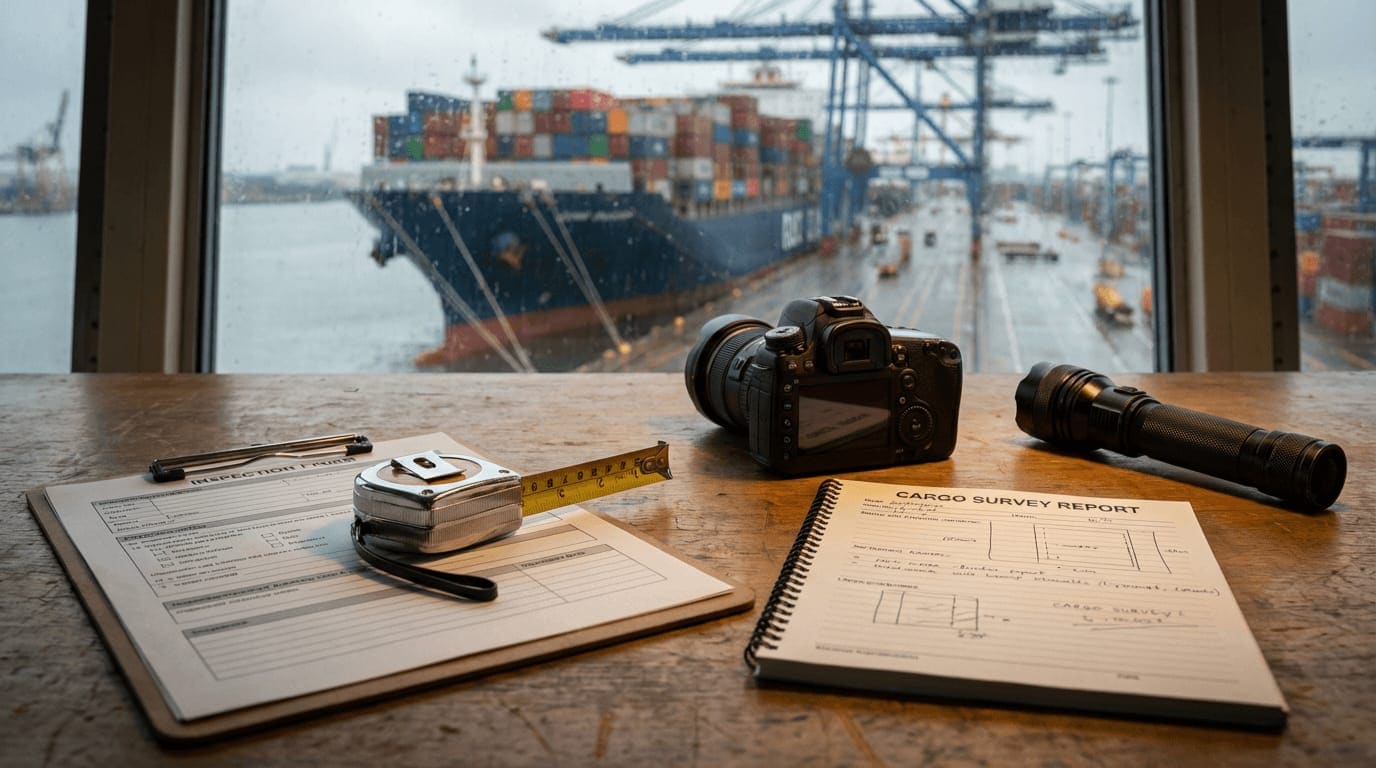
Surveys and condition reports
Cargo surveys and condition reports
A condition report records the machine, its serial number and every mark on it before it ships; a loading survey checks the lashing, the declared dimensions and the weight against the carrier’s rules, so a wrong figure does not lead to a re-rating or a missed sailing[1].
What a survey records
- 01
Identity
Make, model, serial number and hours, photographed and checked against the title or bill of sale[3].
- 02
Condition
Photos of every side, the cab, the undercarriage and any damage, dated and located.
- 03
Loading
Bedding, lashing count and rating, edge protection and the dimensions over the lashings[1].
- 04
Weight
The verified gross mass and how it was found[2].
When to order a survey
| Method | Use it when | Avoid it when |
|---|---|---|
| Before export | The buyer has not seen the machine, or a letter of credit asks for an inspection report. | The buyer inspected it at the yard and accepted it. |
| At loading | Out-of-gauge flat racks and heavy pieces, where a wrong declaration can mean re-rating[1]. | A standard container with a small machine. |
| At destination | Damage is suspected on arrival and an insurance claim may follow. | The unit arrived sealed and intact. |
Rules that apply
- SOLAS verified gross mass (VGM)IMO
Since 1 July 2016 the shipper must give a signed verified gross mass for each packed container, found by weighing the packed unit or by adding the weighed cargo, lashing and dunnage to the container tare. The carrier needs it before the stowage plan is drawn up; without it the container is not loaded.[2]
Applies to: Every packed container, flat rack and open top
- Used self-propelled vehicles: 72-hour ruleU.S. Customs and Border Protection
U.S. regulations count self-propelled construction and agricultural machinery as vehicles. A used one must be filed in AES at least 72 hours before export, whatever its value or destination, and the ITN, the VIN or serial number and the ownership documents go to CBP at the port of export. Filing after departure is not allowed.[4][3][5]
Applies to: Used machines that drive: excavators, loaders, dozers, tractors, trucks
Questions about surveys
Who uses a condition report?
The buyer, to confirm the machine is as sold; the insurer, if there is a claim; and the bank, when a letter of credit asks for an inspection.
Does the survey check the lashing?
A loading survey does: the bedding, the number and rating of lashings, edge protection and the dimensions measured over the lashings.
Can a survey be done at an auction yard?
Yes, if the yard allows access before pickup. Otherwise it is done when the machine reaches our loading point.
Sources
Every figure on this page comes from the documents below, each checked on the date shown. Carriers and authorities revise them, so we confirm the current figure when we book.
- [1]Hapag-Lloyd, A Guide for the Loading and Lashing of Cargo on Hapag-Lloyd Flatracks, checked October 18, 2026
- [2]IMO, SOLAS verified gross mass requirement enters into force (1 July 2016), checked October 18, 2026
- [3]U.S. Customs and Border Protection, Exporting used self-propelled vehicles, checked October 18, 2026
- [4]eCFR, 19 CFR 192.1 Definitions (used self-propelled vehicles), checked October 18, 2026
- [5]U.S. Census Bureau, Foreign Trade Regulations FAQs, checked October 18, 2026
Send us the machine and the destination
Give us the model or the measured dimensions and weight. We come back with the method, the sailing and a price, and the figures behind them.