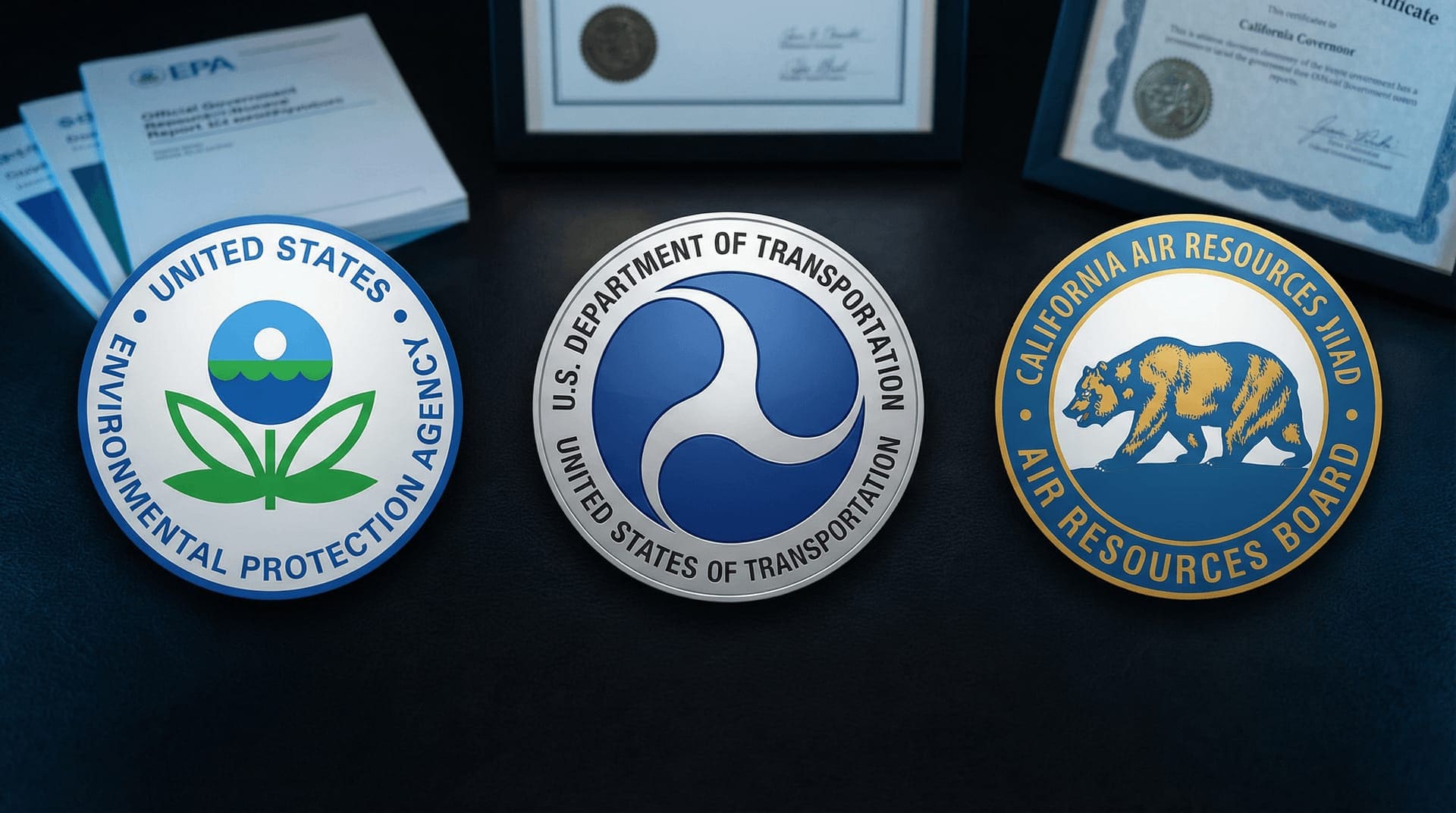
EPA, DOT and CARB
EPA, DOT and CARB rules for exported machinery
A new engine built to a foreign standard is exported under EPA’s export exemption[1], a machine with fuel or batteries travels under DOT hazardous materials rules[2], and an off-road diesel machine sold in California carries CARB’s disclosure on its bill of sale[3].
Which rule applies when
EPA: new nonroad engines and equipment not certified to U.S. standards may be exported if they are labelled solely for export. Selling or offering one to a U.S. buyer voids the exemption, and the machine may only be run in the U.S. to prepare and deliver it for export[1].
DOT: a machine with fuel, a wet, sodium or lithium battery or other hazardous materials is regulated in transport. Gasoline tanks are drained to 500 mL or less; a self-propelled diesel machine may keep its fuel with room for expansion and the cap closed[2].
CARB: a seller of an off-road diesel vehicle subject to the Off-Road Regulation prints CARB’s disclosure on the bill of sale, keeps it for three years and reports the sale in DOORS within 30 days. It applies to sales in California even when the buyer exports the machine[3][4].
Which rules your machine meets
| Method | Use it when | Avoid it when |
|---|---|---|
| New machine built for export | EPA export exemption: labelled solely for export and never sold in the U.S.[1]. | It is offered to a U.S. buyer first: the exemption is lost. |
| Used machine with fuel or batteries | DOT hazardous materials rules: diesel with expansion space, batteries secured, terminals protected[2]. | Shipping by air with fuel in the tank: air rules are stricter. |
| Off-road diesel bought in California | CARB disclosure on the bill of sale and the sale reported in DOORS by the seller[3][4]. | The sale took place entirely outside California. |
Rules that apply
- Engines exported without U.S. certification (40 CFR 1068.230)U.S. EPA
New engines and equipment that are not certified to U.S. emission standards may be exported under 40 CFR 1068.230 if they carry a label stating they are solely for export. Selling or offering one to a buyer in the United States voids the exemption, and the machine may only be run in the U.S. to prepare and deliver it for export.[1]
Applies to: New nonroad engines and equipment built for a foreign market
- Engines, vehicles and machinery as hazardous materials (49 CFR 173.220)PHMSA
A machine is regulated as a hazardous material when it carries fuel, a wet, sodium or lithium battery, or other hazardous materials. A tank of flammable liquid fuel such as gasoline is drained to 500 mL or less and closed; a self-propelled machine on diesel may keep its fuel if the tank has room for expansion and the cap is closed. Batteries stay installed and secured, wet batteries upright, with the terminals protected against short circuits.[2]
Applies to: Machines with fuel, batteries or other hazardous materials, by road, vessel or air
- California off-road diesel sales disclosureCalifornia Air Resources Board
A seller of an off-road diesel vehicle subject to CARB’s Off-Road Regulation must print the regulation’s disclosure on the bill of sale or invoice, keep the record for three years and report the sale to CARB in DOORS within 30 days. The disclosure applies to a sale made in California even when the buyer takes the machine out of the state, and auction houses must include it too.[3][4]
Applies to: Off-road diesel machines sold in California, including at auction
- Used self-propelled vehicles: 72-hour ruleU.S. Customs and Border Protection
U.S. regulations count self-propelled construction and agricultural machinery as vehicles. A used one must be filed in AES at least 72 hours before export, whatever its value or destination, and the ITN, the VIN or serial number and the ownership documents go to CBP at the port of export. Filing after departure is not allowed.[5][6][7]
Applies to: Used machines that drive: excavators, loaders, dozers, tractors, trucks
Questions about EPA, DOT and CARB
Does a machine bought at a California auction need CARB paperwork to be exported?
The seller, including an auction house, must print CARB’s disclosure on the bill of sale and report the sale. That applies even when the buyer takes the machine out of California.
Can an export-only machine be demonstrated in the U.S.?
Only as needed to prepare and deliver it for export. Selling or offering it to a U.S. buyer voids the export exemption.
Does a diesel tank have to be emptied for shipping?
Not for a self-propelled machine shipped by road or sea, as long as the tank is not full and the cap is closed. Gasoline tanks are drained to 500 mL or less.
Sources
Every figure on this page comes from the documents below, each checked on the date shown. Carriers and authorities revise them, so we confirm the current figure when we book.
- [1]eCFR, 40 CFR 1068.230 Exempting engines/equipment for export, checked October 18, 2026
- [2]eCFR, 49 CFR 173.220 Internal combustion engines, vehicles and machinery (hazardous materials), checked October 18, 2026
- [3]California Air Resources Board, Off-Road Regulation overview fact sheet, checked October 18, 2026
- [4]California Air Resources Board, Off-Road Regulation sales disclosure FAQ, checked October 18, 2026
- [5]eCFR, 19 CFR 192.1 Definitions (used self-propelled vehicles), checked October 18, 2026
- [6]U.S. Customs and Border Protection, Exporting used self-propelled vehicles, checked October 18, 2026
- [7]U.S. Census Bureau, Foreign Trade Regulations FAQs, checked October 18, 2026
Send us the machine and the destination
Give us the model or the measured dimensions and weight. We come back with the method, the sailing and a price, and the figures behind them.