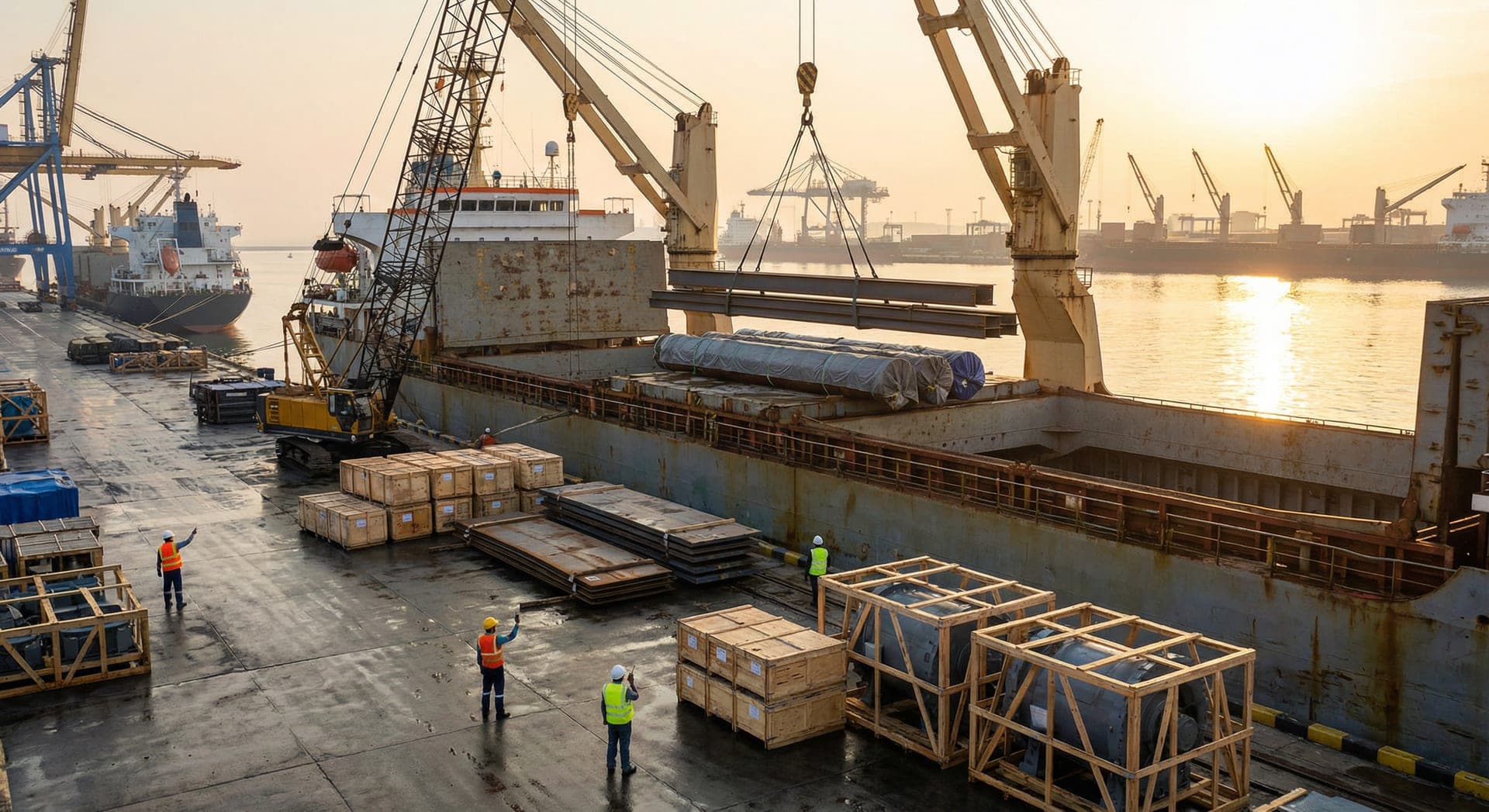
Breakbulk
Breakbulk shipping for heavy and oversized cargo
Breakbulk is cargo lifted aboard piece by piece rather than in a container or on a roll trailer: the choice when a piece weighs more than a flat rack takes on its footprint[3] or a roll trailer carries[2], up to 2,205 US tons (2,000 t) with a heavy-lift ship’s own cranes[1].
- combined crane lift on the heaviest ships in one heavy-lift fleet[1]
- 2,205 US tons (2,000 t)
- hold length on the same ships[1]
- 351 ft 5 in107.1 m
- cargo on the heaviest roll trailers, the RoRo alternative[2]
- 154 US tons140,000 kg
- what a 40′ flat rack takes on a 6 ft 7 in (2 m) footprint[3]
- 56,400 lb25,600 kg
Breakbulk or a liner method
| Method | Use it when | Avoid it when |
|---|---|---|
| Breakbulk ocean shipping | One or a few heavy pieces on a route a multipurpose or heavy-lift operator sails. | A flat rack or roll trailer takes the piece[2][3]. |
| Project vessel charter | Enough cargo to fill a large share of a ship, or a port no liner calls. | The cargo fits regular sailings. |
| Flat rack | The piece is within the rack’s payload for its resting length[3]. | Its weight sits on a short footprint. |
Container, flat rack, RoRo or breakbulk?
We quote in this order because it is usually cheapest first. Most machines that look too big for a box fit once our crew takes off the bucket, boom, cab or wheels; larger ones are taken further apart across several containers, and pieces too big or heavy for a flat rack or roll trailer go breakbulk.
01Container
- Work needed
- We partially disassemble when needed (bucket, boom, cab, wheels), or take larger machines further apart across several high-cubes and open-tops, then crate, block and lash every part.
- Destinations
- Widest: almost every port worldwide, plus inland delivery by rail.
- Typical cost
- Usually the lowest, with no out-of-gauge surcharges.
- Protection
- Sealed steel box; loose parts and attachments travel locked inside.
- Best for
- Most machines: compact ones as they are, others after partial disassembly, and large ones split across several containers.
02Flat rack
- Work needed
- Ships assembled, blocked and lashed. Surcharges apply when wider than 2.4 m or taller than about 1.95 m.
- Destinations
- Most container ports, on the same vessels as containers.
- Typical cost
- Moderate; rises with every centimetre out of gauge.
- Protection
- Open to the weather; we protect cabs, electronics and hydraulics.
- Best for
- Excavators, dozers and loaders too wide for a container door.
03RoRo
- Work needed
- Drives on assembled; non-runners go on a roll trailer.
- Destinations
- Fewer destinations: regular lanes to Europe, West Africa, the Middle East, Oceania and parts of Latin America.
- Typical cost
- Often competitive for large self-propelled machines where a lane exists.
- Protection
- Below deck, but loose items and attachments cannot ride inside the cab.
- Best for
- Running machines going to a port with regular RoRo sailings.
04Breakbulk
- Work needed
- Lifted aboard piece by piece by ship’s or shore cranes, on its own skids or cradle, then stowed and lashed in the hold or on deck.
- Destinations
- Ports with breakbulk berths and heavy-lift cranes; sailings are booked voyage by voyage.
- Typical cost
- Usually the highest for a single small machine; often the only option for the largest pieces.
- Protection
- In the hold or lashed on deck; we crate, wrap and protect exposed parts.
- Best for
- Pieces too large or heavy for a flat rack or roll trailer: transformers, process modules, mining trucks, crane sections.
What heavy-lift ships can lift
Ship types in one heavy-lift operator’s published fleet list. The ship on the fixture, not the type, sets the limit.
| Ship type | Cranes | Combined lift | Hold (L × W × H) | Free deck space[1] |
|---|---|---|---|---|
| Type 183 | 1,102 US tons (1,000 t) × 2 | 2,205 US tons (2,000 t) | 351 ft 5 in × 55 ft 9 in × 44 ft 3 in (107.10 × 17.00 × 13.50 m) | 3,215–3,372 m² |
| Orca | 882 US tons (800 t) × 2 | 1,764 US tons (1,600 t) | 351 ft 1 in × 60 ft 8 in × 43 ft 8 in (107 × 18.5 × 13.3 m) | 3,330 m² |
| Type 176 | 772 US tons (700 t) × 2, plus 386 US tons (350 t) | 1,543 US tons (1,400 t) | 351 ft 5 in × 55 ft 9 in × 43 ft (107.10 × 17.00 × 13.10 m) | 2,918 m² |
| Type 116 | 496 US tons (450 t) × 2 | 992 US tons (900 t) | 309 ft 3 in × 53 ft 2 in × 39 ft 8 in (94.25 × 16.20 × 12.08 m) | 2,311 m² |
Rules that apply
- Electronic Export Information (15 CFR 30)U.S. Census Bureau
Electronic Export Information is filed in AES for each Schedule B number worth more than $2,500 going to one consignee on one conveyance, and for every vehicle whatever its value. For vessel cargo it is due at least 24 hours before loading; the Internal Transaction Number (ITN) goes to the carrier with the booking.[5][6]
Applies to: Any Schedule B line over $2,500, and every vehicle
- ISPM 15 wood packagingIPPC, administered in the U.S. by USDA APHIS
Wood packaging and dunnage must be heat-treated to a core temperature of 56 °C for at least 30 minutes, or fumigated, and carry the IPPC mark with the US country code, the facility number and HT or MB. Marked wood can be reused; repaired or remanufactured wood must be treated and marked again.[7]
Applies to: Crates, skids, blocking and dunnage
- Brown marmorated stink bug season: AustraliaAustralian Department of Agriculture, Fisheries and Forestry
Target high-risk goods shipped from the United States between 1 September and 30 April need mandatory treatment, judged by the shipped-on-board date. Flat rack, open top and breakbulk cargo must be treated before it leaves; if untreated, it is refused discharge or sent back. Heat treatment holds 56 °C at the coldest surface for 30 minutes, and for break bulk pieces under 6,610 lb (3,000 kg) 60 °C for 10 minutes.[4]
Applies to: Machinery, vehicles, steel and other listed goods (HS chapters 84, 85 and 87 among them) shipped from the U.S. by sea, 1 September to 30 April
Questions about breakbulk
What is breakbulk cargo?
Cargo loaded piece by piece, usually by crane, rather than in a container or on a roll trailer: large machines, steel structures, vessels and plant modules.
Is breakbulk more expensive than a container?
Per piece, usually yes, because each piece is lifted at both ends. It is used when the piece does not fit a cheaper method.
Does breakbulk to Australia need BMSB treatment?
Machinery shipped from the U.S. between 1 September and 30 April does, and breakbulk must be treated before it leaves.
Our Breakbulk Services
- Breakbulk Ocean Shipping
Breakbulk pieces are lifted into the hold or onto the deck of a multipurpose or heavy-lift ship and sea fastened for the voyage; holds on the larger ships in one fleet are 55 ft 9 in (17 m) wide and 351 ft 1 in (107 m) long.
- Project Vessel Chartering
A charter fixes a whole ship, or part of one, for a project’s cargo on the project’s dates and ports. Heavy-lift ships in one fleet offer up to 3,372 m² of free deck and two cranes lifting 2,205 US tons (2,000 t) together.
Sources
Every figure on this page comes from the documents below, each checked on the date shown. Carriers and authorities revise them, so we confirm the current figure when we book.
- [1]SAL Heavy Lift, Fleet list (April 2026), checked October 18, 2026
- [2]Wallenius Wilhelmsen, Cargo handling equipment, checked October 18, 2026
- [3]Hapag-Lloyd, Weight distribution in containers for safe transport (guideline), checked October 18, 2026
- [4]Australian Department of Agriculture, Fisheries and Forestry, Seasonal measures for brown marmorated stink bug, checked October 18, 2026
- [5]eCFR, 15 CFR 30.37 Miscellaneous exemptions (Foreign Trade Regulations), checked October 18, 2026
- [6]U.S. Census Bureau, Foreign Trade Regulations FAQs, checked October 18, 2026
- [7]USDA APHIS, Export ISPM 15-compliant wood packaging material, checked October 18, 2026
Send us the machine and the destination
Give us the model or the measured dimensions and weight. We come back with the method, the sailing and a price, and the figures behind them.