Breakbulk shipping
Breakbulk ocean shipping
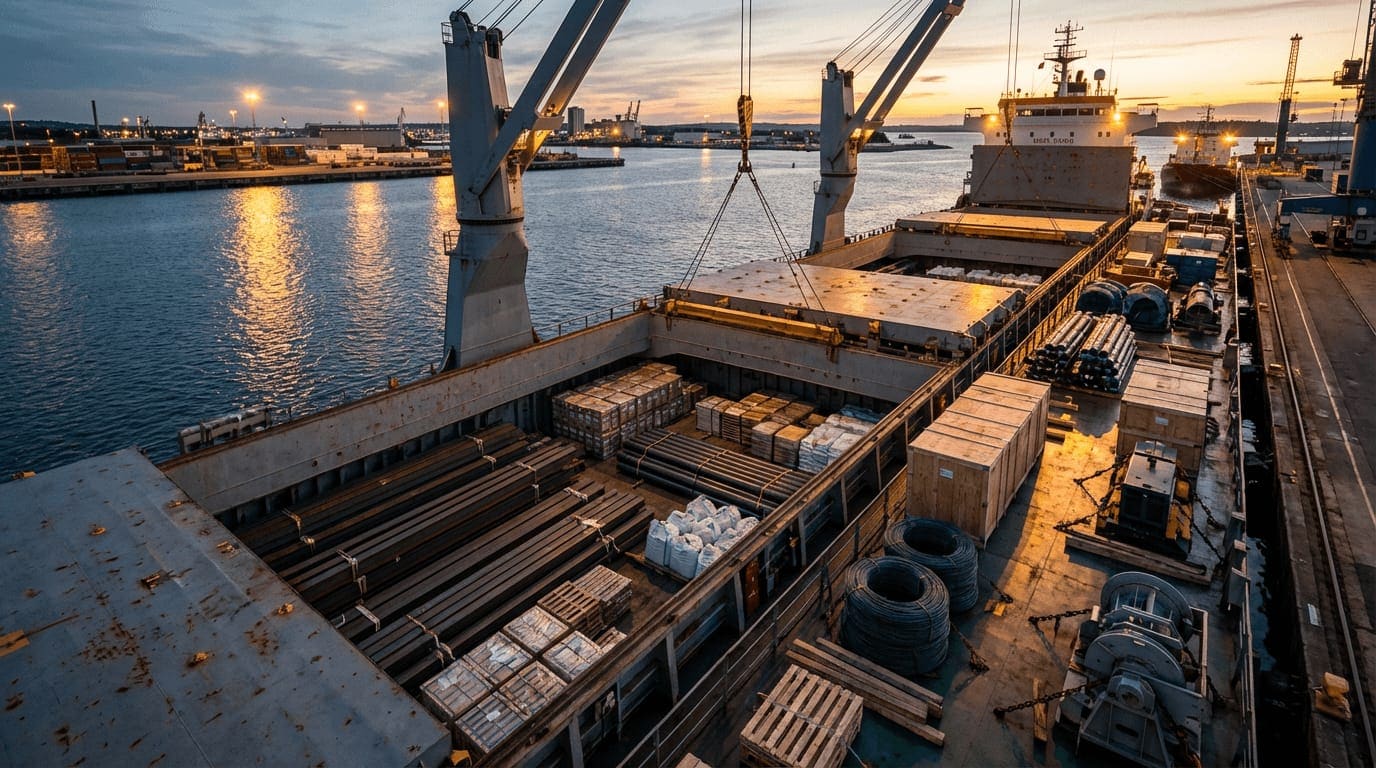
Breakbulk pieces are lifted into the hold or onto the deck of a multipurpose or heavy-lift ship and sea fastened for the voyage; holds on the larger ships in one fleet are 55 ft 9 in (17 m) wide and 351 ft 1 in (107 m) long[1].
What heavy-lift ships can lift
Ship types in one heavy-lift operator’s published fleet list. The ship on the fixture, not the type, sets the limit.
| Ship type | Cranes | Combined lift | Hold (L × W × H) | Free deck space[1] |
|---|---|---|---|---|
| Type 183 | 1,102 US tons (1,000 t) × 2 | 2,205 US tons (2,000 t) | 351 ft 5 in × 55 ft 9 in × 44 ft 3 in (107.10 × 17.00 × 13.50 m) | 3,215–3,372 m² |
| Orca | 882 US tons (800 t) × 2 | 1,764 US tons (1,600 t) | 351 ft 1 in × 60 ft 8 in × 43 ft 8 in (107 × 18.5 × 13.3 m) | 3,330 m² |
| Type 176 | 772 US tons (700 t) × 2, plus 386 US tons (350 t) | 1,543 US tons (1,400 t) | 351 ft 5 in × 55 ft 9 in × 43 ft (107.10 × 17.00 × 13.10 m) | 2,918 m² |
| Type 116 | 496 US tons (450 t) × 2 | 992 US tons (900 t) | 309 ft 3 in × 53 ft 2 in × 39 ft 8 in (94.25 × 16.20 × 12.08 m) | 2,311 m² |
Machines that often ship breakbulk
The largest mining and earthmoving machines, which are past flat rack limits in one piece. Manufacturer figures are linked in the first column.
| Model | Weight | L × W × H (transport) | Best method | Preparation |
|---|---|---|---|---|
| Komatsu HD785-8Rigid dump truckSpec source | 81 US tons (73,800 kg)empty weight | 37 ft × 14 ft 2 in × 18 ft 11 in (11.28 × 4.32 × 5.77 m) | RoRoWhere a RoRo lane serves the destination | Drives on assembled where a RoRo lane serves the destination. |
| CAT 745Articulated truckSpec source | 73,000 lb (33,110 kg)empty weight | 37 ft 6 in × 12 ft 6 in × 12 ft 4 in (11.43 × 3.8 × 3.76 m) | 40 ft flat rackOut-of-gauge | Ships assembled, blocked and lashed; out-of-gauge surcharge applies (4 ft 7 in / 1.4 m over width, 5 ft 11 in / 1.81 m over height). |
| CAT D8Track-type tractor (dozer)Spec source | 87,100 lb (39,500 kg)operating weight | 25 ft 11 in × 9 ft 2 in × 11 ft 7 in (7.91 × 2.79 × 3.53 m) | RoRoWhere a RoRo lane serves the destination | Drives on assembled where a RoRo lane serves the destination. |
| Komatsu PC490LC-11Hydraulic excavatorSpec source | 53 US tons (47,930 kg)operating weight | 39 ft 2 in × 11 ft 3 in × 11 ft 11 in (11.93 × 3.44 × 3.64 m) | RoRoWhere a RoRo lane serves the destination | Drives on assembled where a RoRo lane serves the destination. |
How a breakbulk shipment works
- 01
Cargo data
Dimensions, weight, centre of gravity and lifting points for every piece.
- 02
Stowage
The operator places each piece in the hold or on deck by its size, weight and the deck strength.
- 03
Packing
Crates and blocking in ISPM 15 wood[3].
- 04
Loading and sea fastening
Pieces arrive at the berth in loading order and are lifted, then welded or lashed in place.
Rules that apply
- ISPM 15 wood packagingIPPC, administered in the U.S. by USDA APHIS
Wood packaging and dunnage must be heat-treated to a core temperature of 56 °C for at least 30 minutes, or fumigated, and carry the IPPC mark with the US country code, the facility number and HT or MB. Marked wood can be reused; repaired or remanufactured wood must be treated and marked again.[3]
Applies to: Crates, skids, blocking and dunnage
- Electronic Export Information (15 CFR 30)U.S. Census Bureau
Electronic Export Information is filed in AES for each Schedule B number worth more than $2,500 going to one consignee on one conveyance, and for every vehicle whatever its value. For vessel cargo it is due at least 24 hours before loading; the Internal Transaction Number (ITN) goes to the carrier with the booking.[4][5]
Applies to: Any Schedule B line over $2,500, and every vehicle
- Brown marmorated stink bug season: AustraliaAustralian Department of Agriculture, Fisheries and Forestry
Target high-risk goods shipped from the United States between 1 September and 30 April need mandatory treatment, judged by the shipped-on-board date. Flat rack, open top and breakbulk cargo must be treated before it leaves; if untreated, it is refused discharge or sent back. Heat treatment holds 56 °C at the coldest surface for 30 minutes, and for break bulk pieces under 6,610 lb (3,000 kg) 60 °C for 10 minutes.[2]
Applies to: Machinery, vehicles, steel and other listed goods (HS chapters 84, 85 and 87 among them) shipped from the U.S. by sea, 1 September to 30 April
- Used machinery cleanliness: New ZealandNew Zealand Ministry for Primary Industries
Used machinery must be cleaned inside and out before shipping, and a cleaning certificate for used outdoor machinery reaches MPI before arrival. MPI expects to inspect on arrival, within 12 hours of unloading for breakbulk and open containers, and can require partial or full dismantling. If contamination cannot be removed, the machine may be reshipped or destroyed at the importer’s cost.[6]
Applies to: Used vehicles, machinery and parts shipped to New Zealand
Questions about breakbulk shipping
Does breakbulk cargo go in the hold or on deck?
Either. The operator decides by the piece’s size, weight and sensitivity to weather; machines that can get wet often go on deck.
How is breakbulk cargo protected?
Sea fastening holds it in place, and machines can be shrink wrapped or have openings sealed. The condition is recorded before loading.
Do used machines need cleaning before breakbulk shipping?
For Australia and New Zealand, yes: they must arrive free of soil and plant material, and are inspected on arrival.
Sources
Every figure on this page comes from the documents below, each checked on the date shown. Carriers and authorities revise them, so we confirm the current figure when we book.
- [1]SAL Heavy Lift, Fleet list (April 2026), checked October 18, 2026
- [2]Australian Department of Agriculture, Fisheries and Forestry, Seasonal measures for brown marmorated stink bug, checked October 18, 2026
- [3]USDA APHIS, Export ISPM 15-compliant wood packaging material, checked October 18, 2026
- [4]eCFR, 15 CFR 30.37 Miscellaneous exemptions (Foreign Trade Regulations), checked October 18, 2026
- [5]U.S. Census Bureau, Foreign Trade Regulations FAQs, checked October 18, 2026
- [6]New Zealand Ministry for Primary Industries, Steps to importing vehicles, machinery, or parts, checked October 18, 2026
Send us the machine and the destination
Give us the model or the measured dimensions and weight. We come back with the method, the sailing and a price, and the figures behind them.