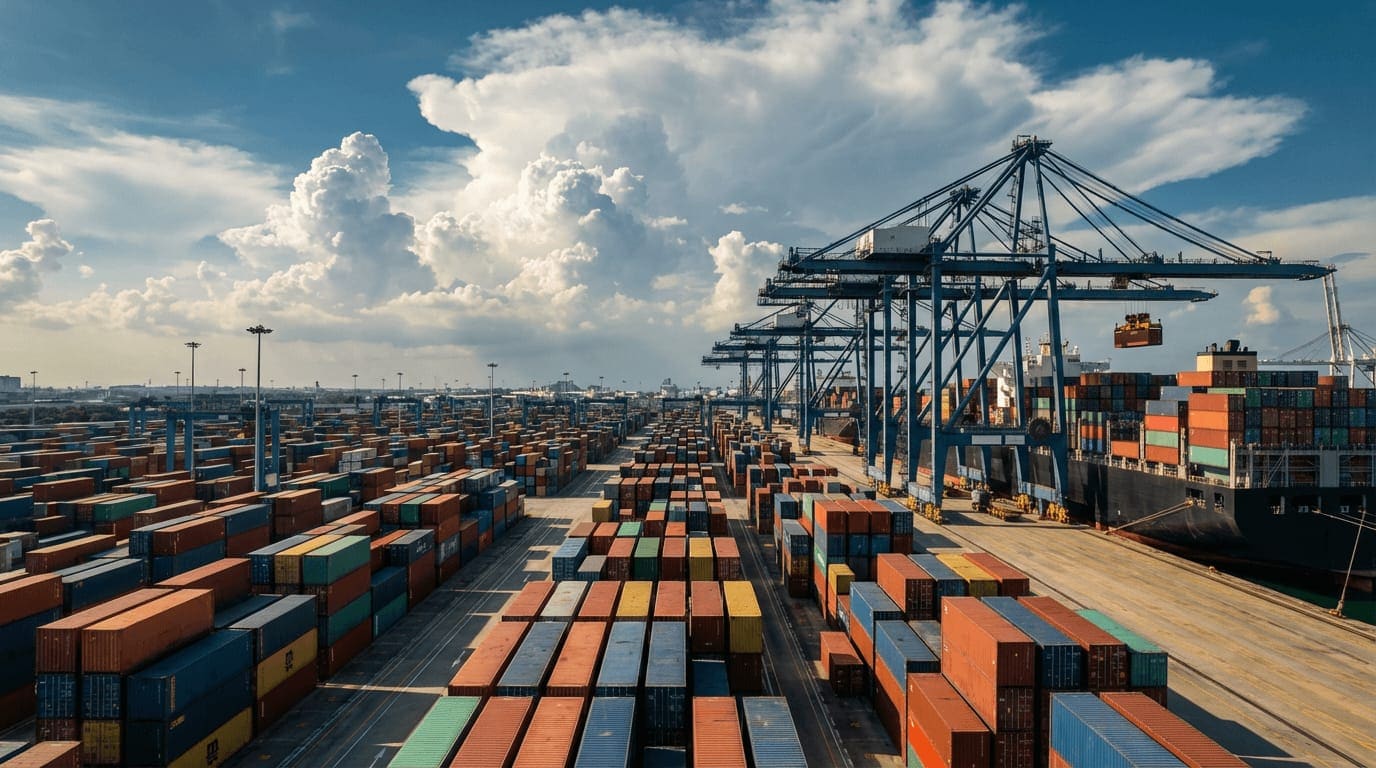
Container shipping
Container shipping for machinery (FCL and LCL)
A machine ships in a container when it, or its parts, passes the 7 ft 8 in (2.34 m) wide door: 7 ft 6 in (2.29 m) high on a standard box and 8 ft 6 in (2.60 m) on a high cube[1]. Inside, it is chocked and lashed so its weight is spread over the floor[2].
Container sizes and limits
Figures from one carrier’s fleet sheet. The door, not the interior, decides what drives or slides in.
| Figure | 20' standard container[1] | 40' standard container[1] | 40' high cube container[1] | 20' open top container[1] | 40' open top container[1] |
|---|---|---|---|---|---|
| ISO size-type code | 22G1 | 42G1 | 45G1 | 22U1 | 42U1 |
| Inside length | 19 ft 4 in (5.9 m) | 39 ft 6 in (12.03 m) | 39 ft 6 in (12.03 m) | 19 ft 4 in (5.9 m) | 39 ft 6 in (12.03 m) |
| Inside width (flat racks: floor) | 7 ft 9 in (2.35 m) | 7 ft 9 in (2.35 m) | 7 ft 8 in (2.34 m) | 7 ft 9 in (2.35 m) | 7 ft 9 in (2.35 m) |
| Inside height (flat racks: floor to top of end walls) | 7 ft 10 in (2.39 m) | 7 ft 10 in (2.4 m) | 8 ft 10 in (2.7 m) | 7 ft 10 in (2.38 m) | 7 ft 10 in (2.38 m) |
| Door opening, width × height | 7 ft 8 in / 2.34 m × 7 ft 6 in / 2.29 m | 7 ft 8 in / 2.34 m × 7 ft 6 in / 2.29 m | 7 ft 8 in / 2.34 m × 8 ft 6 in / 2.6 m | 7 ft 8 in / 2.34 m × 7 ft 6 in / 2.28 m | 7 ft 8 in / 2.34 m × 7 ft 6 in / 2.28 m |
| Roof opening, length × width | – | – | – | 17 ft 6 in / 5.34 m × 7 ft 4 in / 2.23 m | 37 ft 11 in / 11.55 m × 7 ft 4 in / 2.23 m |
| Maximum gross weight | 71,700 lb (32,500 kg) | 71,700 lb (32,500 kg) | 71,700 lb (32,500 kg) | 71,700 lb (32,500 kg) | 71,700 lb (32,500 kg) |
| Tare weight | 5,070 lb (2,300 kg) | 8,160 lb (3,700 kg) | 8,490 lb (3,850 kg) | 5,400 lb (2,450 kg) | 8,930 lb (4,050 kg) |
| Maximum payload | 66,600 lb (30,200 kg) | 63,500 lb (28,800 kg) | 63,200 lb (28,650 kg) | 66,200 lb (30,050 kg) | 62,700 lb (28,450 kg) |
| Volume | 33.2 m³ | 67.7 m³ | 76.3 m³ | 32.5 m³ | 66.5 m³ |
| Rating per lashing point | 2,200 lb (1,000 kg) | 2,200 lb (1,000 kg) | 2,200 lb (1,000 kg) | 2,200 lb (1,000 kg) | 2,200 lb (1,000 kg) |
- 20' standard container: Wooden floor series. Some 20′ series are rated 67,200 lb (30,480 kg) gross, which lowers the payload to 62,100 lb (28,180 kg).[1]
- 40' standard container: Wooden floor series; every Hapag-Lloyd 40′ box has a gooseneck tunnel.[1]
- 40' high cube container: The door opening, not the interior, decides what drives in: 8 ft 6 in (2.60 m) high.[1]
- 20' open top container: Loaded by crane through the roof; the door header swings out. Cargo above the side walls ships under a tarpaulin as over-height.[1]
- 40' open top container: Older 40′ open tops are rated 67,200 lb (30,480 kg) gross (58,700 lb / 26,630 kg payload).[1]
FCL, LCL or another method
| Method | Use it when | Avoid it when |
|---|---|---|
| FCL (full container) | One machine or a set of parts fills the box, or the buyer wants it sealed from loading to delivery. | The machine needs its boom, cab or tracks removed and the buyer cannot refit them. |
| LCL (shared container) | Parts, attachments or a small machine on a skid that fills only part of a box. | The piece needs a crane or ramp to load, which consolidation warehouses may not have. |
| Open top | The piece is too tall for the door but fits the roof opening and is loaded by crane[1]. | It is also too wide for the box. |
| Flat rack or RoRo | The machine is wider than 7 ft 8 in (2.34 m) or taller than 8 ft 6 in (2.60 m) in transport position[1]. | Removing the bucket or cab brings it inside the door. |
Container, flat rack, RoRo or breakbulk?
We quote in this order because it is usually cheapest first. Most machines that look too big for a box fit once our crew takes off the bucket, boom, cab or wheels; larger ones are taken further apart across several containers, and pieces too big or heavy for a flat rack or roll trailer go breakbulk.
01Container
- Work needed
- We partially disassemble when needed (bucket, boom, cab, wheels), or take larger machines further apart across several high-cubes and open-tops, then crate, block and lash every part.
- Destinations
- Widest: almost every port worldwide, plus inland delivery by rail.
- Typical cost
- Usually the lowest, with no out-of-gauge surcharges.
- Protection
- Sealed steel box; loose parts and attachments travel locked inside.
- Best for
- Most machines: compact ones as they are, others after partial disassembly, and large ones split across several containers.
02Flat rack
- Work needed
- Ships assembled, blocked and lashed. Surcharges apply when wider than 2.4 m or taller than about 1.95 m.
- Destinations
- Most container ports, on the same vessels as containers.
- Typical cost
- Moderate; rises with every centimetre out of gauge.
- Protection
- Open to the weather; we protect cabs, electronics and hydraulics.
- Best for
- Excavators, dozers and loaders too wide for a container door.
03RoRo
- Work needed
- Drives on assembled; non-runners go on a roll trailer.
- Destinations
- Fewer destinations: regular lanes to Europe, West Africa, the Middle East, Oceania and parts of Latin America.
- Typical cost
- Often competitive for large self-propelled machines where a lane exists.
- Protection
- Below deck, but loose items and attachments cannot ride inside the cab.
- Best for
- Running machines going to a port with regular RoRo sailings.
04Breakbulk
- Work needed
- Lifted aboard piece by piece by ship’s or shore cranes, on its own skids or cradle, then stowed and lashed in the hold or on deck.
- Destinations
- Ports with breakbulk berths and heavy-lift cranes; sailings are booked voyage by voyage.
- Typical cost
- Usually the highest for a single small machine; often the only option for the largest pieces.
- Protection
- In the hold or lashed on deck; we crate, wrap and protect exposed parts.
- Best for
- Pieces too large or heavy for a flat rack or roll trailer: transformers, process modules, mining trucks, crane sections.
Loading a machine in a box
The weight must be spread along the floor. A load concentrated in one part of the container, or far from its centre, can overload the floor and the box structure; the carrier’s guideline shows how much may be loaded on a given length[2].
Lashing points inside a standard box are rated 2,200 lb (1,000 kg) each[1], far less than on a flat rack, so heavy machines are held mostly by blocking and bracing against the floor and the walls. All wood used must be ISPM 15 treated and marked[4].
Every packed container needs a verified gross mass before it is loaded on the ship[3].
Machines that usually fit a container
Manufacturer figures for each model, linked in the first column, and the method our fit check gives for it.
| Model | Weight | L × W × H (transport) | Best method | Preparation |
|---|---|---|---|---|
| CAT 308 CRMini excavatorSpec source | 18,700 lb (8,462 kg)operating weight | 19 ft × 7 ft 7 in × 8 ft 4 in (5.8 × 2.3 × 2.54 m) | 40 ft high-cube containerFits as is | Ships as it is, blocked and lashed. |
| Bobcat E35Compact excavatorSpec source | 7,660 lb (3,474 kg)operating weight | 15 ft 10 in × 5 ft 10 in × 8 ft (4.83 × 1.77 × 2.44 m) | 40 ft high-cube containerFits as is | Ships as it is, blocked and lashed. |
| Kubota KX080-4Compact excavatorSpec source | 18,400 lb (8,340 kg)operating weight | 21 ft 2 in × 7 ft 3 in × 8 ft 4 in (6.45 × 2.2 × 2.54 m) | 40 ft high-cube containerFits as is | Ships as it is, blocked and lashed. |
| Bobcat S770Skid-steer loaderSpec source | 9,180 lb (4,162 kg)operating weight | 11 ft 10 in × 6 ft 2 in × 6 ft 9 in (3.6 × 1.88 × 2.07 m) | 20 ft containerFits as is | Ships as it is, blocked and lashed. |
| John Deere 333GCompact track loaderSpec source | 12,100 lb (5,493 kg)operating weight | 10 ft 2 in × 6 ft 9 in × 7 ft 3 in (3.1 × 2.05 × 2.2 m) | 20 ft containerFits as is | Ships as it is, blocked and lashed. |
| JCB 3CXBackhoe loaderSpec source | 17,400 lb (7,887 kg)operating weight | 23 ft 7 in × 7 ft 9 in × 11 ft 3 in (7.19 × 2.35 × 3.43 m) | 40 ft flat rackOut-of-gauge | Ships assembled, blocked and lashed; out-of-gauge surcharge applies (4 ft 10 in / 1.48 m over height). |
How a machine is containerized
- 01
Measure in transport position
Width over the tracks or tyres, height over the cab or canopy, and length with the boom folded.
- 02
Remove what does not fit
Bucket, counterweight, cab or ROPS, tagged and crated so they can be refitted.
- 03
Load, chock and lash
Driven or winched in, set on timber, blocked against movement and lashed to the floor rings.
- 04
Rules that apply
- SOLAS verified gross mass (VGM)IMO
Since 1 July 2016 the shipper must give a signed verified gross mass for each packed container, found by weighing the packed unit or by adding the weighed cargo, lashing and dunnage to the container tare. The carrier needs it before the stowage plan is drawn up; without it the container is not loaded.[3]
Applies to: Every packed container, flat rack and open top
- ISPM 15 wood packagingIPPC, administered in the U.S. by USDA APHIS
Wood packaging and dunnage must be heat-treated to a core temperature of 56 °C for at least 30 minutes, or fumigated, and carry the IPPC mark with the US country code, the facility number and HT or MB. Marked wood can be reused; repaired or remanufactured wood must be treated and marked again.[4]
Applies to: Crates, skids, blocking and dunnage
- Electronic Export Information (15 CFR 30)U.S. Census Bureau
Electronic Export Information is filed in AES for each Schedule B number worth more than $2,500 going to one consignee on one conveyance, and for every vehicle whatever its value. For vessel cargo it is due at least 24 hours before loading; the Internal Transaction Number (ITN) goes to the carrier with the booking.[6][5]
Applies to: Any Schedule B line over $2,500, and every vehicle
- Used self-propelled vehicles: 72-hour ruleU.S. Customs and Border Protection
U.S. regulations count self-propelled construction and agricultural machinery as vehicles. A used one must be filed in AES at least 72 hours before export, whatever its value or destination, and the ITN, the VIN or serial number and the ownership documents go to CBP at the port of export. Filing after departure is not allowed.[7][8][5]
Applies to: Used machines that drive: excavators, loaders, dozers, tractors, trucks
Questions about container shipping
Will a mini excavator fit in a 20 ft container?
Usually yes. Most mini excavators are narrower than the 7 ft 8 in (2.34 m) door and lower than 7 ft 6 in (2.29 m) with the canopy, but check the model: our fit check shows the figures for each one.
Is a high cube worth it for machinery?
When the machine is between 7 ft 6 in (2.29 m) and 8 ft 6 in (2.60 m) tall in transport position, yes: the high cube door is 30 cm taller. The width is the same.
What is the difference between FCL and LCL?
FCL is a container booked for one shipper. LCL shares a container with other shippers’ goods and suits parts and small machines on skids.
Sources
Every figure on this page comes from the documents below, each checked on the date shown. Carriers and authorities revise them, so we confirm the current figure when we book.
- [1]Hapag-Lloyd, Container Specification (2024 update), checked October 18, 2026
- [2]Hapag-Lloyd, Weight distribution in containers for safe transport (guideline), checked October 18, 2026
- [3]IMO, SOLAS verified gross mass requirement enters into force (1 July 2016), checked October 18, 2026
- [4]USDA APHIS, Export ISPM 15-compliant wood packaging material, checked October 18, 2026
- [5]U.S. Census Bureau, Foreign Trade Regulations FAQs, checked October 18, 2026
- [6]eCFR, 15 CFR 30.37 Miscellaneous exemptions (Foreign Trade Regulations), checked October 18, 2026
- [7]eCFR, 19 CFR 192.1 Definitions (used self-propelled vehicles), checked October 18, 2026
- [8]U.S. Customs and Border Protection, Exporting used self-propelled vehicles, checked October 18, 2026
Send us the machine and the destination
Give us the model or the measured dimensions and weight. We come back with the method, the sailing and a price, and the figures behind them.