Permits and route surveys
Oversize permits and route surveys
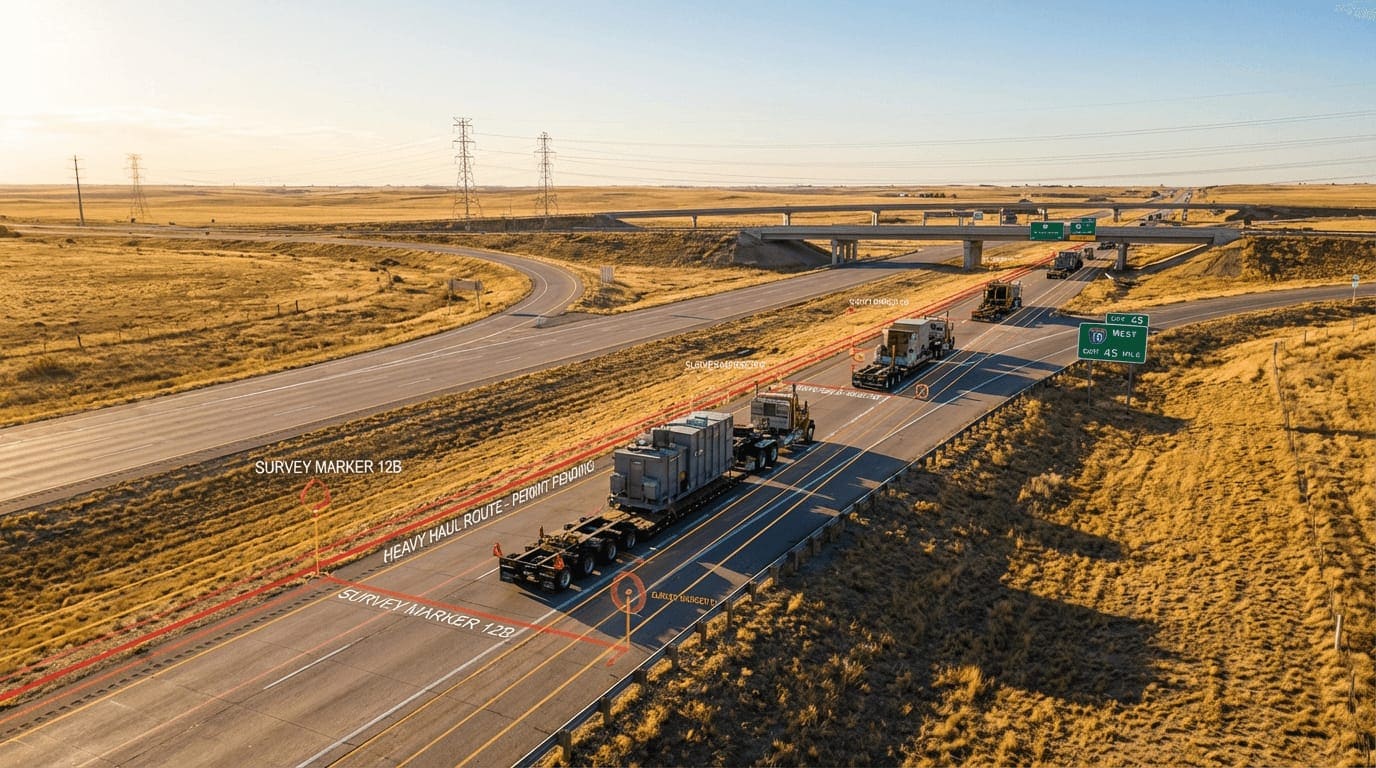
A load over 80,000 lb gross, 102 in wide or the state height limit needs a permit from every state on the route[1]; the route survey finds the path its height, width and axle weights can actually travel.
How a permitted route is planned
- 01
Load dimensions
Loaded height, width, length and axle weights, from the trailer configuration and the machine’s figures.
- 02
Route survey
Bridges, overpasses, overhead lines, turns, grades and road surfaces between the pickup and the port.
- 03
State permits
One for each state on the route, each with its own travel hours, escort and signage rules[1].
- 04
Utility and escort bookings
Line lifts where a load is taller than overhead wires, and pilot cars or police escorts where the permits call for them.
Permit or another method
| Method | Use it when | Avoid it when |
|---|---|---|
| Permitted truck move | A route exists that clears the load’s height, width and axle weights[1]. | The survey finds no route without structural work. |
| Rail | Long distance with sidings at both ends and a railroad clearance[2]. | No siding at the origin. |
| Barge | The piece is beyond any road route and the origin is on a navigable waterway. | There is no loading point near the origin. |
Rules that apply
- Federal truck size and weight limits (23 CFR 658)FHWA
On the Interstate system a truck may gross 80,000 lb, with 20,000 lb on a single axle and 34,000 lb on a tandem; on the National Network the load may be 102 in wide. There is no federal height limit: states set 13.6 to 14.6 ft. A load over any of these needs an oversize or overweight permit from every state on the route.[1]
Applies to: Every road move to and from the port
- Cargo securement on trucks (49 CFR 393.106 and 393.130)FMCSA
The tiedowns on a load must together have a working load limit of at least half its weight. A machine on wheels or tracks weighing 10,000 lb or more needs at least four tiedowns, fixed as close as practicable to its front and rear or to its designed tie points; buckets and shovels are lowered and secured, and articulated machines are locked so they cannot articulate.[3][4]
Applies to: Machines on wheels or tracks moved by truck, and every other load on a public road
- Dimensional loads by railUnion Pacific and Norfolk Southern
Each railroad sets its own limits. Union Pacific treats a load as dimensional above 11 ft wide, 17 ft above the top of rail, 220,000 lb net or four axles, or when it overhangs the car end; it needs an approved clearance proposal, a $500 fee per request and a mechanical inspection before release. Norfolk Southern asks for a clearance request above 10 ft 6 in wide, 15 ft 6 in loaded height, 200,000 lb, 60 ft of lading or under 18 ft for a concentrated load.[2][5]
Applies to: Rail shipments over the railroad’s standard width, height, weight or length
Questions about permits
Does one permit cover the whole trip?
No. Each state on the route issues its own oversize or overweight permit.
How tall can a load be without a permit?
It depends on the state: limits run from 13.6 to 14.6 ft, and there is no federal height limit.
What does a route survey check?
Every bridge, overpass, overhead line, turn and road surface on the path, measured against the loaded height, width and axle weights.
Sources
Every figure on this page comes from the documents below, each checked on the date shown. Carriers and authorities revise them, so we confirm the current figure when we book.
- [1]FHWA, Commercial Vehicle Size and Weight Program (23 CFR 658), checked October 18, 2026
- [2]Union Pacific, Seven Steps for Shipping a Dimensional Load, checked October 18, 2026
- [3]eCFR, 49 CFR 393.106 General requirements for securing articles of cargo, checked October 18, 2026
- [4]eCFR, 49 CFR 393.130 Securement of heavy vehicles, equipment and machinery, checked October 18, 2026
- [5]Norfolk Southern, Dimensional, Oversized, and Equipment Shipping by Rail, checked October 18, 2026
Send us the machine and the destination
Give us the model or the measured dimensions and weight. We come back with the method, the sailing and a price, and the figures behind them.