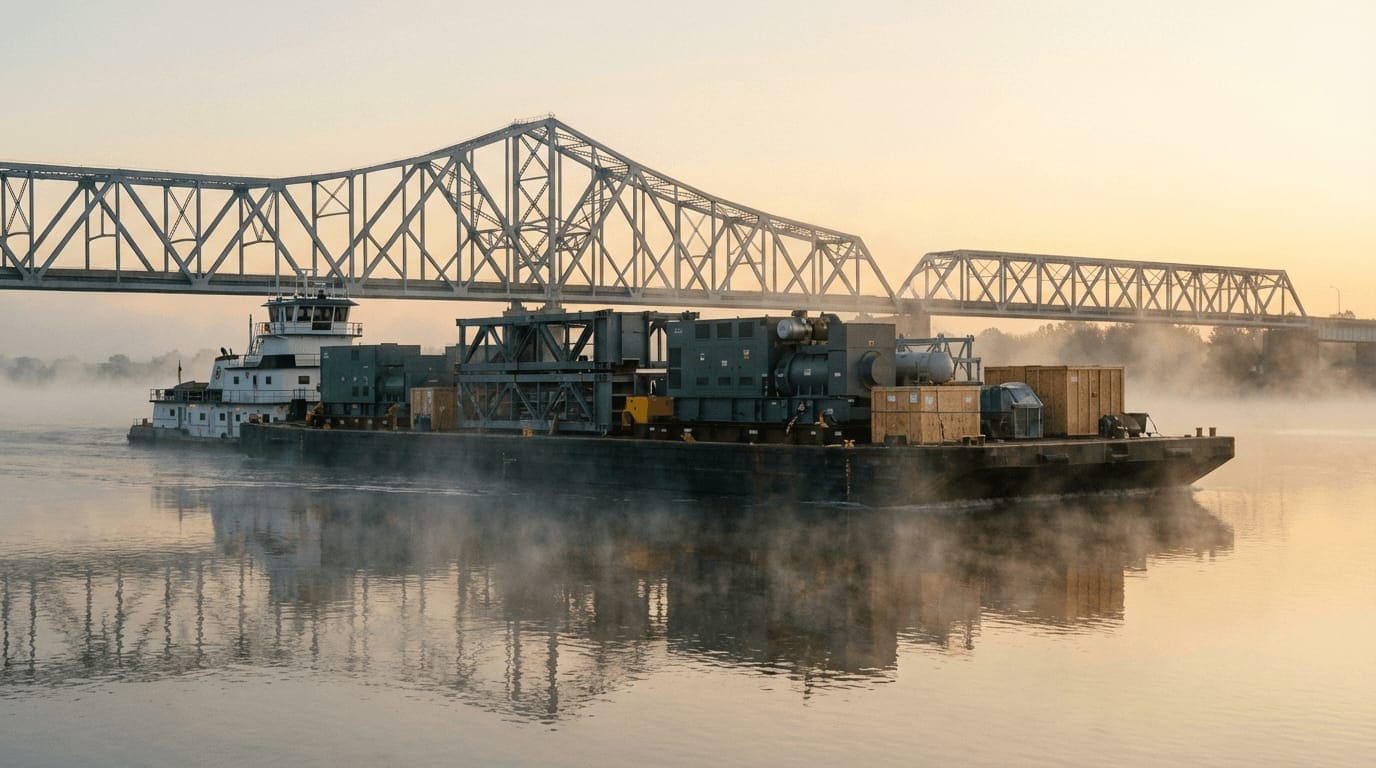
Barge transport
Barge transport for heavy and oversized cargo
A deck barge carries pieces too heavy or wide for any road route. A 195 ft by 35 ft barge takes about 1,205 short tons at 3 ft freeboard, and a 250 ft barge about 3,091[1].
Deck barge sizes and capacity
Selected sizes from one inland operator’s deck barge fleet. Capacity falls as freeboard, the height of deck above water, rises; the river and the towing company set the freeboard.
| Barge (L × W × depth) | 2 ft freeboard | 3 ft freeboard | 4 ft freeboard[1] |
|---|---|---|---|
| 110 × 30 × 7 ft | 340 short tons | 235 short tons | 140 short tons |
| 140 × 40 × 9 ft | 875 short tons | 700 short tons | 530 short tons |
| 195 × 35 × 10 ft 6 in | 1,415 short tons | 1,205 short tons | 1,000 short tons |
| 250 × 54 × 12 ft 6 in | 3,512 short tons | 3,091 short tons | 2,675 short tons |
Barge or road
| Method | Use it when | Avoid it when |
|---|---|---|
| Barge | The piece is beyond any permitted road route, and the plant or a heavy-lift dock is on a navigable waterway. | There is no loading point near the origin. |
| Heavy haul truck | A permitted route exists from the plant to the port[2]. | The route needs bridge work or so many axles that the barge costs less. |
| Barge straight to the ship | The heavy-lift ship can load from the water side with its own cranes. | The port requires cargo to come over the quay. |
How a barge move works
- 01
Choose the barge
By the deck size and the capacity at the freeboard the river and towing company allow[1].
- 02
Load out
By crane, or rolled on with self-propelled modular transporters, at a dock that can take the weight.
- 03
Sea fasten
Cribbing and welded or chained stops hold the piece on the deck for the tow.
- 04
Tow and discharge
The towboat brings the barge to the port, where the piece is lifted to the ship or quay.
Rules that apply
- Federal truck size and weight limits (23 CFR 658)FHWA
On the Interstate system a truck may gross 80,000 lb, with 20,000 lb on a single axle and 34,000 lb on a tandem; on the National Network the load may be 102 in wide. There is no federal height limit: states set 13.6 to 14.6 ft. A load over any of these needs an oversize or overweight permit from every state on the route.[2]
Applies to: Every road move to and from the port
- Cranes and derricks in construction (29 CFR 1926 Subpart CC)OSHA
The crane may only be set up where the ground is firm, drained and graded enough, with mats or cribbing if needed, to meet the manufacturer’s support and level requirements. The operator must be trained, certified and evaluated. Anyone hooking or guiding a load inside the fall zone works with a load rigged by a qualified rigger, and a signal person is required when the operator cannot see the load. Near power lines up to 350 kV, one permitted method keeps the crane, load line and load at least 20 ft away.[3]
Applies to: Crane lifts at U.S. job sites, yards and plants
- Electronic Export Information (15 CFR 30)U.S. Census Bureau
Electronic Export Information is filed in AES for each Schedule B number worth more than $2,500 going to one consignee on one conveyance, and for every vehicle whatever its value. For vessel cargo it is due at least 24 hours before loading; the Internal Transaction Number (ITN) goes to the carrier with the booking.[4][5]
Applies to: Any Schedule B line over $2,500, and every vehicle
Questions about barge transport
How much can a deck barge carry?
It depends on its size and the freeboard allowed. In one operator’s fleet a 195 × 35 ft barge carries about 1,205 short tons at 3 ft freeboard, and a 250 × 54 ft barge about 3,091.
Can a barge deliver straight to the ocean ship?
Yes, when the heavy-lift ship loads from the water side with its own cranes and the port allows it.
Is a barge slower than a truck?
Usually, yes. It is chosen when a road route is not possible or costs more, not for speed.
Sources
Every figure on this page comes from the documents below, each checked on the date shown. Carriers and authorities revise them, so we confirm the current figure when we book.
- [1]McDonough Marine Service, Deck cargo barge fleet (capacity by freeboard), checked October 18, 2026
- [2]FHWA, Commercial Vehicle Size and Weight Program (23 CFR 658), checked October 18, 2026
- [3]eCFR, 29 CFR 1926 Subpart CC Cranes and Derricks in Construction, checked October 18, 2026
- [4]eCFR, 15 CFR 30.37 Miscellaneous exemptions (Foreign Trade Regulations), checked October 18, 2026
- [5]U.S. Census Bureau, Foreign Trade Regulations FAQs, checked October 18, 2026
Send us the machine and the destination
Give us the model or the measured dimensions and weight. We come back with the method, the sailing and a price, and the figures behind them.