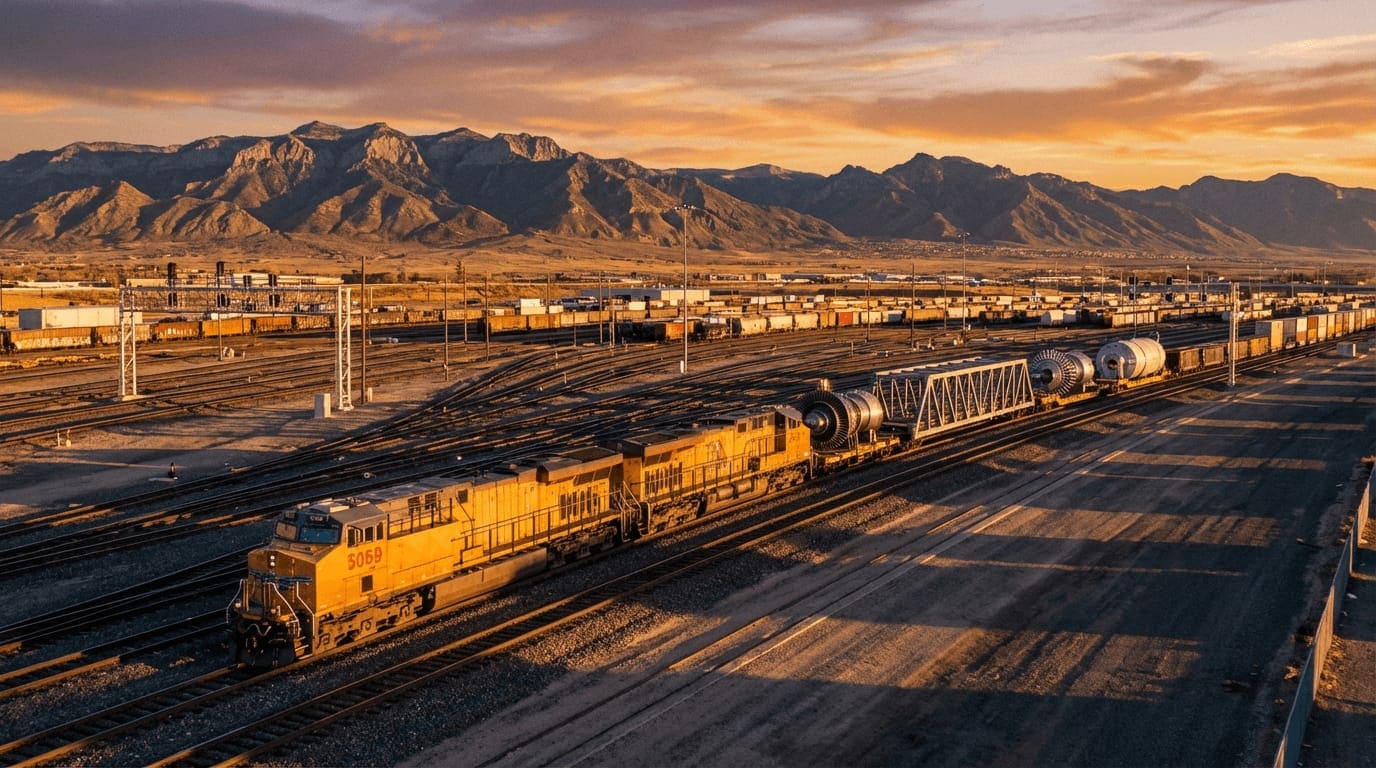
Rail
Shipping machinery by rail to U.S. ports
Rail takes machinery from a siding to the port over long distances. Loads above the railroad’s standard size, 11 ft wide or 17 ft above the rail on Union Pacific[1], need a clearance for the route before they move.
When a rail load needs a clearance
Each railroad sets its own thresholds. The originating railroad clears the whole route, including other railroads it hands the car to.
| Threshold | Union Pacific | Norfolk Southern[1] |
|---|---|---|
| Width | over 11 ft 0 in | over 10 ft 6 in |
| Height | over 17 ft 0 in above the rail | over 15 ft 6 in loaded |
| Weight | over 220,000 lb net | over 200,000 lb |
| Length and overhang | any overhang past the car end | lading over 60 ft or overhanging the car |
| Other | more than four axles | concentrated load under 18 ft |
Norfolk Southern figures from its own page[2].
Rail, truck or both
| Method | Use it when | Avoid it when |
|---|---|---|
| Rail flatcar | A siding at the origin, a long haul and a load within the railroad’s standard size or one it clears[1][2]. | The pickup has no siding: the piece is trucked to a ramp, lifted, then lifted again at the port. |
| Heavy-duty flatcar | Heavy pieces such as transformers, ordered as a special car once the clearance is approved[1]. | A standard flatcar takes the weight. |
| Truck | Short distances, no siding, or a delivery date the rail clearance cannot meet. | The permits needed for the road route cost more than the rail move. |
How a dimensional rail load moves
- 01
Loading diagram
A drawing of the load on the car goes to the railroad, which checks it against the AAR open-top loading rules[1].
- 02
Clearance
The originating railroad clears the route; Union Pacific charges $500 for each proposal[1].
- 03
- 04
Load, secure and inspect
The shipper loads and secures the load; the railroad inspects it before releasing the car[1].
Rules that apply
- Dimensional loads by railUnion Pacific and Norfolk Southern
Each railroad sets its own limits. Union Pacific treats a load as dimensional above 11 ft wide, 17 ft above the top of rail, 220,000 lb net or four axles, or when it overhangs the car end; it needs an approved clearance proposal, a $500 fee per request and a mechanical inspection before release. Norfolk Southern asks for a clearance request above 10 ft 6 in wide, 15 ft 6 in loaded height, 200,000 lb, 60 ft of lading or under 18 ft for a concentrated load.[1][2]
Applies to: Rail shipments over the railroad’s standard width, height, weight or length
- Engines, vehicles and machinery as hazardous materials (49 CFR 173.220)PHMSA
A machine is regulated as a hazardous material when it carries fuel, a wet, sodium or lithium battery, or other hazardous materials. A tank of flammable liquid fuel such as gasoline is drained to 500 mL or less and closed; a self-propelled machine on diesel may keep its fuel if the tank has room for expansion and the cap is closed. Batteries stay installed and secured, wet batteries upright, with the terminals protected against short circuits.[3]
Applies to: Machines with fuel, batteries or other hazardous materials, by road, vessel or air
- Electronic Export Information (15 CFR 30)U.S. Census Bureau
Electronic Export Information is filed in AES for each Schedule B number worth more than $2,500 going to one consignee on one conveyance, and for every vehicle whatever its value. For vessel cargo it is due at least 24 hours before loading; the Internal Transaction Number (ITN) goes to the carrier with the booking.[4][5]
Applies to: Any Schedule B line over $2,500, and every vehicle
Questions about rail
What is a dimensional load on the railroad?
A load over the railroad’s standard size or weight. On Union Pacific that is over 11 ft wide, over 17 ft above the rail, over 220,000 lb net, more than four axles or overhanging the car end.
Who secures the load on the rail car?
The shipper. The railroad reviews the loading diagram and inspects the load before it releases the car.
How long does a rail clearance take?
It depends on the route and the size of the load; the clearance has to be approved before the car can be ordered. We request it as soon as the drawings are available.
Sources
Every figure on this page comes from the documents below, each checked on the date shown. Carriers and authorities revise them, so we confirm the current figure when we book.
- [1]Union Pacific, Seven Steps for Shipping a Dimensional Load, checked October 18, 2026
- [2]Norfolk Southern, Dimensional, Oversized, and Equipment Shipping by Rail, checked October 18, 2026
- [3]eCFR, 49 CFR 173.220 Internal combustion engines, vehicles and machinery (hazardous materials), checked October 18, 2026
- [4]eCFR, 15 CFR 30.37 Miscellaneous exemptions (Foreign Trade Regulations), checked October 18, 2026
- [5]U.S. Census Bureau, Foreign Trade Regulations FAQs, checked October 18, 2026
Send us the machine and the destination
Give us the model or the measured dimensions and weight. We come back with the method, the sailing and a price, and the figures behind them.