Project plan
Project plan: tractors and combines to South Africa
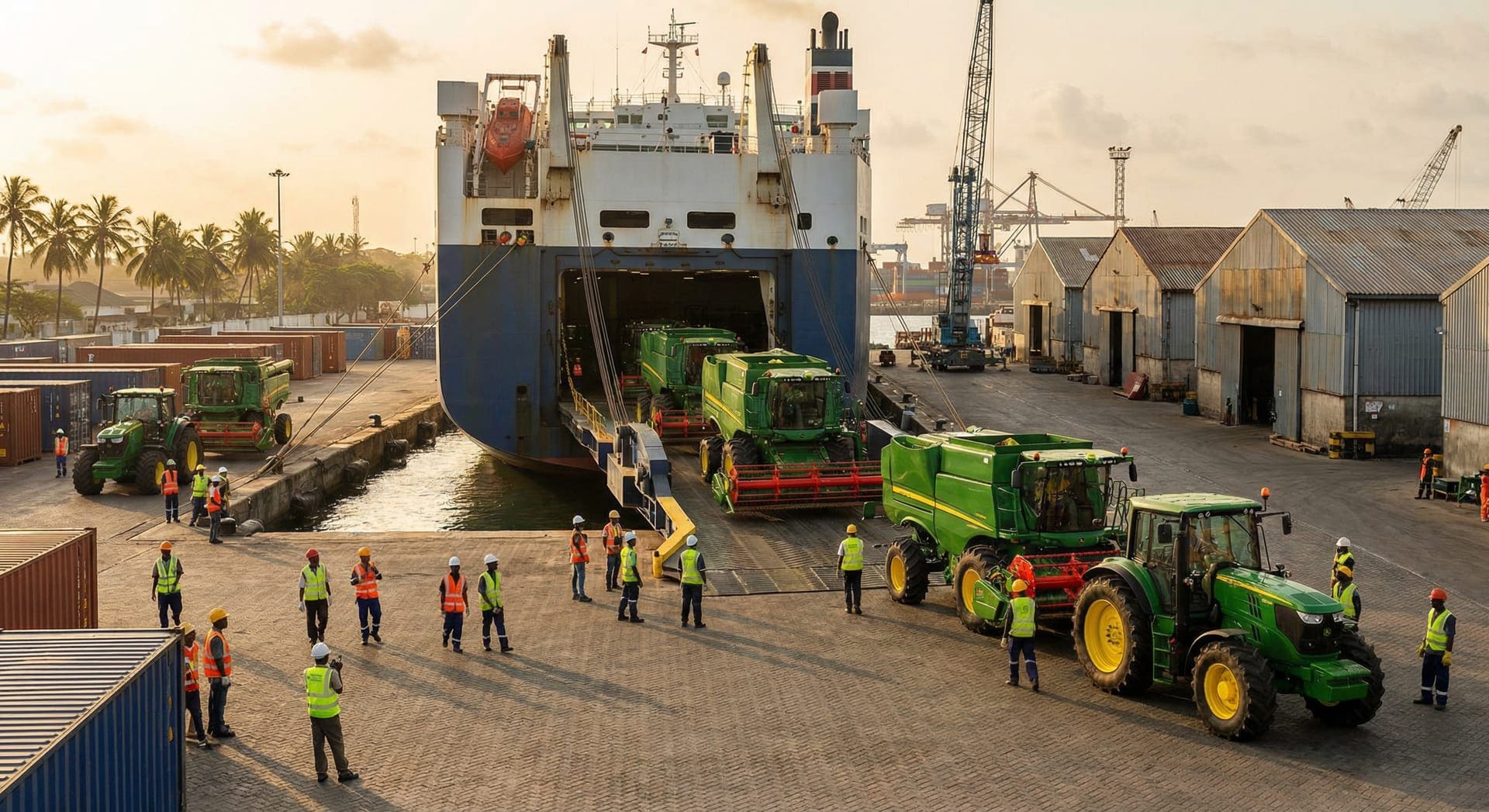
South Africa bought $85 million of U.S. wheeled tractors in 2024[1]; tractors and combines that drive can sail RoRo from Jacksonville to Durban in 37 to 42 days on the voyages that call there[2], and compact tractors and implements can go by container on the direct U.S.–South Africa service[3].
This is a project plan, not a record of a completed job. It shows how we would plan the move from the published carrier, port and regulatory data cited below; the manufacturer’s drawings replace every assumption once we have them.
The plan, step by step
- 01
Measure on the tyres it ships on
A tractor’s width depends on its tyres and duals, so we measure each machine as it will ship, and a combine with its header off.
- 02
Split RoRo and container
Utility tractors and implements that pass a 7 ft 8 in (2.34 m) wide container door go by container[6]; row-crop tractors and combines drive aboard a RoRo ship.
- 03
- 04
File each machine
Each used tractor or combine is filed in AES at least 72 hours before export, and its ITN, serial number and ownership documents go to CBP at the port[5].
- 05
Block and brace
Wood used to block machines in containers or on flat racks is ISPM 15 heat-treated and stamped[7].
- 06
Clear in South Africa
The importer’s clearing agent files the import entry; we send the commercial invoice, packing list and bill of lading before the ship arrives.
Machines in this plan
| Model | Weight | L × W × H (transport) | Best method | Preparation |
|---|---|---|---|---|
| John Deere 8R 410Row-crop tractorSpec source | 28,000 lb (12,700 kg)base weight | 21 ft 9 in (6.64 m) × n/a × 11 ft 6 in (3.5 m) | Measured before quoting | The manufacturer does not publish the transport width, so we measure the machine at pickup and confirm the method before you book. |
| Case IH Magnum 340Row-crop tractorSpec source | 25,900 lb (11,730 kg)shipping weight | 19 ft 9 in × 8 ft 4 in × 11 ft 1 in (6.02 × 2.55 × 3.38 m) | 40 ft high-cube containerFits after partial disassembly | We handle the disassembly: wheels off, exhaust stack and beacons off, and duals off. How we containerize |
| New Holland T7.270TractorSpec source | 16,100 lb (7,300 kg)shipping weight | 18 ft 11 in × 8 ft 1 in × 10 ft 5 in (5.77 × 2.47 × 3.17 m) | 40 ft high-cube containerFits after partial disassembly | We handle the disassembly: wheels off, exhaust stack and beacons off, and duals off. How we containerize |
| John Deere S780Combine harvesterSpec source | 45,700 lb (20,750 kg)base weight | 29 ft 10 in × 13 ft 1 in × 13 ft 1 in (9.1 × 3.99 × 4 m) | 40 ft flat rackOut-of-gauge | Ships assembled, blocked and lashed; out-of-gauge surcharge applies (5 ft 3 in / 1.59 m over width, 6 ft 9 in / 2.05 m over height). |
| Case IH Axial-Flow 8250Combine harvesterSpec source | 44,100 lb (20,000 kg)base weight | 26 ft 5 in (8.05 m) × n/a × 13 ft 1 in (3.98 m) | Measured before quoting | The manufacturer does not publish the transport width, so we measure the machine at pickup and confirm the method before you book. |
Sailings from the U.S. to Africa
| Destination port | Grimaldi[8]North America – West AfricaRoRo | Sallaum Lines[2]USA to West AfricaRoRo | MSC[3]USA – South Africa (weekly)Container |
|---|---|---|---|
| Loads at | Freeport, Brunswick, Jacksonville, Baltimore, Newark, Wilmington (DE), Davisville (RI), Providence (RI) | Freeport, Jacksonville, Baltimore, Davisville (RI) | Newark, Baltimore, Norfolk, Charleston, Freeport |
| Dakar |
| No direct call | No direct call |
| Tema |
| No direct call | No direct call |
| Lomé | No direct call | Calls; transit not listed | No direct call |
| Cotonou | Calls; transit not listed | Calls; transit not listed | No direct call |
| Lagos |
|
| No direct call |
| Durban | No direct call |
| Calls; transit not listed |
| Gqeberha | No direct call | No direct call | Calls; transit not listed |
| Cape Town | No direct call | No direct call | Calls; transit not listed |
| Mombasa | No direct call | No direct call | No direct call |
| Dar es Salaam | No direct call | No direct call | No direct call |
- Grimaldi: Lomé is served by transshipment on this service. The ships continue to Brazil, Colombia and Mexico, so the U.S. calls come in a different order on each voyage.
- Sallaum Lines: Durban is on some voyages only. Cargo cut-off is 4 to 8 days before the ship reaches the U.S. port.
- MSC: The only direct container link between the U.S. East Coast and South Africa, with eight ships for a weekly call. Flat racks and open tops ride the same ships when the carrier accepts the cargo.
Where U.S. farm machinery goes
U.S. exports by HS subheading in 2024, as reported by the United States to UN Comtrade.
| Product | U.S. exports, 2024 | Units | Largest markets, share of value |
|---|---|---|---|
| Wheeled tractorsHS 870190 | $2.48 billion[1] | 36,979 | Canada 50% · Australia 13% · Belgium 5% · Brazil 5% · Mexico 4% |
| Combine harvestersHS 843351 | $1.48 billion[4] | 5,688 | Canada 72% · Australia 9% · Belgium 5% · Brazil 2% · Mexico 2% |
Rules this move has to meet
- Used self-propelled vehicles: 72-hour ruleU.S. Customs and Border Protection
U.S. regulations count self-propelled construction and agricultural machinery as vehicles. A used one must be filed in AES at least 72 hours before export, whatever its value or destination, and the ITN, the VIN or serial number and the ownership documents go to CBP at the port of export. Filing after departure is not allowed.[9][5][10]
Applies to: Used machines that drive: excavators, loaders, dozers, tractors, trucks
- Electronic Export Information (15 CFR 30)U.S. Census Bureau
Electronic Export Information is filed in AES for each Schedule B number worth more than $2,500 going to one consignee on one conveyance, and for every vehicle whatever its value. For vessel cargo it is due at least 24 hours before loading; the Internal Transaction Number (ITN) goes to the carrier with the booking.[11][10]
Applies to: Any Schedule B line over $2,500, and every vehicle
- Engines exported without U.S. certification (40 CFR 1068.230)U.S. EPA
New engines and equipment that are not certified to U.S. emission standards may be exported under 40 CFR 1068.230 if they carry a label stating they are solely for export. Selling or offering one to a buyer in the United States voids the exemption, and the machine may only be run in the U.S. to prepare and deliver it for export.[12]
Applies to: New nonroad engines and equipment built for a foreign market
- ISPM 15 wood packagingIPPC, administered in the U.S. by USDA APHIS
Wood packaging and dunnage must be heat-treated to a core temperature of 56 °C for at least 30 minutes, or fumigated, and carry the IPPC mark with the US country code, the facility number and HT or MB. Marked wood can be reused; repaired or remanufactured wood must be treated and marked again.[7]
Applies to: Crates, skids, blocking and dunnage
- SOLAS verified gross mass (VGM)IMO
Since 1 July 2016 the shipper must give a signed verified gross mass for each packed container, found by weighing the packed unit or by adding the weighed cargo, lashing and dunnage to the container tare. The carrier needs it before the stowage plan is drawn up; without it the container is not loaded.[13]
Applies to: Every packed container, flat rack and open top
Questions about this plan
Which South African ports have direct sailings from the U.S.?
On the services we checked, MSC’s container service calls Durban, Gqeberha and Cape Town, and some Sallaum RoRo voyages call Durban.
Is this a job you have completed?
No. It is a plan built from published data to show how we would run the move. Send us the machine list and we will turn it into a quote.
Sources
Every figure on this page comes from the documents below, each checked on the date shown. Carriers and authorities revise them, so we confirm the current figure when we book.
- [1]World Bank WITS (UN Comtrade), U.S. exports of HS 870190, 2024, checked October 18, 2026
- [2]Sallaum Lines, USA to West Africa sailing schedule (updated 17 Oct 2026), checked October 18, 2026
- [3]MSC, Standalone direct service between South Africa and the USA (customer advisory), checked October 18, 2026
- [4]World Bank WITS (UN Comtrade), U.S. exports of HS 843351, 2024, checked October 18, 2026
- [5]U.S. Customs and Border Protection, Exporting used self-propelled vehicles, checked October 18, 2026
- [6]Hapag-Lloyd, Container Specification (2024 update), checked October 18, 2026
- [7]USDA APHIS, Export ISPM 15-compliant wood packaging material, checked October 18, 2026
- [8]Grimaldi Lines, North America – West Africa Service schedule (published 16 Oct 2026), checked October 18, 2026
- [9]eCFR, 19 CFR 192.1 Definitions (used self-propelled vehicles), checked October 18, 2026
- [10]U.S. Census Bureau, Foreign Trade Regulations FAQs, checked October 18, 2026
- [11]eCFR, 15 CFR 30.37 Miscellaneous exemptions (Foreign Trade Regulations), checked October 18, 2026
- [12]eCFR, 40 CFR 1068.230 Exempting engines/equipment for export, checked October 18, 2026
- [13]IMO, SOLAS verified gross mass requirement enters into force (1 July 2016), checked October 18, 2026
Send us the machine and the destination
Give us the model or the measured dimensions and weight. We come back with the method, the sailing and a price, and the figures behind them.