Project plan
Project plan: oilfield modules, Houston to Nigeria
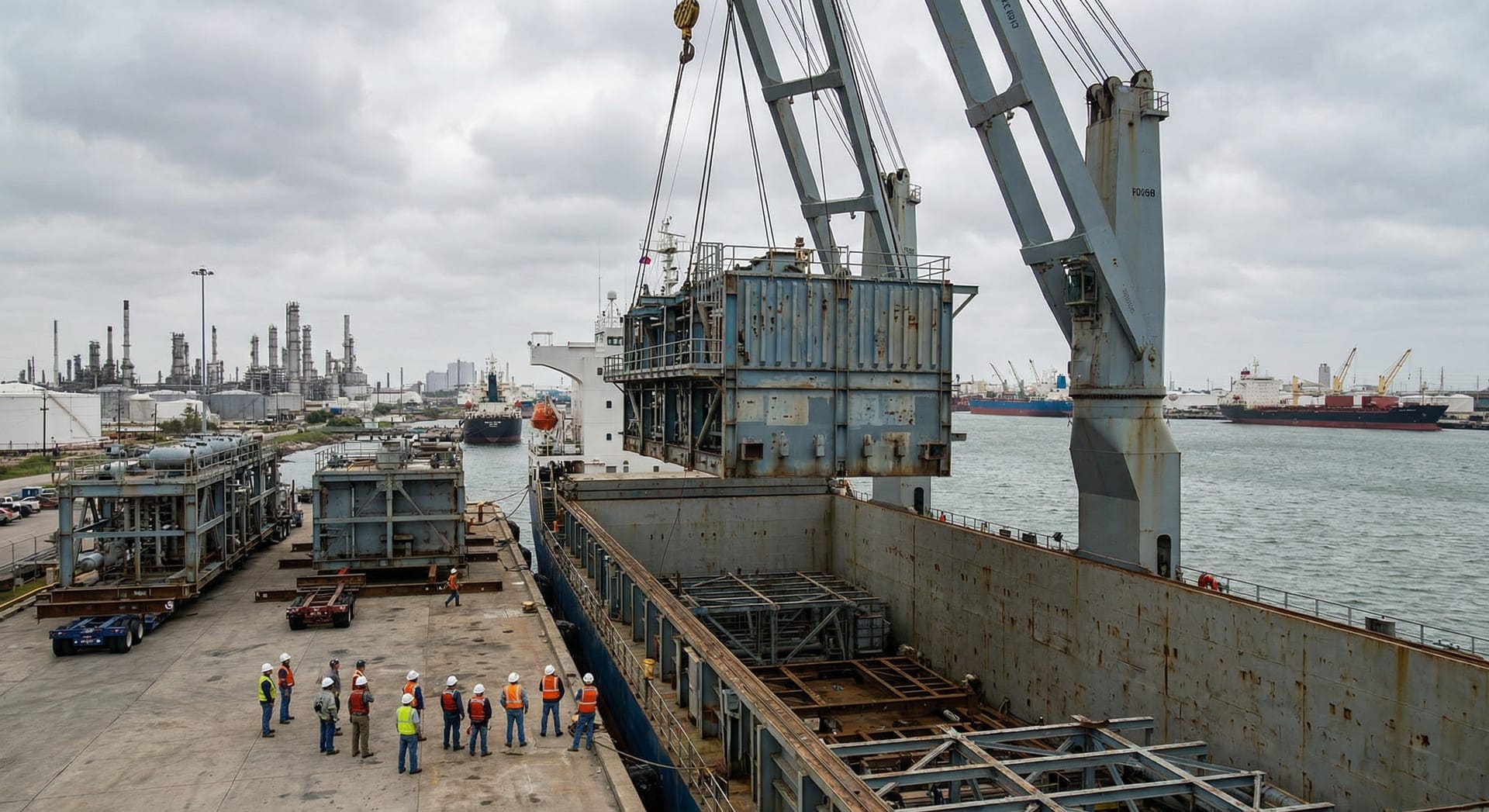
Skid-mounted oilfield modules from the Houston area can sail RoRo from Freeport, Texas, to Lagos in 27 to 32 days[1] on roll trailers rated up to 154 US tons (140 t) in one fleet[2]; larger process modules go breakbulk on a heavy-lift ship[3], and any module that holds fuel or batteries ships as a hazardous material[4].
This is a project plan, not a record of a completed job. It shows how we would plan the move from the published carrier, port and regulatory data cited below; the manufacturer’s drawings replace every assumption once we have them.
The plan, step by step
- 01
List every module
For each skid and module we record the weight, dimensions, lifting points and whether it holds fuel, batteries, chemicals or residue. That list sets the ship, the hazardous materials paperwork and the lift plan.
- 02
Drain, isolate and declare
A tank of gasoline or other flammable fuel is drained to 500 mL or less and closed; a diesel engine may keep its fuel if the tank has room for expansion. Batteries stay installed and secured, with the terminals protected[4].
- 03
Classify for export
The exporter confirms each item’s ECCN or EAR99, and Electronic Export Information is filed in AES for each Schedule B line over $2,500[6].
- 04
- 05
Pack and block
Crates, skids and blocking of solid wood are ISPM 15 heat-treated and stamped before they reach the port[5].
- 06
Discharge at Lagos
The consignee’s clearing agent handles Nigerian customs. Before booking a piece that needs lifting at discharge, we confirm the crane capacity at the berth.
Sailings from the U.S. to Africa
| Destination port | Grimaldi[1]North America – West AfricaRoRo | Sallaum Lines[7]USA to West AfricaRoRo | MSC[8]USA – South Africa (weekly)Container |
|---|---|---|---|
| Loads at | Freeport, Brunswick, Jacksonville, Baltimore, Newark, Wilmington (DE), Davisville (RI), Providence (RI) | Freeport, Jacksonville, Baltimore, Davisville (RI) | Newark, Baltimore, Norfolk, Charleston, Freeport |
| Dakar |
| No direct call | No direct call |
| Tema |
| No direct call | No direct call |
| Lomé | No direct call | Calls; transit not listed | No direct call |
| Cotonou | Calls; transit not listed | Calls; transit not listed | No direct call |
| Lagos |
|
| No direct call |
| Durban | No direct call |
| Calls; transit not listed |
| Gqeberha | No direct call | No direct call | Calls; transit not listed |
| Cape Town | No direct call | No direct call | Calls; transit not listed |
| Mombasa | No direct call | No direct call | No direct call |
| Dar es Salaam | No direct call | No direct call | No direct call |
- Grimaldi: Lomé is served by transshipment on this service. The ships continue to Brazil, Colombia and Mexico, so the U.S. calls come in a different order on each voyage.
- Sallaum Lines: Durban is on some voyages only. Cargo cut-off is 4 to 8 days before the ship reaches the U.S. port.
- MSC: The only direct container link between the U.S. East Coast and South Africa, with eight ships for a weekly call. Flat racks and open tops ride the same ships when the carrier accepts the cargo.
Roll trailer, flat rack and open top limits
| Figure | MAFI roll trailer[9] | 40' high cube flat rack[10] | 40' open top container[12] |
|---|---|---|---|
| ISO size-type code | – | 45P3 | 42U1 |
| Inside length | – | 38 ft 3 in (11.65 m) | 39 ft 6 in (12.03 m) |
| Inside width (flat racks: floor) | – | 7 ft 8 in (2.35 m) | 7 ft 9 in (2.35 m) |
| Inside height (flat racks: floor to top of end walls) | – | 7 ft 5 in (2.27 m) | 7 ft 10 in (2.38 m) |
| Door opening, width × height | – | – | 7 ft 8 in / 2.34 m × 7 ft 6 in / 2.28 m |
| Roof opening, length × width | – | – | 37 ft 11 in / 11.55 m × 7 ft 4 in / 2.23 m |
| Deck, length × width | 39 ft 4 in / 12 m × 8 ft 2 in / 2.5 m | – | – |
| Floor height above ground | 2 ft 5 in (0.73 m) | 2 ft 2 in (0.65 m) | – |
| Clear deck height | 1 ft 5 in (0.44 m) – 3 ft 7 in (1.1 m) | – | – |
| Trailer lengths in fleet | 19 ft 8 in (6 m) – 78 ft 9 in (24 m) | – | – |
| Maximum gross weight | – | 61 US tons (55,000 kg) | 71,700 lb (32,500 kg) |
| Tare weight | – | 13,000 lb (5,900 kg) | 8,930 lb (4,050 kg) |
| Maximum payload | 110 US tons (100,000 kg) | 54 US tons (49,100 kg) | 62,700 lb (28,450 kg) |
| Weight range | up to 154 US tons (140,000 kg) | – | – |
| Volume | – | – | 66.5 m³ |
| Rating per lashing point | – | 11,000 lb (5,000 kg) | 2,200 lb (1,000 kg) |
- MAFI roll trailer: Figures for a standard 40′ 100-tonne trailer (Transfennica). Wallenius Wilhelmsen runs trailers from 19 ft 8 in to 78 ft 9 in (6 to 24 m) long for cargo up to 154 US tons (140 t). The cargo stays on the trailer for the whole voyage.[2]
- 40' high cube flat rack: Series range from 97,100 lb to 60 US tons (44,050 to 54,200 kg) payload. The weight must reach the two main beams, directly or through cross timbers; on a 6 ft 7 in (2 m) resting length this rack takes 56,400 lb (25.6 t).[11]
- 40' open top container: Older 40′ open tops are rated 67,200 lb (30,480 kg) gross (58,700 lb / 26,630 kg payload).[12]
Rules this move has to meet
- Engines, vehicles and machinery as hazardous materials (49 CFR 173.220)PHMSA
A machine is regulated as a hazardous material when it carries fuel, a wet, sodium or lithium battery, or other hazardous materials. A tank of flammable liquid fuel such as gasoline is drained to 500 mL or less and closed; a self-propelled machine on diesel may keep its fuel if the tank has room for expansion and the cap is closed. Batteries stay installed and secured, wet batteries upright, with the terminals protected against short circuits.[4]
Applies to: Machines with fuel, batteries or other hazardous materials, by road, vessel or air
- Export classification under the EAR (ECCN or EAR99)BIS (U.S. Department of Commerce)
An item subject to the EAR is either listed on the Commerce Control List under an Export Control Classification Number (ECCN) or classified EAR99, the basket for items not listed. The ECCN’s reasons for control, read against the Commerce Country Chart, decide whether the destination needs a license. An EAR99 item rarely needs one, but no item, EAR99 included, may go to a person under a denial order or to a prohibited end use or end user without BIS authorization.[13][14][15]
Applies to: Every export of goods subject to the Export Administration Regulations
- Electronic Export Information (15 CFR 30)U.S. Census Bureau
Electronic Export Information is filed in AES for each Schedule B number worth more than $2,500 going to one consignee on one conveyance, and for every vehicle whatever its value. For vessel cargo it is due at least 24 hours before loading; the Internal Transaction Number (ITN) goes to the carrier with the booking.[16][6]
Applies to: Any Schedule B line over $2,500, and every vehicle
- ISPM 15 wood packagingIPPC, administered in the U.S. by USDA APHIS
Wood packaging and dunnage must be heat-treated to a core temperature of 56 °C for at least 30 minutes, or fumigated, and carry the IPPC mark with the US country code, the facility number and HT or MB. Marked wood can be reused; repaired or remanufactured wood must be treated and marked again.[5]
Applies to: Crates, skids, blocking and dunnage
- SOLAS verified gross mass (VGM)IMO
Since 1 July 2016 the shipper must give a signed verified gross mass for each packed container, found by weighing the packed unit or by adding the weighed cargo, lashing and dunnage to the container tare. The carrier needs it before the stowage plan is drawn up; without it the container is not loaded.[17]
Applies to: Every packed container, flat rack and open top
Questions about this plan
How long is the sailing from Texas to Lagos?
On the schedules we checked, 27 to 32 days from Freeport, Texas, with Grimaldi. From Baltimore it is 14 to 23 days with Grimaldi or 21 to 36 days with Sallaum.
Can a module go RoRo if it does not drive?
Yes, on a roll trailer, if it is within the trailer’s rating and length: up to 154 US tons (140 t) and 78 ft 9 in (24 m) in one RoRo fleet.
Is this a job you have completed?
No. It is a plan built from published data to show how we would run the move. Send us the module list and we will turn it into a quote.
Sources
Every figure on this page comes from the documents below, each checked on the date shown. Carriers and authorities revise them, so we confirm the current figure when we book.
- [1]Grimaldi Lines, North America – West Africa Service schedule (published 16 Oct 2026), checked October 18, 2026
- [2]Wallenius Wilhelmsen, Cargo handling equipment, checked October 18, 2026
- [3]SAL Heavy Lift, Fleet list (April 2026), checked October 18, 2026
- [4]eCFR, 49 CFR 173.220 Internal combustion engines, vehicles and machinery (hazardous materials), checked October 18, 2026
- [5]USDA APHIS, Export ISPM 15-compliant wood packaging material, checked October 18, 2026
- [6]U.S. Census Bureau, Foreign Trade Regulations FAQs, checked October 18, 2026
- [7]Sallaum Lines, USA to West Africa sailing schedule (updated 17 Oct 2026), checked October 18, 2026
- [8]MSC, Standalone direct service between South Africa and the USA (customer advisory), checked October 18, 2026
- [9]Transfennica, Roll trailer and cassette dimensions (1/2024), checked October 18, 2026
- [10]Hapag-Lloyd, 40′ High Cube Flatrack, checked October 18, 2026
- [11]Hapag-Lloyd, Weight distribution in containers for safe transport (guideline), checked October 18, 2026
- [12]Hapag-Lloyd, Container Specification (2024 update), checked October 18, 2026
- [13]eCFR, 15 CFR 734.3 Items subject to the EAR (EAR99), checked October 18, 2026
- [14]eCFR, 15 CFR 738.4 Determining whether a license is required, checked October 18, 2026
- [15]eCFR, 15 CFR 732.3 Steps regarding the ten general prohibitions, checked October 18, 2026
- [16]eCFR, 15 CFR 30.37 Miscellaneous exemptions (Foreign Trade Regulations), checked October 18, 2026
- [17]IMO, SOLAS verified gross mass requirement enters into force (1 July 2016), checked October 18, 2026
Send us the machine and the destination
Give us the model or the measured dimensions and weight. We come back with the method, the sailing and a price, and the figures behind them.