Project plan
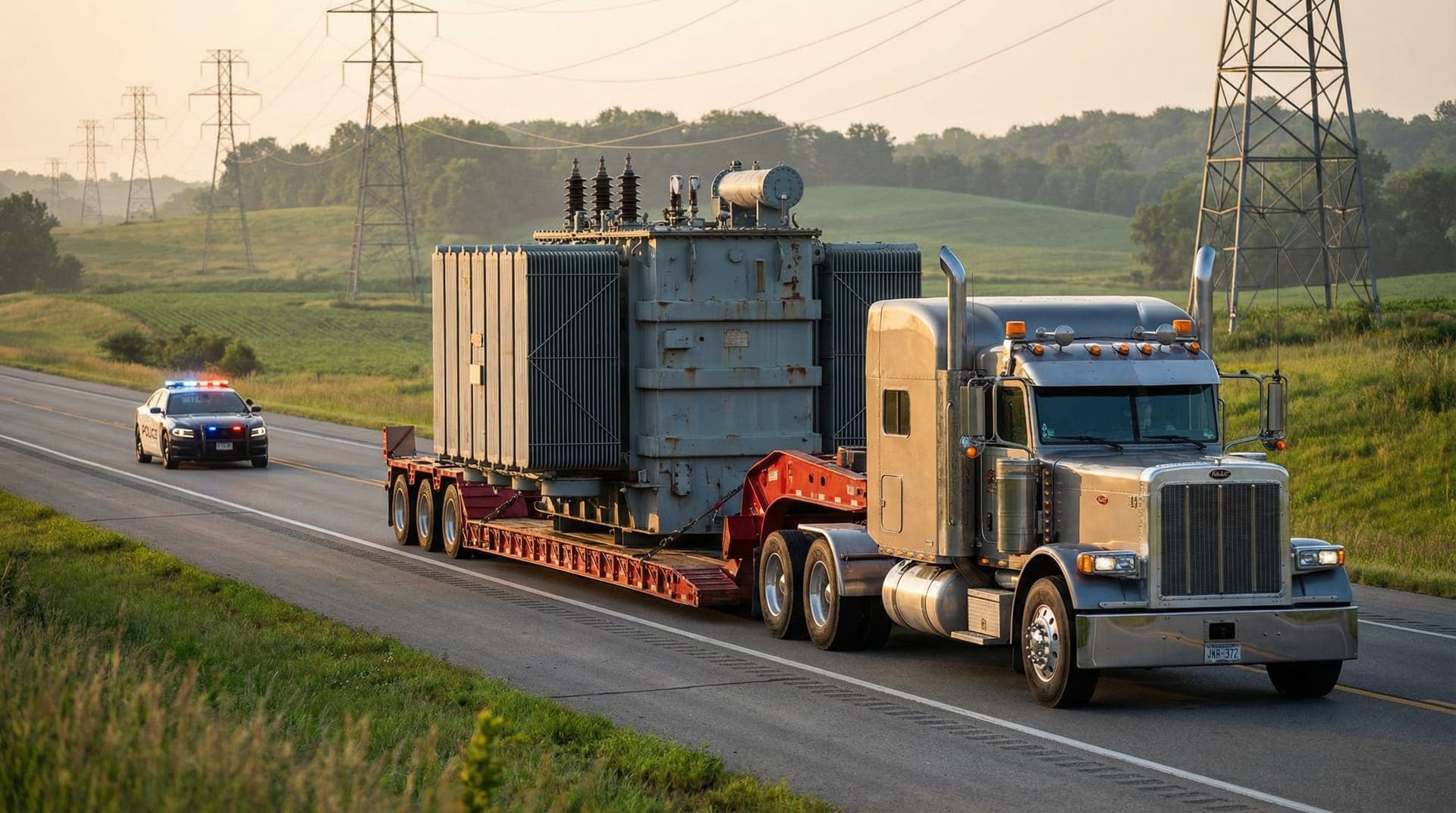
Project plan: a power transformer from the U.S. to Mexico
Mexico bought 47 of the 117 large liquid-filled transformers the U.S. exported in 2024[1]; one goes by rail or permitted heavy haul across the land border, or by RoRo from Freeport, Texas, which reaches Altamira in 4 to 5 days on a roll trailer rated in one fleet for up to 154 US tons (140 t)[2][3].
This is a project plan, not a record of a completed job. It shows how we would plan the move from the published carrier, port and regulatory data cited below; the manufacturer’s drawings replace every assumption once we have them.
The plan, step by step
- 01
Get the shipping drawing
The transformer maker’s drawing gives the shipping weight, the dimensions with radiators and bushings removed, the lifting and jacking points and the centre of gravity. Every later step works from it.
- 02
Choose rail, road or sea
Union Pacific treats a load over 220,000 lb net or 11 ft wide as dimensional and needs an approved clearance before it moves[4]. On the road, anything over 80,000 lb gross or 102 in wide needs a permit from every state on the route[5]. Within a roll trailer’s rating, RoRo from Freeport to Altamira or Veracruz replaces the land crossing[2][3].
- 03
Register the importer
The Mexican buyer must be listed in the Padrón de Importadores, and a licensed customs broker files the pedimento with a Spanish commercial invoice and the importer’s RFC[6].
- 04
File the export
Electronic Export Information is filed in AES for each Schedule B line worth more than $2,500 going to one consignee, and the ITN goes to the carrier with the booking.
- 05
Carry the Carta Porte
Inside Mexico the transformer travels with a CFDI invoice carrying the Carta Porte supplement, from the border or the port to the substation[7].
- 06
Set it on its pad
At the substation it is jacked and skidded or lifted onto its foundation at the points on the drawing. We plan the crane, mats and rigging before the transformer leaves the plant.
Sailings from the U.S. to Mexico
RoRo sailings to Mexico’s Gulf ports, an alternative to the land border for a piece within roll trailer limits.
| Destination port | Grimaldi[3]MED/USA/MEXRoRo | NYK RORO[8]North–SouthRoRo | Höegh Autoliners[9]Vessel scheduleRoRo |
|---|---|---|---|
| Loads at | Freeport, Jacksonville, Baltimore | Freeport | Charleston |
| Veracruz |
|
|
|
| Altamira |
| No direct call | No direct call |
- Grimaldi: The ships come from the Mediterranean and call the U.S. ports on the way to Mexico, so Freeport is the last U.S. call.
- NYK RORO: Three voyages called Veracruz on the schedule we checked.
- Höegh Autoliners: One voyage was listed when we checked.
Roll trailer limits
| Figure | MAFI roll trailer[10] |
|---|---|
| Deck, length × width | 39 ft 4 in / 12 m × 8 ft 2 in / 2.5 m |
| Floor height above ground | 2 ft 5 in (0.73 m) |
| Clear deck height | 1 ft 5 in (0.44 m) – 3 ft 7 in (1.1 m) |
| Trailer lengths in fleet | 19 ft 8 in (6 m) – 78 ft 9 in (24 m) |
| Maximum payload | 110 US tons (100,000 kg) |
| Weight range | up to 154 US tons (140,000 kg) |
- MAFI roll trailer: Figures for a standard 40′ 100-tonne trailer (Transfennica). Wallenius Wilhelmsen runs trailers from 19 ft 8 in to 78 ft 9 in (6 to 24 m) long for cargo up to 154 US tons (140 t). The cargo stays on the trailer for the whole voyage.[2]
Rules this move has to meet
- Dimensional loads by railUnion Pacific and Norfolk Southern
Each railroad sets its own limits. Union Pacific treats a load as dimensional above 11 ft wide, 17 ft above the top of rail, 220,000 lb net or four axles, or when it overhangs the car end; it needs an approved clearance proposal, a $500 fee per request and a mechanical inspection before release. Norfolk Southern asks for a clearance request above 10 ft 6 in wide, 15 ft 6 in loaded height, 200,000 lb, 60 ft of lading or under 18 ft for a concentrated load.[4][11]
Applies to: Rail shipments over the railroad’s standard width, height, weight or length
- Federal truck size and weight limits (23 CFR 658)FHWA
On the Interstate system a truck may gross 80,000 lb, with 20,000 lb on a single axle and 34,000 lb on a tandem; on the National Network the load may be 102 in wide. There is no federal height limit: states set 13.6 to 14.6 ft. A load over any of these needs an oversize or overweight permit from every state on the route.[5]
Applies to: Every road move to and from the port
- Cargo securement on trucks (49 CFR 393.106 and 393.130)FMCSA
The tiedowns on a load must together have a working load limit of at least half its weight. A machine on wheels or tracks weighing 10,000 lb or more needs at least four tiedowns, fixed as close as practicable to its front and rear or to its designed tie points; buckets and shovels are lowered and secured, and articulated machines are locked so they cannot articulate.[12][13]
Applies to: Machines on wheels or tracks moved by truck, and every other load on a public road
- Electronic Export Information (15 CFR 30)U.S. Census Bureau
Electronic Export Information is filed in AES for each Schedule B number worth more than $2,500 going to one consignee on one conveyance, and for every vehicle whatever its value. For vessel cargo it is due at least 24 hours before loading; the Internal Transaction Number (ITN) goes to the carrier with the booking.[14][15]
Applies to: Any Schedule B line over $2,500, and every vehicle
- Importing into Mexico: importer registry and pedimentoANAM and SAT (Mexico)
The importer must be listed in SAT’s Padrón de Importadores, and in a sector registry for goods that have one, and clears the goods through a customs broker (agente aduanal) or an authorized customs representative. The pedimento is the import declaration; it goes with a Spanish commercial invoice, the bill of lading and any permits or NOM certificates, and since 1 January 2025 every declaration carries the importer’s RFC tax ID. Goods claiming USMCA preference need a certification of origin with nine minimum data elements, which the importer, exporter or producer may issue.[16][6][17]
Applies to: Every commercial import into Mexico
- Carta Porte for goods moving inside MexicoSAT (Mexico)
Goods moved within Mexico travel with a CFDI electronic invoice that carries the Carta Porte supplement, version 3.1 since 17 July 2024. For goods in foreign trade it has been enforceable since 1 January 2024, so the leg from the border or the port to the site needs one.[7][6]
Applies to: Goods carried in Mexico by road, rail, sea or air, imports included
Questions about this plan
Can a transformer cross into Mexico by rail?
Yes, where both railroads clear the load. On the U.S. side Union Pacific needs an approved clearance proposal for a dimensional load, with a $500 fee per request and a mechanical inspection before release.
Does a transformer export to Mexico need EEI?
Yes, whenever a Schedule B line is worth more than $2,500, which a power transformer always is. The EEI exemption for Canada does not apply to Mexico.
Is this a job you have completed?
No. It is a plan built from published data to show how we would run the move. Send us the shipping drawing and we will turn it into a quote.
Sources
Every figure on this page comes from the documents below, each checked on the date shown. Carriers and authorities revise them, so we confirm the current figure when we book.
- [1]World Bank WITS (UN Comtrade), U.S. exports of HS 850423, 2024, checked October 18, 2026
- [2]Wallenius Wilhelmsen, Cargo handling equipment, checked October 18, 2026
- [3]Grimaldi Lines, MED/USA/MEX Service schedule (published 16 Oct 2026), checked October 18, 2026
- [4]Union Pacific, Seven Steps for Shipping a Dimensional Load, checked October 18, 2026
- [5]FHWA, Commercial Vehicle Size and Weight Program (23 CFR 658), checked October 18, 2026
- [6]U.S. International Trade Administration, Mexico Country Commercial Guide: Import Requirements and Documentation, checked October 18, 2026
- [7]Servicio de Administración Tributaria (SAT), Complemento Carta Porte, checked October 18, 2026
- [8]NYK RORO, North–South loop schedule: U.S. Gulf, Mexico, Panama and East Coast South America (week 42, 16 Oct 2026), checked October 18, 2026
- [9]Höegh Autoliners, Sailing schedule by vessel (as listed 18 Oct 2026), checked October 18, 2026
- [10]Transfennica, Roll trailer and cassette dimensions (1/2024), checked October 18, 2026
- [11]Norfolk Southern, Dimensional, Oversized, and Equipment Shipping by Rail, checked October 18, 2026
- [12]eCFR, 49 CFR 393.106 General requirements for securing articles of cargo, checked October 18, 2026
- [13]eCFR, 49 CFR 393.130 Securement of heavy vehicles, equipment and machinery, checked October 18, 2026
- [14]eCFR, 15 CFR 30.37 Miscellaneous exemptions (Foreign Trade Regulations), checked October 18, 2026
- [15]U.S. Census Bureau, Foreign Trade Regulations FAQs, checked October 18, 2026
- [16]Agencia Nacional de Aduanas de México (ANAM), Requisitos para importar, checked October 18, 2026
- [17]U.S. International Trade Administration, Mexico Country Commercial Guide: Customs Regulations, checked October 18, 2026
Send us the machine and the destination
Give us the model or the measured dimensions and weight. We come back with the method, the sailing and a price, and the figures behind them.