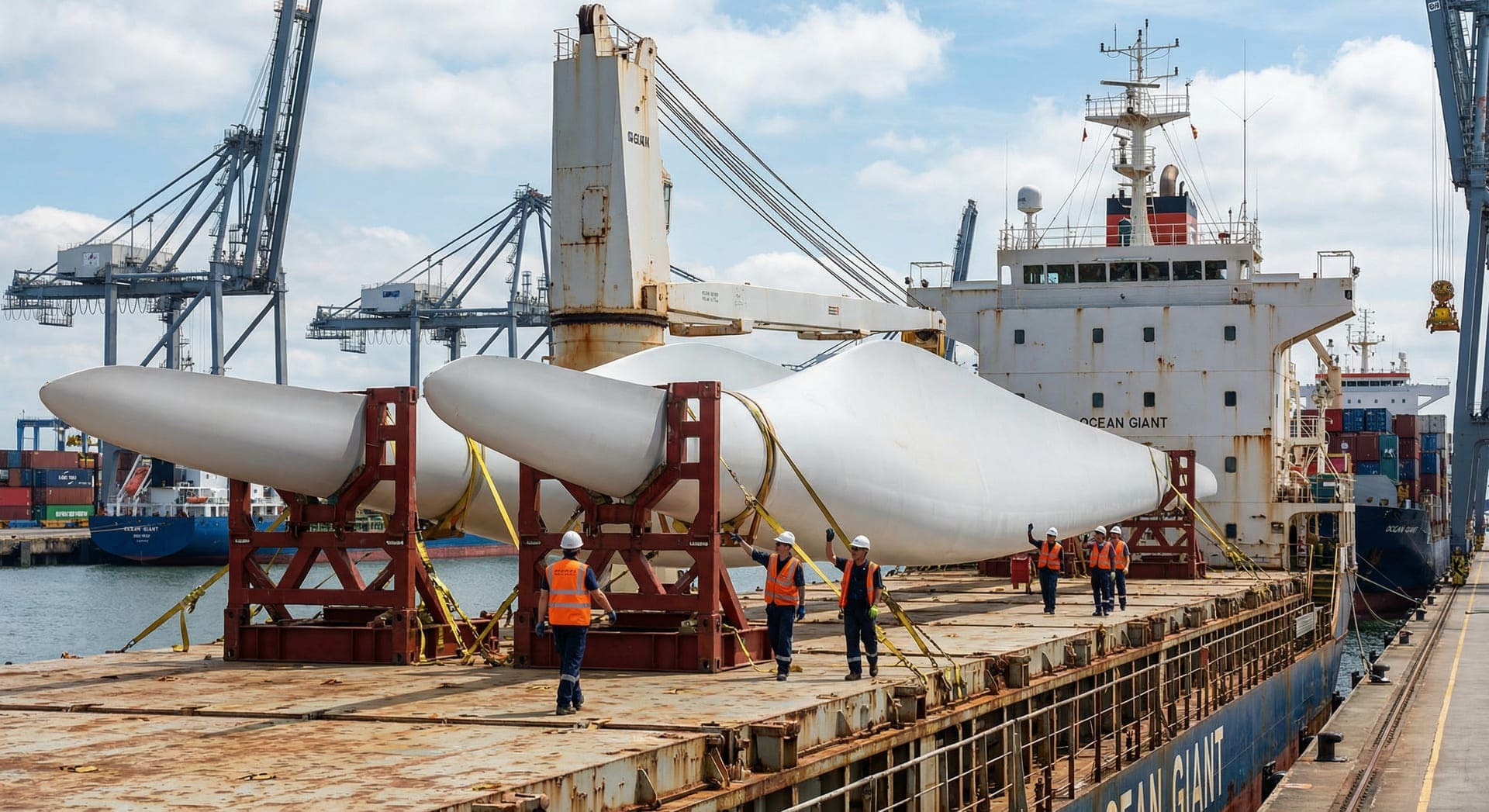
Project plan
Project plan: wind turbine components, Texas to Brazil
Blades, nacelles, hubs and tower sections from Texas to a wind farm in Brazil usually sail as breakbulk on a heavy-lift ship, whose holds in one fleet run to 351 ft 5 in (107.1 m) and whose cranes lift up to 2,205 US tons (2,000 t) together[1]; pieces that fit a roll trailer can take the RoRo service from Freeport, Texas, which reaches Vitória in 18 to 24 days[2][3].
This is a project plan, not a record of a completed job. It shows how we would plan the move from the published carrier, port and regulatory data cited below; the manufacturer’s drawings replace every assumption once we have them.
The plan, step by step
- 01
Measure every piece
We take each component’s length, width, height, weight and centre of gravity from the turbine maker’s transport drawings. Blades and tower sections decide the ship; the heaviest nacelle decides the cranes and the road permits.
- 02
Choose the ship
Pieces longer than the 78 ft 9 in (24 m) roll trailers in one RoRo fleet, such as blades and long tower sections, go breakbulk[2]. Nacelles and hubs within a trailer’s 154 US tons (140 t) rating and length can ride a roll trailer on a RoRo ship[2]; the rest goes on a heavy-lift ship booked for the project[1].
- 03
Move each piece to the port
A load over 102 in wide or 80,000 lb gross needs a permit from every state on the route, and each state sets its own escort and travel-time conditions[4].
- 04
- 05
Declare and file
The shipper declares each piece’s verified gross mass before loading[7], and the Electronic Export Information is filed in AES before the cargo is loaded.
- 06
Discharge and deliver
The road leg from the Brazilian port to the site is surveyed and permitted in Brazil. We plan it with the buyer’s local contractor before the ship is booked, because it can limit the length of piece the site will accept.
Sailings from the U.S. to South America
Published RoRo and container sailings to Brazil and the rest of South America. Heavy-lift ships are booked for each project and do not appear on these schedules.
| Destination port | NYK RORO[8]MSXRoRo | NYK RORO[8]USCX (via the Panama Canal)RoRo | NYK RORO[3]North–SouthRoRo | Höegh Autoliners[9]Jacksonville – Colombia – PanamaRoRo |
|---|---|---|---|---|
| Loads at | Baltimore, Jacksonville, Newark, Davisville (RI) | Baltimore, Jacksonville, Newark | Freeport | Jacksonville |
| Cartagena | No direct call | No direct call | No direct call |
|
| Santa Marta | No direct call | No direct call | No direct call |
|
| Suape |
| No direct call | No direct call | No direct call |
| Vitória | No direct call | No direct call |
| No direct call |
| Rio de Janeiro | No direct call | No direct call |
| No direct call |
| Santos |
| No direct call | No direct call | No direct call |
| Paranaguá | No direct call | No direct call |
| No direct call |
| Zárate |
| No direct call |
| No direct call |
| San Antonio |
|
| No direct call | No direct call |
| Iquique |
|
| No direct call | No direct call |
| Callao |
|
| No direct call | No direct call |
| Guayaquil | No direct call | No direct call | No direct call | No direct call |
- NYK RORO: Calls the east coast of South America first and goes on to Chile and Peru. Used cargo for Chile is not accepted at Davisville or at the Newark and Red Hook terminals, and two of the ships take no U.S. cargo for the west coast.
- NYK RORO: One voyage was listed when we checked. The ship calls Manzanillo, Panama, and crosses the canal to the west coast.
- NYK RORO: The only Gulf Coast load port among these services. Cargo over 66,100 lb (30 t) is not accepted for transshipment to the west coast of South America.
- Höegh Autoliners: About one voyage a month on the vessel schedule when we checked.
Roll trailer and flat rack limits
| Figure | MAFI roll trailer[10] | 40' high cube flat rack[11] |
|---|---|---|
| ISO size-type code | – | 45P3 |
| Inside length | – | 38 ft 3 in (11.65 m) |
| Inside width (flat racks: floor) | – | 7 ft 8 in (2.35 m) |
| Inside height (flat racks: floor to top of end walls) | – | 7 ft 5 in (2.27 m) |
| Deck, length × width | 39 ft 4 in / 12 m × 8 ft 2 in / 2.5 m | – |
| Floor height above ground | 2 ft 5 in (0.73 m) | 2 ft 2 in (0.65 m) |
| Clear deck height | 1 ft 5 in (0.44 m) – 3 ft 7 in (1.1 m) | – |
| Trailer lengths in fleet | 19 ft 8 in (6 m) – 78 ft 9 in (24 m) | – |
| Maximum gross weight | – | 61 US tons (55,000 kg) |
| Tare weight | – | 13,000 lb (5,900 kg) |
| Maximum payload | 110 US tons (100,000 kg) | 54 US tons (49,100 kg) |
| Weight range | up to 154 US tons (140,000 kg) | – |
| Rating per lashing point | – | 11,000 lb (5,000 kg) |
- MAFI roll trailer: Figures for a standard 40′ 100-tonne trailer (Transfennica). Wallenius Wilhelmsen runs trailers from 19 ft 8 in to 78 ft 9 in (6 to 24 m) long for cargo up to 154 US tons (140 t). The cargo stays on the trailer for the whole voyage.[2]
- 40' high cube flat rack: Series range from 97,100 lb to 60 US tons (44,050 to 54,200 kg) payload. The weight must reach the two main beams, directly or through cross timbers; on a 6 ft 7 in (2 m) resting length this rack takes 56,400 lb (25.6 t).[12]
Rules this move has to meet
- Federal truck size and weight limits (23 CFR 658)FHWA
On the Interstate system a truck may gross 80,000 lb, with 20,000 lb on a single axle and 34,000 lb on a tandem; on the National Network the load may be 102 in wide. There is no federal height limit: states set 13.6 to 14.6 ft. A load over any of these needs an oversize or overweight permit from every state on the route.[4]
Applies to: Every road move to and from the port
- Cargo securement on trucks (49 CFR 393.106 and 393.130)FMCSA
The tiedowns on a load must together have a working load limit of at least half its weight. A machine on wheels or tracks weighing 10,000 lb or more needs at least four tiedowns, fixed as close as practicable to its front and rear or to its designed tie points; buckets and shovels are lowered and secured, and articulated machines are locked so they cannot articulate.[13][14]
Applies to: Machines on wheels or tracks moved by truck, and every other load on a public road
- Cranes and derricks in construction (29 CFR 1926 Subpart CC)OSHA
The crane may only be set up where the ground is firm, drained and graded enough, with mats or cribbing if needed, to meet the manufacturer’s support and level requirements. The operator must be trained, certified and evaluated. Anyone hooking or guiding a load inside the fall zone works with a load rigged by a qualified rigger, and a signal person is required when the operator cannot see the load. Near power lines up to 350 kV, one permitted method keeps the crane, load line and load at least 20 ft away.[5]
Applies to: Crane lifts at U.S. job sites, yards and plants
- ISPM 15 wood packagingIPPC, administered in the U.S. by USDA APHIS
Wood packaging and dunnage must be heat-treated to a core temperature of 56 °C for at least 30 minutes, or fumigated, and carry the IPPC mark with the US country code, the facility number and HT or MB. Marked wood can be reused; repaired or remanufactured wood must be treated and marked again.[6]
Applies to: Crates, skids, blocking and dunnage
- SOLAS verified gross mass (VGM)IMO
Since 1 July 2016 the shipper must give a signed verified gross mass for each packed container, found by weighing the packed unit or by adding the weighed cargo, lashing and dunnage to the container tare. The carrier needs it before the stowage plan is drawn up; without it the container is not loaded.[7]
Applies to: Every packed container, flat rack and open top
- Electronic Export Information (15 CFR 30)U.S. Census Bureau
Electronic Export Information is filed in AES for each Schedule B number worth more than $2,500 going to one consignee on one conveyance, and for every vehicle whatever its value. For vessel cargo it is due at least 24 hours before loading; the Internal Transaction Number (ITN) goes to the carrier with the booking.[15][16]
Applies to: Any Schedule B line over $2,500, and every vehicle
Questions about this plan
Can wind turbine blades go on a RoRo ship?
Only if they fit a roll trailer and the ship’s deck. In one RoRo fleet the longest roll trailers are 78 ft 9 in (24 m), so longer blades go breakbulk on a heavy-lift ship.
How long does the ocean leg take?
By RoRo, Freeport, Texas, to Vitória takes 18 to 24 days and to Rio de Janeiro 19 to 26 days on the schedule we checked. A heavy-lift ship booked for the project sails on the dates agreed for it.
Is this a job you have completed?
No. It is a plan built from published data to show how we would run the move. Send us the transport drawings and we will turn it into a quote.
Sources
Every figure on this page comes from the documents below, each checked on the date shown. Carriers and authorities revise them, so we confirm the current figure when we book.
- [1]SAL Heavy Lift, Fleet list (April 2026), checked October 18, 2026
- [2]Wallenius Wilhelmsen, Cargo handling equipment, checked October 18, 2026
- [3]NYK RORO, North–South loop schedule: U.S. Gulf, Mexico, Panama and East Coast South America (week 42, 16 Oct 2026), checked October 18, 2026
- [4]FHWA, Commercial Vehicle Size and Weight Program (23 CFR 658), checked October 18, 2026
- [5]eCFR, 29 CFR 1926 Subpart CC Cranes and Derricks in Construction, checked October 18, 2026
- [6]USDA APHIS, Export ISPM 15-compliant wood packaging material, checked October 18, 2026
- [7]IMO, SOLAS verified gross mass requirement enters into force (1 July 2016), checked October 18, 2026
- [8]NYK RORO, MSX/USCX schedule: U.S. East Coast to South America (week 42, 16 Oct 2026), checked October 18, 2026
- [9]Höegh Autoliners, Sailing schedule by vessel (as listed 18 Oct 2026), checked October 18, 2026
- [10]Transfennica, Roll trailer and cassette dimensions (1/2024), checked October 18, 2026
- [11]Hapag-Lloyd, 40′ High Cube Flatrack, checked October 18, 2026
- [12]Hapag-Lloyd, Weight distribution in containers for safe transport (guideline), checked October 18, 2026
- [13]eCFR, 49 CFR 393.106 General requirements for securing articles of cargo, checked October 18, 2026
- [14]eCFR, 49 CFR 393.130 Securement of heavy vehicles, equipment and machinery, checked October 18, 2026
- [15]eCFR, 15 CFR 30.37 Miscellaneous exemptions (Foreign Trade Regulations), checked October 18, 2026
- [16]U.S. Census Bureau, Foreign Trade Regulations FAQs, checked October 18, 2026
Send us the machine and the destination
Give us the model or the measured dimensions and weight. We come back with the method, the sailing and a price, and the figures behind them.