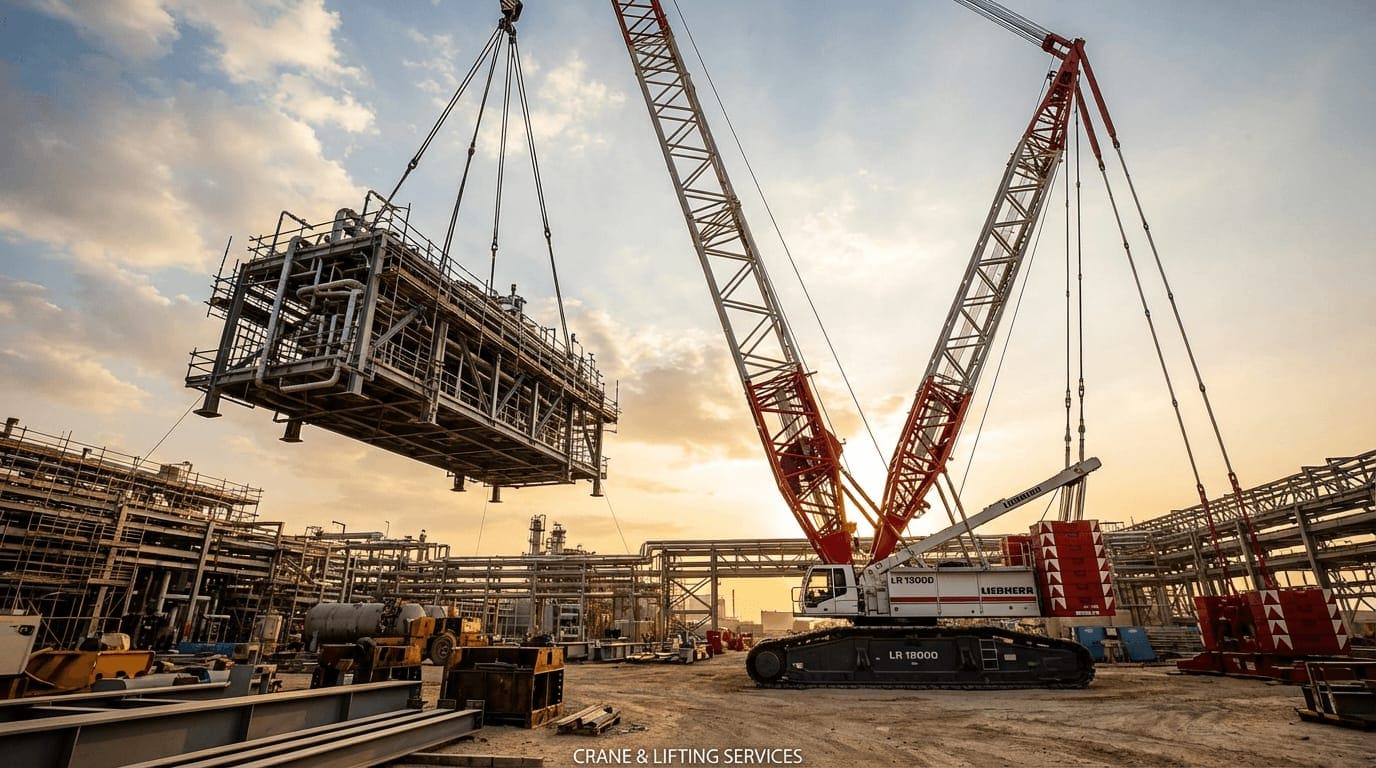
Crane lifting
Crane lifting for machinery and project cargo
A crane lift at a U.S. plant, yard or site follows OSHA’s crane rules: firm, graded ground, a certified operator, a qualified rigger for anyone in the fall zone, a signal person when the operator cannot see the load, and distance from power lines[1].
What OSHA requires on a lift
| Requirement | What it means[1] |
|---|---|
| Ground | Firm, drained and graded, with mats or cribbing if needed to meet the crane maker’s support and level limits |
| Operator | Trained, certified and evaluated, except on equipment rated 2,000 lb or less |
| Rigging | A qualified rigger rigs the load when anyone hooks or guides it in the fall zone |
| Signals | A signal person when the operator cannot see the load or the travel path |
| Power lines | Up to 350 kV, one permitted method keeps the crane, load line and load 20 ft away |
How a lift is planned
- 01
Load data
Weight, centre of gravity and lifting points from the manufacturer.
- 02
Crane and radius
A crane whose load chart covers the weight at the radius and height needed.
- 03
Ground and lines
The ground under the outriggers and the distance to any power line[1].
- 04
Rigging and crew
Slings, shackles and spreader beams rated for the load; a qualified rigger and a signal person where required[1].
Rules that apply
- Cranes and derricks in construction (29 CFR 1926 Subpart CC)OSHA
The crane may only be set up where the ground is firm, drained and graded enough, with mats or cribbing if needed, to meet the manufacturer’s support and level requirements. The operator must be trained, certified and evaluated. Anyone hooking or guiding a load inside the fall zone works with a load rigged by a qualified rigger, and a signal person is required when the operator cannot see the load. Near power lines up to 350 kV, one permitted method keeps the crane, load line and load at least 20 ft away.[1]
Applies to: Crane lifts at U.S. job sites, yards and plants
- ISPM 15 wood packagingIPPC, administered in the U.S. by USDA APHIS
Wood packaging and dunnage must be heat-treated to a core temperature of 56 °C for at least 30 minutes, or fumigated, and carry the IPPC mark with the US country code, the facility number and HT or MB. Marked wood can be reused; repaired or remanufactured wood must be treated and marked again.[3]
Applies to: Crates, skids, blocking and dunnage
Questions about crane lifting
Do crane operators need certification?
Yes, under OSHA’s construction crane rules, except on equipment rated 2,000 lb or less.
Who decides if the ground is good enough?
The controlling contractor must make sure it is firm, drained and graded; the crane operator checks it against the crane maker’s requirements before the lift.
Can ships lift cargo with their own cranes?
Heavy-lift ships can. In one current fleet each of two cranes lifts up to 1,102 US tons (1,000 t), together 2,205 US tons (2,000 t).
Sources
Every figure on this page comes from the documents below, each checked on the date shown. Carriers and authorities revise them, so we confirm the current figure when we book.
- [1]eCFR, 29 CFR 1926 Subpart CC Cranes and Derricks in Construction, checked October 18, 2026
- [2]SAL Heavy Lift, Fleet list (April 2026), checked October 18, 2026
- [3]USDA APHIS, Export ISPM 15-compliant wood packaging material, checked October 18, 2026
Send us the machine and the destination
Give us the model or the measured dimensions and weight. We come back with the method, the sailing and a price, and the figures behind them.