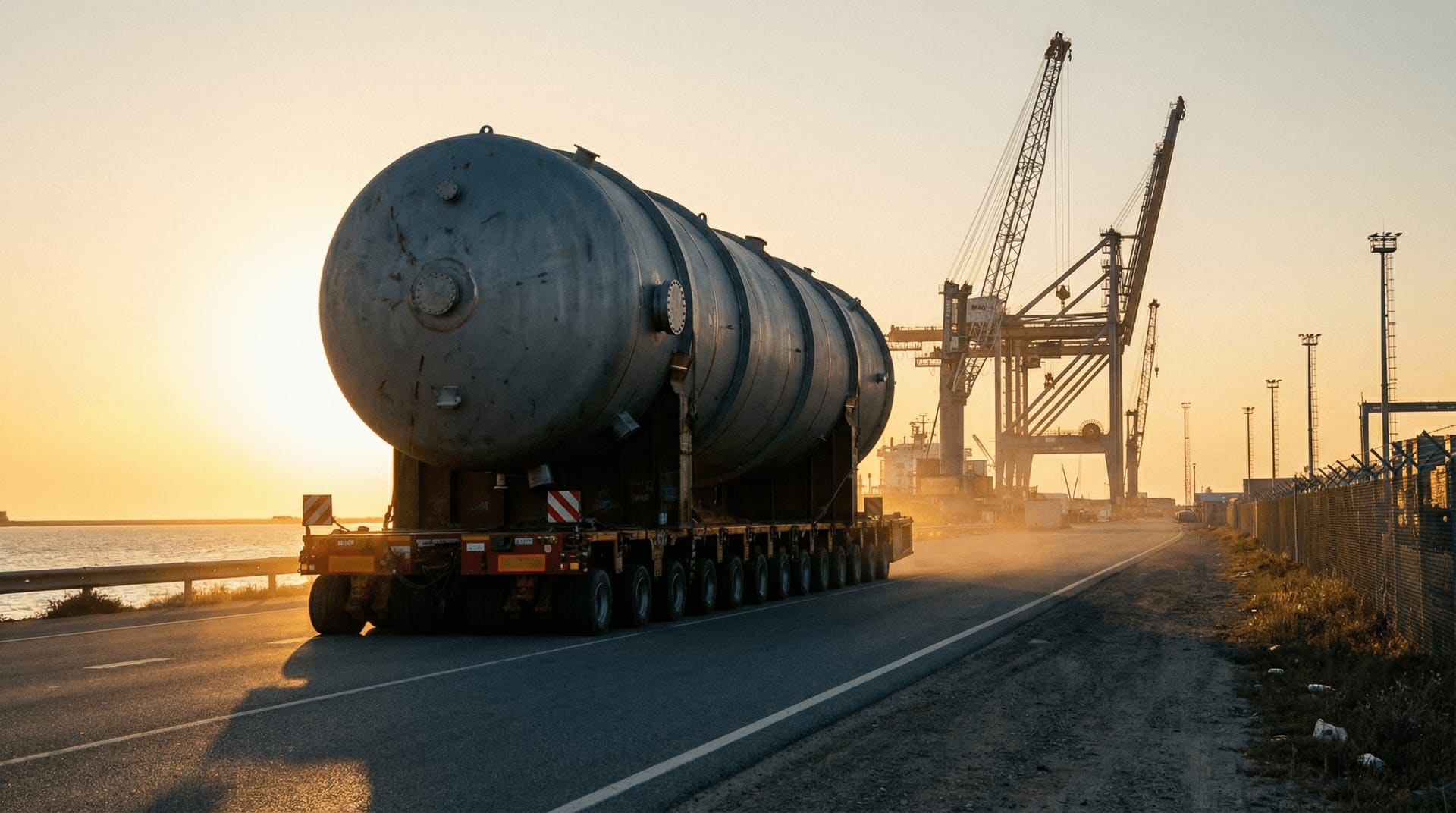
- combined crane lift on the heaviest ships in one fleet[1]
- 2,205 US tons (2,000 t)
- combined lift on the same operator’s Orca class[1]
- 1,764 US tons (1,600 t)
- capacity of a 250 ft deck barge at 2 ft freeboard[2]
- 3,512 short tons
- gross truck weight on the Interstate before every state’s permit is needed[3]
- 80,000 lb36,287 kg
What heavy-lift ships can lift
Ship types in one heavy-lift operator’s published fleet list. The ship on the fixture, not the type, sets the limit.
| Ship type | Cranes | Combined lift | Hold (L × W × H) | Free deck space[1] |
|---|---|---|---|---|
| Type 183 | 1,102 US tons (1,000 t) × 2 | 2,205 US tons (2,000 t) | 351 ft 5 in × 55 ft 9 in × 44 ft 3 in (107.10 × 17.00 × 13.50 m) | 3,215–3,372 m² |
| Orca | 882 US tons (800 t) × 2 | 1,764 US tons (1,600 t) | 351 ft 1 in × 60 ft 8 in × 43 ft 8 in (107 × 18.5 × 13.3 m) | 3,330 m² |
| Type 176 | 772 US tons (700 t) × 2, plus 386 US tons (350 t) | 1,543 US tons (1,400 t) | 351 ft 5 in × 55 ft 9 in × 43 ft (107.10 × 17.00 × 13.10 m) | 2,918 m² |
| Type 116 | 496 US tons (450 t) × 2 | 992 US tons (900 t) | 309 ft 3 in × 53 ft 2 in × 39 ft 8 in (94.25 × 16.20 × 12.08 m) | 2,311 m² |
Deck barge sizes and capacity
Selected sizes from one inland operator’s deck barge fleet. Capacity falls as freeboard, the height of deck above water, rises; the river and the towing company set the freeboard.
| Barge (L × W × depth) | 2 ft freeboard | 3 ft freeboard | 4 ft freeboard[2] |
|---|---|---|---|
| 110 × 30 × 7 ft | 340 short tons | 235 short tons | 140 short tons |
| 140 × 40 × 9 ft | 875 short tons | 700 short tons | 530 short tons |
| 195 × 35 × 10 ft 6 in | 1,415 short tons | 1,205 short tons | 1,000 short tons |
| 250 × 54 × 12 ft 6 in | 3,512 short tons | 3,091 short tons | 2,675 short tons |
How a super heavy piece moves
- 01
Engineering
Weight, centre of gravity and lifting points from the manufacturer; a transport drawing for the trailer and the ship.
- 02
- 03
Secure
Tiedowns with a working load limit of at least half the weight on the road[4]; sea fastening welded or chained on the ship.
- 04
Lift aboard
By the ship’s own cranes within their combined rating[1], or by floating crane.
Rules that apply
- Federal truck size and weight limits (23 CFR 658)FHWA
On the Interstate system a truck may gross 80,000 lb, with 20,000 lb on a single axle and 34,000 lb on a tandem; on the National Network the load may be 102 in wide. There is no federal height limit: states set 13.6 to 14.6 ft. A load over any of these needs an oversize or overweight permit from every state on the route.[3]
Applies to: Every road move to and from the port
- Cargo securement on trucks (49 CFR 393.106 and 393.130)FMCSA
The tiedowns on a load must together have a working load limit of at least half its weight. A machine on wheels or tracks weighing 10,000 lb or more needs at least four tiedowns, fixed as close as practicable to its front and rear or to its designed tie points; buckets and shovels are lowered and secured, and articulated machines are locked so they cannot articulate.[4][5]
Applies to: Machines on wheels or tracks moved by truck, and every other load on a public road
- Cranes and derricks in construction (29 CFR 1926 Subpart CC)OSHA
The crane may only be set up where the ground is firm, drained and graded enough, with mats or cribbing if needed, to meet the manufacturer’s support and level requirements. The operator must be trained, certified and evaluated. Anyone hooking or guiding a load inside the fall zone works with a load rigged by a qualified rigger, and a signal person is required when the operator cannot see the load. Near power lines up to 350 kV, one permitted method keeps the crane, load line and load at least 20 ft away.[6]
Applies to: Crane lifts at U.S. job sites, yards and plants
Questions about super heavy lift
Can a heavy-lift ship load from a barge?
Yes. Its own cranes can lift a piece off a barge alongside, which avoids a heavy quay when the port allows it.
How long does planning take?
It depends on the permits and the ship’s schedule. Permits for very heavy road moves can need bridge checks, so planning starts once the weight and drawings are known.
Can you move transformers?
Yes, on multi-axle or modular trailers, by rail on heavy-duty flatcars when cleared, or by barge, then by heavy-lift ship.
Sources
Every figure on this page comes from the documents below, each checked on the date shown. Carriers and authorities revise them, so we confirm the current figure when we book.
- [1]SAL Heavy Lift, Fleet list (April 2026), checked October 18, 2026
- [2]McDonough Marine Service, Deck cargo barge fleet (capacity by freeboard), checked October 18, 2026
- [3]FHWA, Commercial Vehicle Size and Weight Program (23 CFR 658), checked October 18, 2026
- [4]eCFR, 49 CFR 393.106 General requirements for securing articles of cargo, checked October 18, 2026
- [5]eCFR, 49 CFR 393.130 Securement of heavy vehicles, equipment and machinery, checked October 18, 2026
- [6]eCFR, 29 CFR 1926 Subpart CC Cranes and Derricks in Construction, checked October 18, 2026
Send us the machine and the destination
Give us the model or the measured dimensions and weight. We come back with the method, the sailing and a price, and the figures behind them.