Breakbulk and charter
Breakbulk and vessel charter for heavy cargo
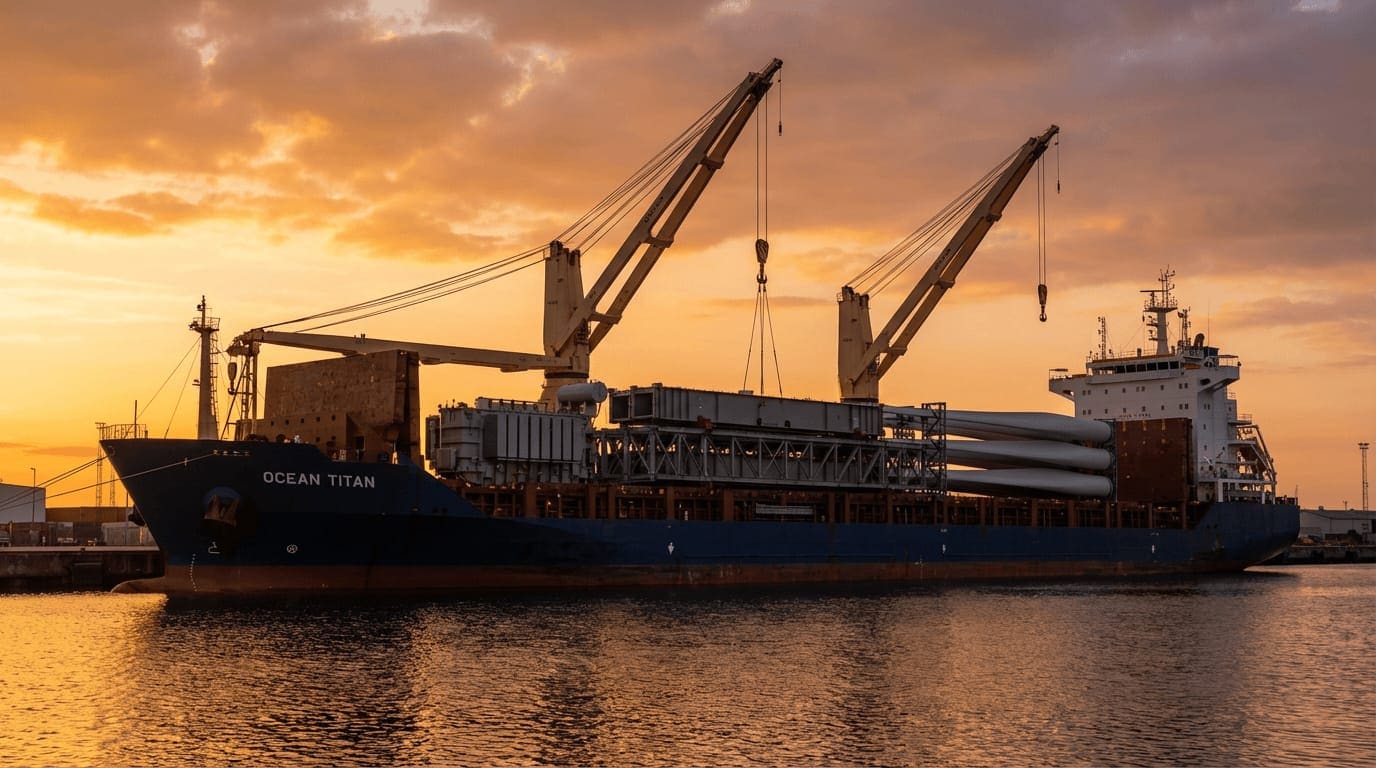
Breakbulk ships carry pieces that no container, flat rack or roll trailer can take, lifted aboard by crane. Heavy-lift ships in one current fleet combine two cranes for lifts of up to 2,205 US tons (2,000 t)[1].
What heavy-lift ships can lift
Ship types in one heavy-lift operator’s published fleet list. The ship on the fixture, not the type, sets the limit.
| Ship type | Cranes | Combined lift | Hold (L × W × H) | Free deck space[1] |
|---|---|---|---|---|
| Type 183 | 1,102 US tons (1,000 t) × 2 | 2,205 US tons (2,000 t) | 351 ft 5 in × 55 ft 9 in × 44 ft 3 in (107.10 × 17.00 × 13.50 m) | 3,215–3,372 m² |
| Orca | 882 US tons (800 t) × 2 | 1,764 US tons (1,600 t) | 351 ft 1 in × 60 ft 8 in × 43 ft 8 in (107 × 18.5 × 13.3 m) | 3,330 m² |
| Type 176 | 772 US tons (700 t) × 2, plus 386 US tons (350 t) | 1,543 US tons (1,400 t) | 351 ft 5 in × 55 ft 9 in × 43 ft (107.10 × 17.00 × 13.10 m) | 2,918 m² |
| Type 116 | 496 US tons (450 t) × 2 | 992 US tons (900 t) | 309 ft 3 in × 53 ft 2 in × 39 ft 8 in (94.25 × 16.20 × 12.08 m) | 2,311 m² |
Breakbulk, charter or a liner method
| Method | Use it when | Avoid it when |
|---|---|---|
| Breakbulk on a liner service | One or a few heavy pieces, on a route a multipurpose or heavy-lift operator sails regularly. | A flat rack or roll trailer takes the piece: those avoid crane lifts at both ends. |
| Full or part charter | A project has many heavy pieces, a fixed delivery window or a port no liner calls. | The cargo is a single piece that fits a regular sailing. |
| RoRo on a roll trailer | The piece is within a roll trailer’s rating, up to 154 US tons (140 t) in one fleet, and a RoRo ship calls the port[2]. | The piece is longer or heavier than the trailers on the route. |
How a breakbulk shipment is planned
- 01
Cargo data
Dimensions, weight, centre of gravity and lifting points for every piece, from the manufacturer’s drawings.
- 02
Ship and stowage
The operator checks crane outreach, hold and deck space, and the deck strength for each piece.
- 03
Lift plan and sea fastening
Rigging, lifting gear and the welding or lashing plan that holds each piece for the voyage.
- 04
Port delivery
Pieces arrive at the berth in loading order, with heavy haul permits for the road leg and the export filing in place[3].
Rules that apply
- Electronic Export Information (15 CFR 30)U.S. Census Bureau
Electronic Export Information is filed in AES for each Schedule B number worth more than $2,500 going to one consignee on one conveyance, and for every vehicle whatever its value. For vessel cargo it is due at least 24 hours before loading; the Internal Transaction Number (ITN) goes to the carrier with the booking.[4][3]
Applies to: Any Schedule B line over $2,500, and every vehicle
- ISPM 15 wood packagingIPPC, administered in the U.S. by USDA APHIS
Wood packaging and dunnage must be heat-treated to a core temperature of 56 °C for at least 30 minutes, or fumigated, and carry the IPPC mark with the US country code, the facility number and HT or MB. Marked wood can be reused; repaired or remanufactured wood must be treated and marked again.[5]
Applies to: Crates, skids, blocking and dunnage
- Federal truck size and weight limits (23 CFR 658)FHWA
On the Interstate system a truck may gross 80,000 lb, with 20,000 lb on a single axle and 34,000 lb on a tandem; on the National Network the load may be 102 in wide. There is no federal height limit: states set 13.6 to 14.6 ft. A load over any of these needs an oversize or overweight permit from every state on the route.[6]
Applies to: Every road move to and from the port
- Brown marmorated stink bug season: AustraliaAustralian Department of Agriculture, Fisheries and Forestry
Target high-risk goods shipped from the United States between 1 September and 30 April need mandatory treatment, judged by the shipped-on-board date. Flat rack, open top and breakbulk cargo must be treated before it leaves; if untreated, it is refused discharge or sent back. Heat treatment holds 56 °C at the coldest surface for 30 minutes, and for break bulk pieces under 6,610 lb (3,000 kg) 60 °C for 10 minutes.[7]
Applies to: Machinery, vehicles, steel and other listed goods (HS chapters 84, 85 and 87 among them) shipped from the U.S. by sea, 1 September to 30 April
Questions about breakbulk and charter
What is the heaviest piece a ship can lift with its own cranes?
In one current heavy-lift fleet, 2,205 US tons (2,000 t), with two 1,102 US tons (1,000 t) cranes working together. Heavier pieces are rolled aboard or carried on semi-submersible ships.
Is breakbulk cheaper than a flat rack?
Rarely for a single machine. Breakbulk adds crane lifts at both ends; it makes sense when the piece is beyond flat rack and roll trailer limits.
Does breakbulk cargo to Australia need BMSB treatment?
Machinery and vehicles shipped from the U.S. between 1 September and 30 April do, and breakbulk must be treated before it leaves: untreated breakbulk is refused discharge or sent back.
Sources
Every figure on this page comes from the documents below, each checked on the date shown. Carriers and authorities revise them, so we confirm the current figure when we book.
- [1]SAL Heavy Lift, Fleet list (April 2026), checked October 18, 2026
- [2]Wallenius Wilhelmsen, Cargo handling equipment, checked October 18, 2026
- [3]U.S. Census Bureau, Foreign Trade Regulations FAQs, checked October 18, 2026
- [4]eCFR, 15 CFR 30.37 Miscellaneous exemptions (Foreign Trade Regulations), checked October 18, 2026
- [5]USDA APHIS, Export ISPM 15-compliant wood packaging material, checked October 18, 2026
- [6]FHWA, Commercial Vehicle Size and Weight Program (23 CFR 658), checked October 18, 2026
- [7]Australian Department of Agriculture, Fisheries and Forestry, Seasonal measures for brown marmorated stink bug, checked October 18, 2026
Send us the machine and the destination
Give us the model or the measured dimensions and weight. We come back with the method, the sailing and a price, and the figures behind them.