- distance from power lines up to 350 kV under one permitted crane method[1]
- 20 ft6.1 m
- tiedowns at least, for a machine of 10,000 lb or more on a truck[2]
- 4
- crane rating at or below which the operator needs no certification[1]
- 2,000 lb907 kg
- load width on the National Network without a permit[3]
- 8 ft 6 in2.59 m
From the port to the foundation
- 01
Site check
Access road, turning room, overhead lines and the ground where the crane will stand[1].
- 02
Road leg
Permits from each state for loads over the federal limits, and the escort the permit requires[3].
- 03
Unload
By crane or jacking and skidding, with the load rigged by a qualified rigger[1].
- 04
Set and level
The piece is placed on the foundation, aligned and handed over to the installer.
Crane, jacking or skidding
| Method | Use it when | Avoid it when |
|---|---|---|
| Mobile crane | There is room to set up on firm ground and the lift is within the crane’s chart at the radius needed[1]. | Power lines or buildings sit inside the swing radius. |
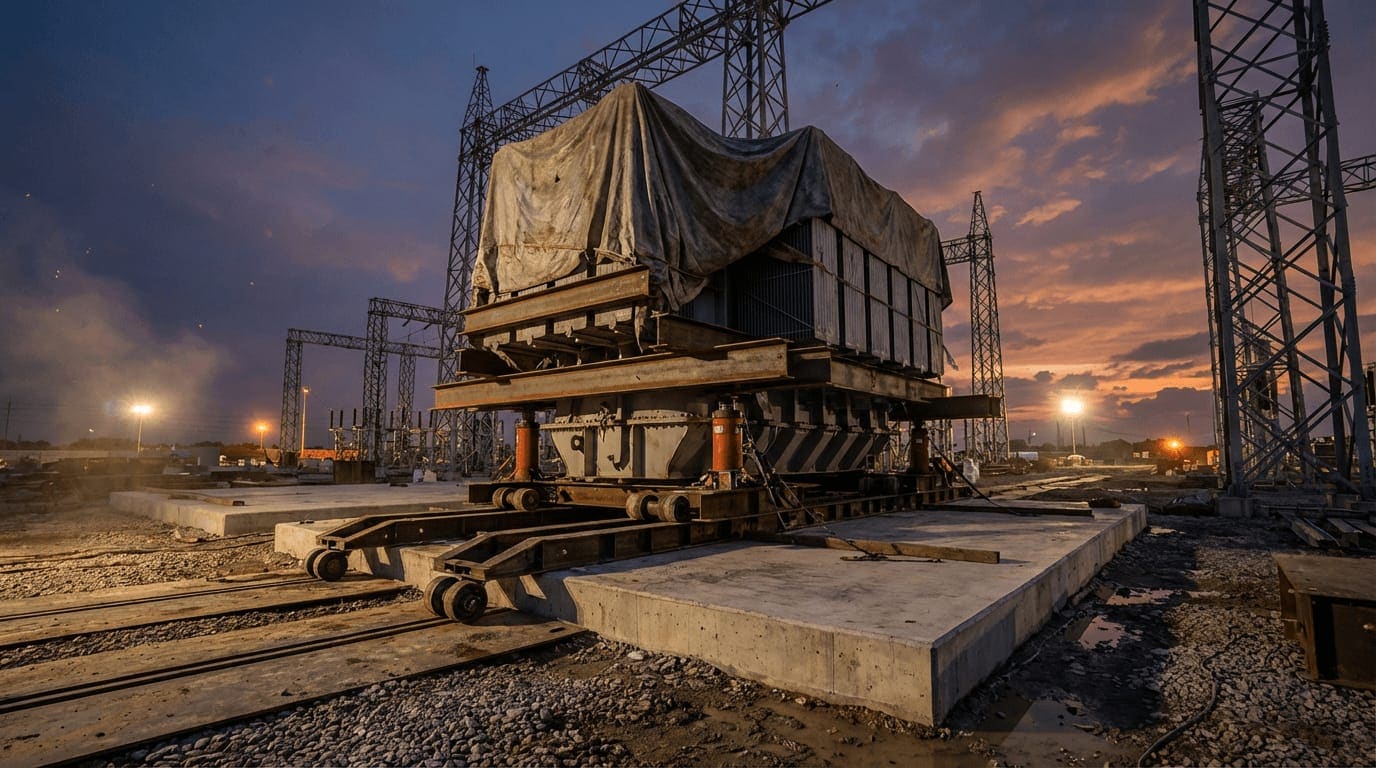
| Jacking and skidding | The piece goes inside a building or under a roof where no crane reaches. | The floor cannot take the point loads of the skid track. |
| Self-propelled modular transporter | Very heavy pieces moved across the site to the foundation. | The route on site is soft or too steep. |
Rules that apply
- Cranes and derricks in construction (29 CFR 1926 Subpart CC)OSHA
The crane may only be set up where the ground is firm, drained and graded enough, with mats or cribbing if needed, to meet the manufacturer’s support and level requirements. The operator must be trained, certified and evaluated. Anyone hooking or guiding a load inside the fall zone works with a load rigged by a qualified rigger, and a signal person is required when the operator cannot see the load. Near power lines up to 350 kV, one permitted method keeps the crane, load line and load at least 20 ft away.[1]
Applies to: Crane lifts at U.S. job sites, yards and plants
- Cargo securement on trucks (49 CFR 393.106 and 393.130)FMCSA
The tiedowns on a load must together have a working load limit of at least half its weight. A machine on wheels or tracks weighing 10,000 lb or more needs at least four tiedowns, fixed as close as practicable to its front and rear or to its designed tie points; buckets and shovels are lowered and secured, and articulated machines are locked so they cannot articulate.[4][2]
Applies to: Machines on wheels or tracks moved by truck, and every other load on a public road
- Federal truck size and weight limits (23 CFR 658)FHWA
On the Interstate system a truck may gross 80,000 lb, with 20,000 lb on a single axle and 34,000 lb on a tandem; on the National Network the load may be 102 in wide. There is no federal height limit: states set 13.6 to 14.6 ft. A load over any of these needs an oversize or overweight permit from every state on the route.[3]
Applies to: Every road move to and from the port
Questions about site delivery
Who prepares the ground for the crane?
The site owner or the controlling contractor, so it is firm, drained and graded enough for the crane and its mats. We check it before the lift date.
Can a crane work near power lines?
Only within OSHA’s rules. One permitted method for lines up to 350 kV keeps the crane, load line and load at least 20 ft away.
Do you install the machine?
We set it on the foundation and level it. Mechanical and electrical connection is done by the manufacturer’s or the buyer’s installer.
Sources
Every figure on this page comes from the documents below, each checked on the date shown. Carriers and authorities revise them, so we confirm the current figure when we book.
- [1]eCFR, 29 CFR 1926 Subpart CC Cranes and Derricks in Construction, checked October 18, 2026
- [2]eCFR, 49 CFR 393.130 Securement of heavy vehicles, equipment and machinery, checked October 18, 2026
- [3]FHWA, Commercial Vehicle Size and Weight Program (23 CFR 658), checked October 18, 2026
- [4]eCFR, 49 CFR 393.106 General requirements for securing articles of cargo, checked October 18, 2026
Send us the machine and the destination
Give us the model or the measured dimensions and weight. We come back with the method, the sailing and a price, and the figures behind them.