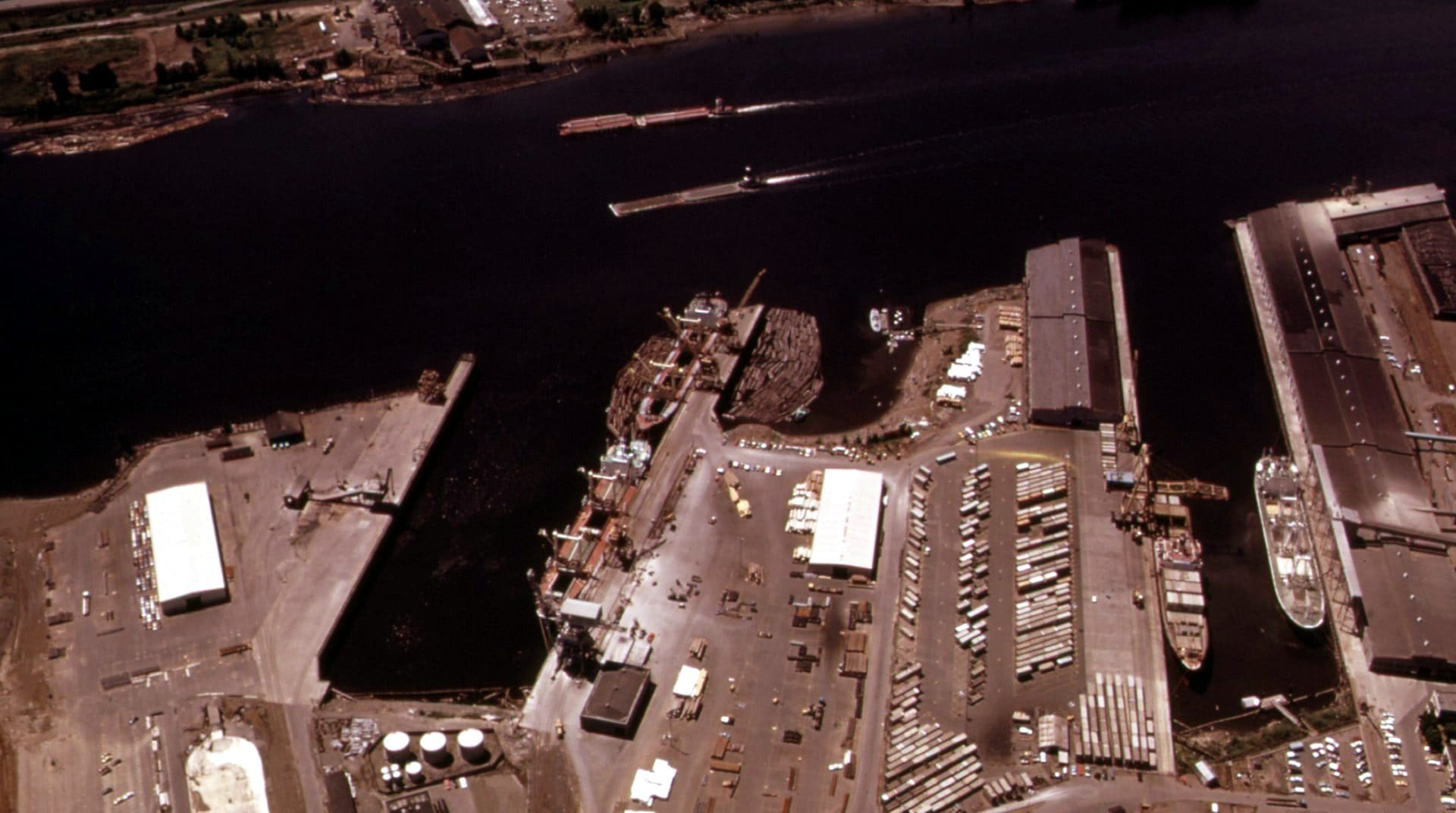
Official website: Port of Portland. Terminal names and figures on this page come from its own publications, listed under Sources.
Container, flat rack, RoRo and breakbulk here
| Method | At this port | Where |
|---|---|---|
| Container | Yes | Oregon Container Terminal at Terminal 6, run by Harbor Industrial Services since January 2026, with seven ship-to-shore cranes and weekly container service; it is Oregon’s only active international container terminal[1][4][6]. |
| Flat rack | Yes | Flat racks are containers, so they load at Oregon Container Terminal when the carrier calling Portland offers them; the terminal also handles breakbulk and project cargo with its ship-to-shore cranes[4]. |
| RoRo | Yes | Terminal 4, where Toyota imports vehicles, and Terminal 6, where Auto Warehousing Company handles Ford, Hyundai and other makes; the Port lists RoRo and high-and-heavy cargo at both[1][2][3]. |
| Breakbulk | Yes | Terminals 4 and 6 handle breakbulk and project cargo, though the Port’s public terminals moved only 412 metric tons of breakbulk in 2025; Terminal 2 no longer works as a breakbulk terminal[1][5][7]. |
Terminals and rail
Terminal 6 sits on the Columbia River at the inland end of a 105-mile, 43 ft deep-draft channel, with berths of 43 ft at 604 and 605 and an eight-track, on-dock intermodal yard[2][4]. BNSF and Union Pacific both reach the terminal directly, and Union Pacific runs regular IPI service between Terminal 6 and Chicago, Kansas City and Memphis[2][4]. Terminal 4 has four berths with 40 ft alongside[3].
Container service at Portland has come and gone: the Port’s public terminals handled 164,931 TEUs in 2014, 26 in 2019 and 86,387 in 2025[5]. SM Line brought weekly service back to Terminal 6 in January 2020[8], and in January 2026 Harbor Industrial Services took over the container operation under a long-term lease from the Port[6]. Because which carriers call Portland changes, we confirm the line, the sailing and flat rack availability when the booking is made.
Questions about shipping from Portland
Does the Port of Portland still have container service?
Yes. Oregon Container Terminal at Terminal 6 has run weekly container service since Harbor Industrial Services took over in January 2026. Fewer lines call than at Seattle or Tacoma, so we check the carrier and sailing for each booking.
Can I ship machinery RoRo from Portland?
Yes. The Port lists RoRo and high-and-heavy cargo at Terminals 4 and 6, the same terminals that handle the port’s auto imports and exports.
Does Terminal 2 still handle breakbulk?
No. The Port concluded Terminal 2 was no longer needed for breakbulk and is turning it into a mass timber and housing campus. Breakbulk and project cargo now go through Terminals 4 and 6.
Auction yards that ship through this port
Equipment auction yards for which the Port of Portland is one of the recommended export ports, by road distance from the yard (OSRM, OpenStreetMap).
- Ritchie Bros. Chehalis, WashingtonChehalis, Washington85 mi, about 1.5 h
- Ritchie Bros. Billings, MontanaBillings, Montana890 mi, about 18 h
- Smith Sales Co. Auctioneers, Miles CityMiles City, Montana1,041 mi, about 21 h
Sources
Every figure on this page comes from the documents below, each checked on the date shown. Carriers and authorities revise them, so we confirm the current figure when we book.
- [1]Port of Portland, Marine cargo, checked October 18, 2026
- [2]Port of Portland, Terminal 6, checked October 18, 2026
- [3]Port of Portland, Terminal 4, checked October 18, 2026
- [4]Oregon Container Terminal (Harbor Industrial Services), About OCT, checked October 18, 2026
- [5]Port of Portland, Marine terminal statistics, 1995–2025, checked October 18, 2026
- [6]Port of Portland, Oregon Container Terminal launches at Terminal 6, checked October 18, 2026
- [7]Port of Portland, Timeline: How we’re transforming a former marine terminal into much more, checked October 18, 2026
- [8]Port of Portland, SM Line brings weekly container service to the Port of Portland’s Terminal 6, checked October 18, 2026
Send us the machine and the destination
Give us the model or the measured dimensions and weight. We come back with the method, the sailing and a price, and the figures behind them.