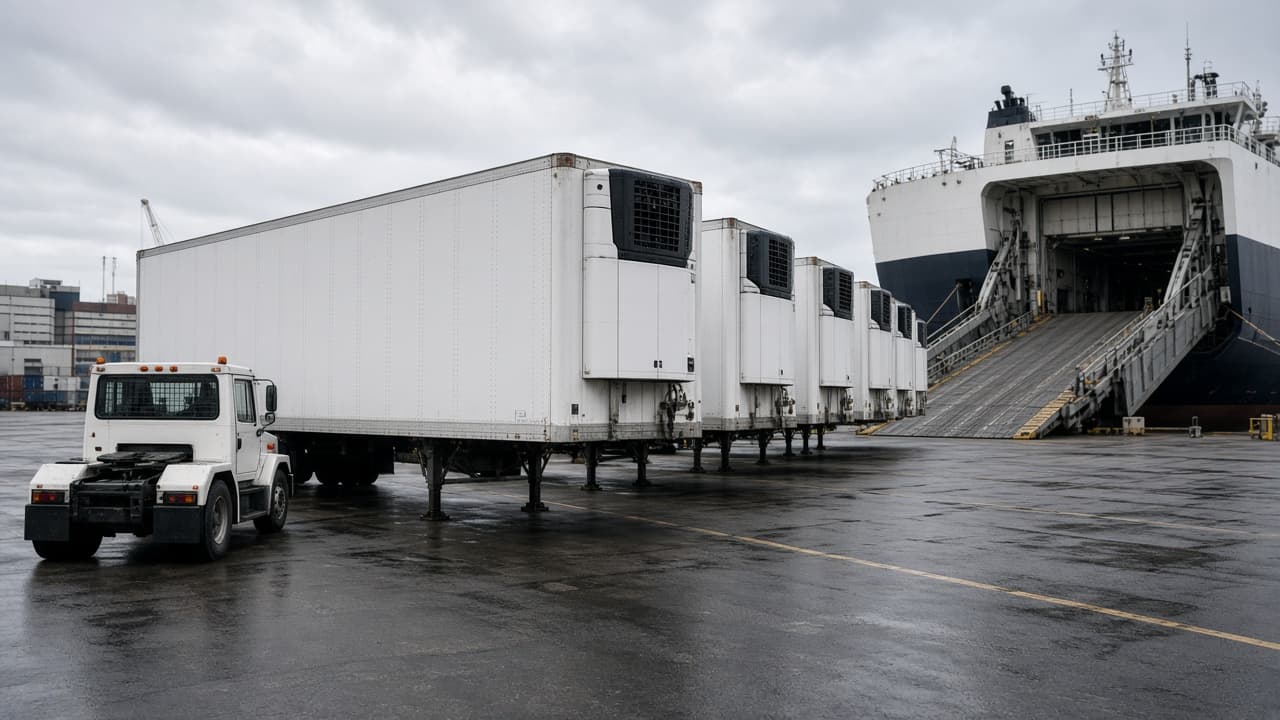

Utility Trailer Equipment Shipping
Utility specifies its 53 ft 4000D-X Composite dry van and 3000R reefer at 53 ft 0 in by 102⅜ in by 13 ft 6 in, and its 4000AE flatbeds at 48 ft 0 in by 102 in. Longer than a 40 ft flat rack and wider than a container door, they are towed aboard a RoRo ship.
How each Utility Trailer model ships
Weights and transport dimensions come from the manufacturer's published specifications (linked under each model). The method is worked out from those dimensions against container, flat rack and RoRo limits, in the order we quote them.
| Model | Weight | L × W × H (transport) | Best method | Preparation |
|---|---|---|---|---|
| Utility 4000D-X Composite53 ft dry van trailerSpec source | not publishedweighed at pickup | 53 ft × 8 ft 6 in × 13 ft 6 in (16.15 × 2.6 × 4.12 m) | RoRoWhere a RoRo lane serves the destination | Drives on assembled where a RoRo lane serves the destination. |
| Utility 3000R53 ft refrigerated trailerSpec source | not publishedweighed at pickup | 53 ft × 8 ft 6 in × 13 ft 6 in (16.15 × 2.6 × 4.12 m) | RoRoWhere a RoRo lane serves the destination | Drives on assembled where a RoRo lane serves the destination. |
| Utility 4000AE48 ft flatbed trailerSpec source | not publishedweighed at pickup | 48 ft × 8 ft 6 in × 4 ft 10 in (14.63 × 2.59 × 1.48 m) | RoRoWhere a RoRo lane serves the destination | Drives on assembled where a RoRo lane serves the destination. |
| Utility 4000AE Drop Deck48 ft drop deck trailerSpec source | not publishedweighed at pickup | 48 ft × 8 ft 6 in × 5 ft (14.63 × 2.59 × 1.51 m) | RoRoWhere a RoRo lane serves the destination | Drives on assembled where a RoRo lane serves the destination. |
Dimensions vary with shoes, tyres, buckets and options, so we confirm them on your machine before booking. Container limits used: 40 ft high-cube door 7 ft 8 in (2.34 m) wide and 8 ft 6 in (2.58 m) high, 39 ft 6 in (12.03 m) long inside.
Container, flat rack, RoRo or breakbulk?
We quote in this order because it is usually cheapest first. Most machines that look too big for a box fit once our crew takes off the bucket, boom, cab or wheels; larger ones are taken further apart across several containers, and pieces too big or heavy for a flat rack or roll trailer go breakbulk.
01Container
- Work needed
- We partially disassemble when needed (bucket, boom, cab, wheels), or take larger machines further apart across several high-cubes and open-tops, then crate, block and lash every part.
- Destinations
- Widest: almost every port worldwide, plus inland delivery by rail.
- Typical cost
- Usually the lowest, with no out-of-gauge surcharges.
- Protection
- Sealed steel box; loose parts and attachments travel locked inside.
- Best for
- Most machines: compact ones as they are, others after partial disassembly, and large ones split across several containers.
02Flat rack
- Work needed
- Ships assembled, blocked and lashed. Surcharges apply when wider than 2.4 m or taller than about 1.95 m.
- Destinations
- Most container ports, on the same vessels as containers.
- Typical cost
- Moderate; rises with every centimetre out of gauge.
- Protection
- Open to the weather; we protect cabs, electronics and hydraulics.
- Best for
- Excavators, dozers and loaders too wide for a container door.
03RoRo
Best fit- Work needed
- Drives on assembled; non-runners go on a roll trailer.
- Destinations
- Fewer destinations: regular lanes to Europe, West Africa, the Middle East, Oceania and parts of Latin America.
- Typical cost
- Often competitive for large self-propelled machines where a lane exists.
- Protection
- Below deck, but loose items and attachments cannot ride inside the cab.
- Best for
- Running machines going to a port with regular RoRo sailings.
04Breakbulk
- Work needed
- Lifted aboard piece by piece by ship’s or shore cranes, on its own skids or cradle, then stowed and lashed in the hold or on deck.
- Destinations
- Ports with breakbulk berths and heavy-lift cranes; sailings are booked voyage by voyage.
- Typical cost
- Usually the highest for a single small machine; often the only option for the largest pieces.
- Protection
- In the hold or lashed on deck; we crate, wrap and protect exposed parts.
- Best for
- Pieces too large or heavy for a flat rack or roll trailer: transformers, process modules, mining trucks, crane sections.
Preparing Utility Trailer machines for export
- Tyres, brakes, lights and landing gear are checked so the trailer can be towed aboard, and the doors are sealed or the deck cleared.
- The VIN plate, title and any lien release go with the trailer, and a reefer's fuel tank is drawn down.
- A 53 ft Utility van or reefer is 53 ft (16.15 m) long and 8 ft 6 in (2.60 m) wide, longer than a 40 ft flat rack and wider than a container door, so it is towed aboard a RoRo ship.
- The 48 ft 4000AE flatbeds are 48 ft (14.63 m) long and stand 4 ft 10 in to 4 ft 11 in (1.48 to 1.51 m) high on the fifth wheel; RoRo takes them whole, and where no RoRo sails they ship breakbulk.
- Utility's reefer figures are for the trailer, so the survey measures the refrigeration unit on the front wall.
Containerizing a machine means taking off the parts that stop it fitting, then crating, labelling and lashing them in the same box. See how we containerize heavy equipment
Where Utility Trailer machines go from the U.S.
The destinations we see most for Utility Trailer equipment, with the import rule that most often catches buyers out.
 VenezuelaTransit 8-10 days
Trailers under heading 87.16 are largely exempt from Decreto 5.103's age rule, but no scheduled RoRo sails.
Quote to Venezuela EcuadorTransit 7-22 days
The rule for used trailers is unconfirmed and duty under 8716 runs from 0% to 20%, so ask your broker first.
Quote to Ecuador ChileTransit 16-32 days
No source covers used highway trailers or dry vans, so treat them as unconfirmed and ask before you buy.
Quote to Chile
Equipment Types We Ship
Utility Trailer Manufacturing Company, founded in 1914 and headquartered in City of Industry, California, calls itself America's oldest privately owned, family-operated trailer manufacturer and the largest producer of refrigerated trailers. It builds its trailers at five US factories and one in Mexico.
Why Ship Utility Trailer with Us
- Model pages built from Utility's own specification tables
- Trailers towed to the RoRo terminal by our drivers, with the landing gear and lights checked first
- Destination rules for used trailers checked with your broker before you buy
Utility Trailer shipping questions
Can a 53 ft Utility trailer go in a container?
No. At 53 ft (16.15 m) long and 8 ft 6 in (2.60 m) wide it is longer than a 40 ft box and wider than its door. It is towed aboard a RoRo ship, or ships breakbulk where no RoRo sails.
Does the 13 ft 6 in height include the refrigeration unit?
Utility gives the trailer's height standing on a 46½ in fifth wheel. The refrigeration unit sits on the front wall, so the survey measures it before we book.
Utility Trailer and its logo are trademarks of their respective owner, shown only to identify the equipment we ship. Seaway Project Cargo is an independent shipper and is not affiliated with or endorsed by Utility Trailer.
Ready to Ship Your Utility Trailer Equipment?
Get a competitive quote for shipping Utility Trailer machinery to any destination worldwide.