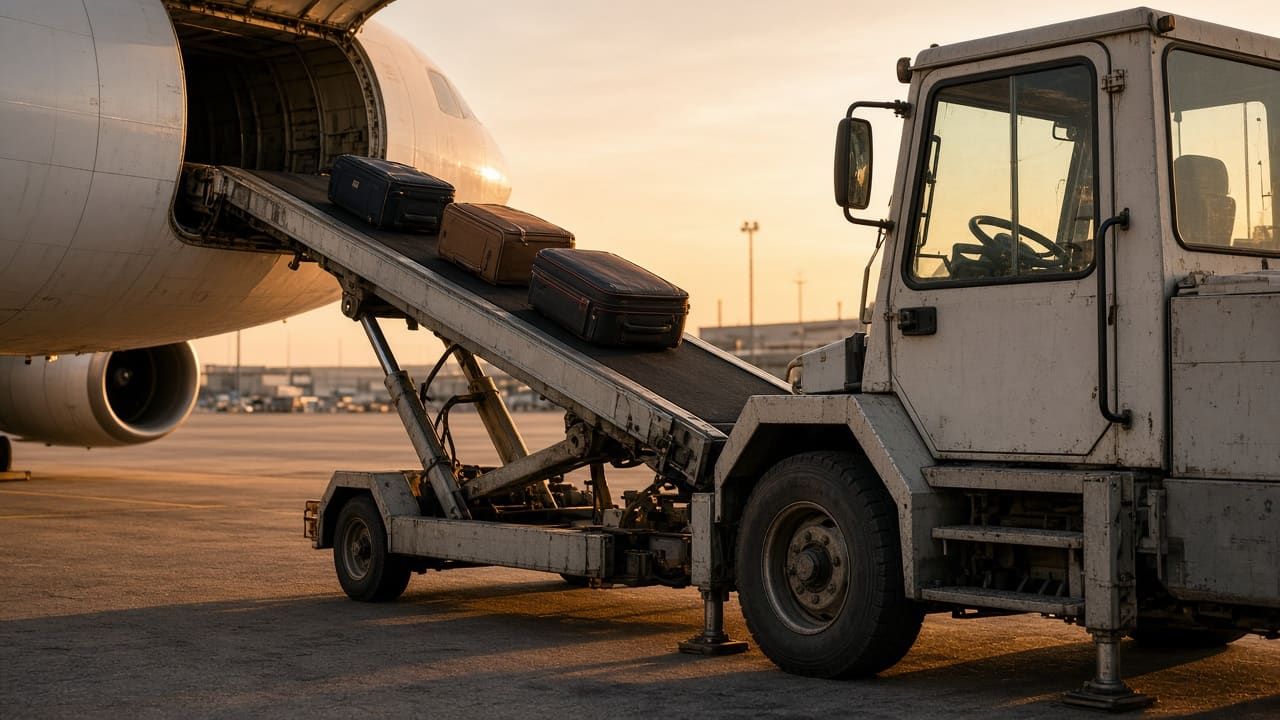
Belt Loaders Shipping
A belt loader goes in a 40 ft high cube with the conveyor lowered, where it clears the door; most go by RoRo or on a flat rack. The conveyor length decides it.
Overview
Belt loaders are truck chassis with a long inclined conveyor, built to load baggage into an aircraft hold. With the conveyor fully lowered, the overall length and the handrails decide the method: some pass the 2.34 m by 2.58 m door of a 40 ft high cube, which is 12.03 m long inside, and many do not.
Those that do not fit ship by RoRo, driving aboard at Baltimore, Brunswick, Jacksonville or Houston where a lane serves the destination, or on a 40 ft flat rack, which carries about 39,000 kg on a 12.06 m deck. Folding handrails are lowered and secured.
Fuel is kept to the level the carrier allows, batteries on electric units are declared, and the belt and chassis are cleaned. Airports often sell ground equipment in batches with tugs and carts.
We have no belt loaders in our own loading records, so this page sets out the method rather than a past plan. We plan from the manufacturer's transport dimensions and photos of your units before booking.
Send the make, model and serial number and say whether the loader is diesel, gas or electric. Several belt loaders can share one container with the conveyor lowered. Disconnect batteries before transport.
Cost depends on how many loaders share the box. A container is priced per box plus trucking to the port, so several belt loaders in one 40 ft high cube cost much less per unit than one on its own. A single loader can also fill space in a box of other airport equipment.
Typical Specifications
| Weight | 3 - 6 metric tons |
|---|---|
| Transport Width | 2.2m - 2.5m |
| Transport Height | 2.0m - 2.6m (belt lowered) |
| Belt | Adjustable conveyor, lowered for transport |
Recommended Shipping Methods
Worked example
Tug 660 diesel belt loader (narrowbody): 26 ft / 7.92 m long, 7 ft 6 in / 2.29 m wide, 7 ft / 2.13 m high, 8,600 lb / 3,900 kg.
The ladder below is worked out from these figures. Larger or smaller units of the same type can land on a different rung.
Cheapest first: the shipping cost ladder
We price every machine from the bottom rung up. A machine only moves up a rung when a measurement rules out the cheaper method.
Tug 660 diesel belt loader (narrowbody) fits a container in one piece, the cheapest way to ship it.
- Rung 1
Container
Lowest cost
Best fit for Tug 660 diesel belt loader (narrowbody)
When: Fits through a 7 ft 8 in / 2.34 m × 8 ft 6 in / 2.58 m door and under 59,500 lb / 27,000 kg, whole or after we take off the bucket, boom, cab or wheels.
- Rung 2
Flat rack
Mid cost
When: Too wide or tall for a container door, but within 14 ft 9 in / 4.5 m wide, 13 ft 1 in / 4 m tall and 86,000 lb / 39,000 kg on one rack.
- Rung 3
RoRo
Mid cost
When: Drives or tows aboard, under 19 ft 8 in / 6 m tall and 110 US tons / 100,000 kg, going to a port with regular RoRo sailings.
- Rung 4
Breakbulk
Highest cost
When: Past flat-rack and roll-trailer limits, or shipped as modules lifted aboard piece by piece.
Container Shipping
RecommendedBelt loaders often fit standard/flat-rack containers.
RoRo (Roll-on/Roll-off)
RecommendedSimple drive-on shipping for these compact units.
Heavy Haul Trucking
RecommendedInland transport to the port.
Container, flat rack, RoRo or breakbulk?
01Container
- Work needed
- We partially disassemble when needed (bucket, boom, cab, wheels), or take larger machines further apart across several high-cubes and open-tops, then crate, block and lash every part.
- Destinations
- Widest: almost every port worldwide, plus inland delivery by rail.
- Typical cost
- Usually the lowest, with no out-of-gauge surcharges.
- Protection
- Sealed steel box; loose parts and attachments travel locked inside.
- Best for
- Most machines: compact ones as they are, others after partial disassembly, and large ones split across several containers.
02Flat rack
- Work needed
- Ships assembled, blocked and lashed. Surcharges apply when wider than 2.4 m or taller than about 1.95 m.
- Destinations
- Most container ports, on the same vessels as containers.
- Typical cost
- Moderate; rises with every centimetre out of gauge.
- Protection
- Open to the weather; we protect cabs, electronics and hydraulics.
- Best for
- Excavators, dozers and loaders too wide for a container door.
03RoRo
- Work needed
- Drives on assembled; non-runners go on a roll trailer.
- Destinations
- Fewer destinations: regular lanes to Europe, West Africa, the Middle East, Oceania and parts of Latin America.
- Typical cost
- Often competitive for large self-propelled machines where a lane exists.
- Protection
- Below deck, but loose items and attachments cannot ride inside the cab.
- Best for
- Running machines going to a port with regular RoRo sailings.
04Breakbulk
- Work needed
- Lifted aboard piece by piece by ship’s or shore cranes, on its own skids or cradle, then stowed and lashed in the hold or on deck.
- Destinations
- Ports with breakbulk berths and heavy-lift cranes; sailings are booked voyage by voyage.
- Typical cost
- Usually the highest for a single small machine; often the only option for the largest pieces.
- Protection
- In the hold or lashed on deck; we crate, wrap and protect exposed parts.
- Best for
- Pieces too large or heavy for a flat rack or roll trailer: transformers, process modules, mining trucks, crane sections.
Handling & Preparation Requirements
- Lower and secure the conveyor belt boom
- Reduce fluids and disconnect batteries for ocean shipment
- Protect controls and lights
- Consolidate units for container efficiency
- Document hours and condition
Common Models We Ship
- TLD JBT belt loaders
- Tug 660 / 880 belt loaders
- Charlatte CBL series
- Power Stow roller track (ancillary)
Where belt loaders shipments go wrong
Mistakes we see on belt loaders bookings, and what avoids them.
- Electric belt loaders with lithium packs ship as Class 9 dangerous goods, so the UN38.3 test summary and battery details must be ready before the carrier will confirm the booking.
- Leaving the fold-down handrails at the top of the belt upright adds several hundred millimetres, which can stop a loader that otherwise fits from passing a 2.58 m container door.
- A belt frame parked only on its hydraulic cylinders can creep down during the voyage and load the lashings, so we block the frame mechanically before closing the container.
Frequently Asked Questions
Do belt loaders fit in a container?
Yes, most belt loaders fit standard or flat-rack containers and consolidate well; RoRo is also common.
Is the belt removed?
No, the conveyor boom is lowered and secured for transport.
Can you ship a fleet of belt loaders?
Yes, we consolidate belt loaders with other GSE for a single airport delivery.
Sources
Every figure on this page comes from the documents below, each checked on the date shown. Carriers and authorities revise them, so we confirm the current figure when we book.
- [1]Seaway Project Cargo: about the company, checked October 22, 2026
- [2]Seaway Project Cargo country shipping guides, checked October 22, 2026
Plan your shipment
Import Duty & Tax Estimator
Estimate duty and VAT on the CIF value for 70+ destinations.
Dimensional Weight Calculator
Work out chargeable weight before you book.
Container Space Calculator
See how your cargo fits in 20ft, 40ft, and HC containers.
Route Finder
Load port, sailings, duty and rules for a machine and destination.
Ready to Ship Your Belt Loaders?
Send the make, model and pickup location. We quote belt loaders by container, flat rack or RoRo from the U.S. port that suits the machine.