Wind Turbine Components Shipping
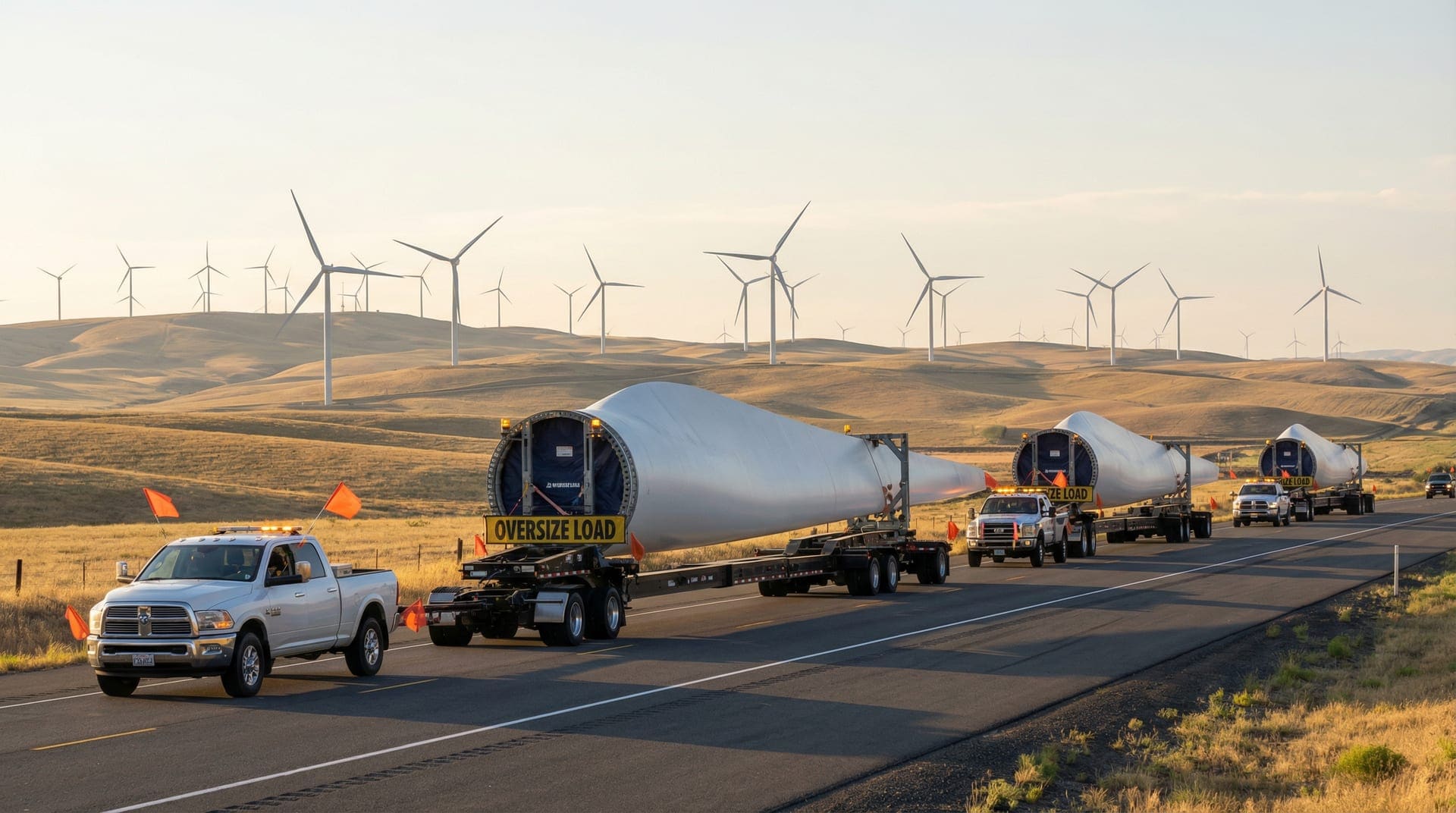
Wind turbine blades, tower sections and nacelles ship as breakbulk on vessels fitted for project cargo. Hubs and smaller parts go on flat racks, and electrical parts in containers.
Overview
A wind turbine ships as separate components: blades, tower sections, the nacelle, the hub, the drivetrain where it ships separately, and the electrical and control parts. Blades are long and light, tower sections are wide and heavy, and the nacelle is the heaviest single piece. Each is planned from the manufacturer's transport drawings, which give the size, weight and lifting points.
Blades and tower sections go as breakbulk on vessels with deck space and cranes for project cargo, on purpose-built frames that the turbine maker supplies. Nacelles and hubs go as breakbulk or on flat racks by weight: a 40 ft flat rack carries about 39,000 kg on a 12.06 m deck. Converters, cables, bolts and spare parts go in 40 ft high cubes.
Used turbines and components for repowering projects are a growing share of these moves. We have no wind components in our own loading records, so this page sets out the method rather than a past plan.
Breakbulk sailings leave from Houston and other Gulf ports. Inland transport for blades needs route surveys and escorts, which we plan with the site before booking.
Send the component list: blades, tower sections, nacelle and hub, with dimensions and weights from the manufacturer's data. Each component class needs its own transport frames and route survey. Used components are often bought without frames, so the seller's answer on frames changes the plan.
Cost depends on the component's length and weight. Blades and tower sections ship as breakbulk, priced by weight or volume, whichever is greater, and the length of a blade decides which ships can take it. Hubs and parts go in containers or on flat racks.
Typical Specifications
| Blade Length | 50m - 110m+ |
|---|---|
| Nacelle Weight | 100 - 600 tons |
| Tower Sections | 3-6 per tower |
| Turbine Capacity | 2 - 15+ MW |
Recommended Shipping Methods
Worked example
Vestas V150 blade (73.7 m): 241 ft 10 in / 73.7 m long, 13 ft 9 in / 4.2 m wide, 13 ft 1 in / 4 m high, 48,500 lb / 22,000 kg.
The ladder below is worked out from these figures. Larger or smaller units of the same type can land on a different rung.
Cheapest first: the shipping cost ladder
We price every machine from the bottom rung up. A machine only moves up a rung when a measurement rules out the cheaper method.
Vestas V150 blade (73.7 m) is 241 ft 10 in / 73.7 m long, more than a 39 ft 7 in / 12.06 m flat rack deck, so it ships breakbulk.
- Rung 1
Container
Lowest cost
When: Fits through a 7 ft 8 in / 2.34 m × 8 ft 6 in / 2.58 m door and under 59,500 lb / 27,000 kg, whole or after we take off the bucket, boom, cab or wheels.
- Rung 2
Flat rack
Mid cost
When: Too wide or tall for a container door, but within 14 ft 9 in / 4.5 m wide, 13 ft 1 in / 4 m tall and 86,000 lb / 39,000 kg on one rack.
- Rung 3
RoRo
Mid cost
When: Drives or tows aboard, under 19 ft 8 in / 6 m tall and 110 US tons / 100,000 kg, going to a port with regular RoRo sailings.
- Rung 4
Breakbulk
Highest cost
Best fit for Vestas V150 blade (73.7 m)
When: Past flat-rack and roll-trailer limits, or shipped as modules lifted aboard piece by piece.
Breakbulk/Heavy Lift
RecommendedFor ocean transport of all components.
Specialized Blade Trailers
RecommendedExtendable, steerable blade haulers.
Heavy Haul Trucking
RecommendedMulti-axle for nacelles and towers.
Jack-up Vessels
For offshore installation projects.
Container, flat rack, RoRo or breakbulk?
01Container
- Work needed
- We partially disassemble when needed (bucket, boom, cab, wheels), or take larger machines further apart across several high-cubes and open-tops, then crate, block and lash every part.
- Destinations
- Widest: almost every port worldwide, plus inland delivery by rail.
- Typical cost
- Usually the lowest, with no out-of-gauge surcharges.
- Protection
- Sealed steel box; loose parts and attachments travel locked inside.
- Best for
- Most machines: compact ones as they are, others after partial disassembly, and large ones split across several containers.
02Flat rack
- Work needed
- Ships assembled, blocked and lashed. Surcharges apply when wider than 2.4 m or taller than about 1.95 m.
- Destinations
- Most container ports, on the same vessels as containers.
- Typical cost
- Moderate; rises with every centimetre out of gauge.
- Protection
- Open to the weather; we protect cabs, electronics and hydraulics.
- Best for
- Excavators, dozers and loaders too wide for a container door.
03RoRo
- Work needed
- Drives on assembled; non-runners go on a roll trailer.
- Destinations
- Fewer destinations: regular lanes to Europe, West Africa, the Middle East, Oceania and parts of Latin America.
- Typical cost
- Often competitive for large self-propelled machines where a lane exists.
- Protection
- Below deck, but loose items and attachments cannot ride inside the cab.
- Best for
- Running machines going to a port with regular RoRo sailings.
04Breakbulk
- Work needed
- Lifted aboard piece by piece by ship’s or shore cranes, on its own skids or cradle, then stowed and lashed in the hold or on deck.
- Destinations
- Ports with breakbulk berths and heavy-lift cranes; sailings are booked voyage by voyage.
- Typical cost
- Usually the highest for a single small machine; often the only option for the largest pieces.
- Protection
- In the hold or lashed on deck; we crate, wrap and protect exposed parts.
- Best for
- Pieces too large or heavy for a flat rack or roll trailer: transformers, process modules, mining trucks, crane sections.
Handling & Preparation Requirements
- Blade tip protection
- Root end securing
- Tower section handling gear
- Nacelle weatherproofing
- Route survey for blade transport
- Sequenced delivery to pad
Common Models We Ship
- Vestas V150, V162, V236
- Siemens Gamesa SG 8.0-167 DD, SG 14-222 DD
- GE Haliade-X, Cypress
- Nordex N163, N175
- Goldwind GW165, GW184
Where wind turbine components shipments go wrong
Mistakes we see on wind turbine components bookings, and what avoids them.
- Blade root studs left uncapped can rust or be bent against the transport frame, and replacing a set of root studs at the wind farm delays the rotor lift.
- The OEM's root and tip transport frames must travel with every blade and be returned, because a blade on improvised supports flexes under vessel motion and cracks along the trailing edge.
- Tower section flanges must stay flat within tolerance, so each end needs a bracing frame, and an ovalised flange will not bolt up until it is pulled back into shape on site.
Frequently Asked Questions
How are 100m+ blades transported?
Specialized blade trailers with extendable, steerable rear axles. Some routes require blade tilting mechanisms.
What are the main blade transport challenges?
Road geometry (turns, bridges, grades), overhead clearances, and weather windows for safe transport.
Do you handle offshore wind logistics?
Yes, including feedering, marshalling, and coordination with offshore installation vessels.
Sources
Every figure on this page comes from the documents below, each checked on the date shown. Carriers and authorities revise them, so we confirm the current figure when we book.
- [1]Seaway Project Cargo: about the company, checked October 22, 2026
- [2]Seaway Project Cargo country shipping guides, checked October 22, 2026
Plan your shipment
Import Duty & Tax Estimator
Estimate duty and VAT on the CIF value for 70+ destinations.
Dimensional Weight Calculator
Work out chargeable weight before you book.
Container Space Calculator
See how your cargo fits in 20ft, 40ft, and HC containers.
Route Finder
Load port, sailings, duty and rules for a machine and destination.
Ready to Ship Your Wind Turbine Components?
Send the make, model and pickup location. We quote wind turbine components by container, flat rack or RoRo from the U.S. port that suits the machine.