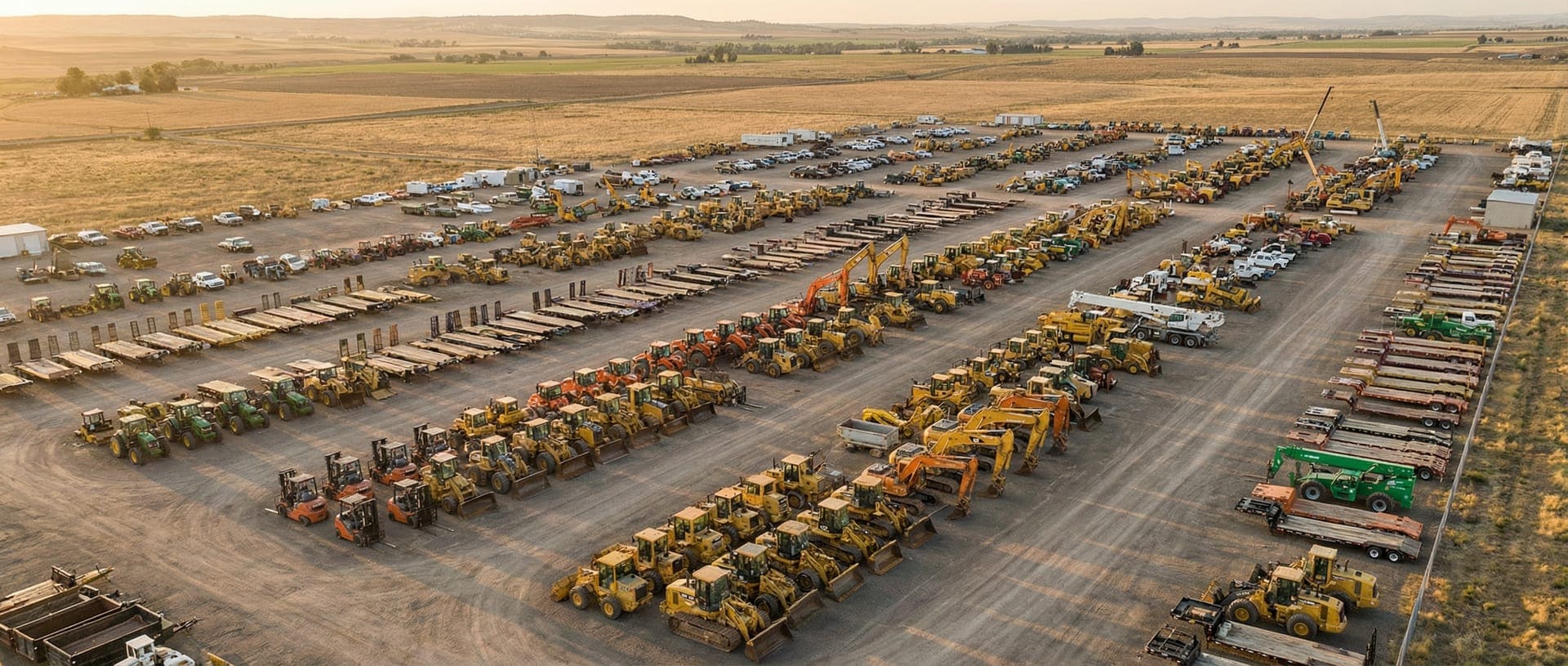
Shipping equipment bought at HiBid overseas
Also searched as HiBid.com, Hi Bid, HiBid auctions
HiBid is Sandhills Global's bidding platform for independent auctioneers. Each auctioneer sets the terms, sends the invoice and handles pickup; HiBid does not process payments.
How HiBid works for export buyers
Thousands of auction houses list sales on HiBid, from farm and estate sales to equipment consignment auctions. The auctioneer, not HiBid, is the seller's agent and controls payment and pickup.
Read the terms of each sale for the buyer's premium, payment window and removal date, and send them to us with the invoice.
HiBid buyer terms
- Seller terms
- The auctioneer sets the terms, sends the invoice and handles pickup and any refunds. Source
- Payments
- HiBid does not process payments; you pay the auctioneer. Source
Checked October 2026. Terms vary by sale, so confirm them on your invoice.
After you win at HiBid
- 1Pay the auctioneer as the invoice instructs.
- 2Send us the invoice, the auctioneer's contact and the pickup terms from the sale.
- 3We collect the machine, load it with our own carrier and take it to the port, or first to our facility if it needs partial disassembly to fit a container.
- 4We file the export declaration (EEI) in the Automated Export System. It is required when any Schedule B line is worth more than $2,500 or needs an export license, and its ITN confirmation goes to the carrier at least 24 hours before the vessel loads.
- 5For titled machines and vehicles, the original title and the EEI go to U.S. Customs at the port at least 72 hours before export. Without them the unit cannot sail.
- 6We send you the bill of lading and the documents your customs broker needs to clear the machine at destination.
How we work with HiBid
- We agree pickup directly with each auctioneer and can consolidate lots from several HiBid sales into one shipment.
HiBid locations and their best export ports
HiBid lots sit at seller and agency sites across the country, so the best port depends on where the machine is. Closest ports by pickup region: Shipping from HiBid: pickup and ports
| Pickup region | Container and flat rack | RoRo |
|---|---|---|
| Pacific Northwest (Yakima, WA) | Port of Seattle145 mi, about 3 h | Port of Tacoma155 mi, about 3 h |
| California (Fresno) | Port of Oakland177 mi, about 3.5 h | Port of Hueneme230 mi, about 4.5 h |
| Southwest (Phoenix) | Port of Los Angeles / Long Beach382 mi, about 7.5 h | Port of Los Angeles / Long Beach382 mi, about 7.5 h |
| Mountain West (Denver) | Port of Los Angeles / Long Beach1,033 mi, about 20.5 hContainers: usually railed from the Denver intermodal rail ramps, 6 mi away | Port of Los Angeles / Long Beach1,033 mi, about 20.5 h |
| Northern Plains (Sioux Falls, SD) | Port of Houston1,108 mi, about 22 hContainers: usually railed from the Kansas City intermodal rail ramps, 391 mi away | Port of Houston1,108 mi, about 22 h |
| Texas (Dallas–Fort Worth) | Port of Houston267 mi, about 5.5 hContainers: usually railed from the Dallas–Fort Worth intermodal rail ramps, 17 mi away | Port of Houston267 mi, about 5.5 h |
| Corn Belt (Des Moines, IA) | Port of Houston961 mi, about 19 hContainers: usually railed from the Kansas City intermodal rail ramps, 227 mi away | Port of Houston961 mi, about 19 h |
| Great Lakes (Indianapolis) | Port of Baltimore599 mi, about 12 hContainers: usually railed from the Chicago intermodal rail ramps, 185 mi away | Port of Baltimore599 mi, about 12 h |
| Southeast (Atlanta) | Port of Savannah249 mi, about 5 h | Port of Brunswick (Colonel's Island)278 mi, about 5.5 h |
| Florida (Orlando) | Port of Jacksonville (JAXPORT)146 mi, about 3 h | Port of Jacksonville (JAXPORT)146 mi, about 3 hOr Brunswick, the busiest U.S. RoRo gateway: 201 mi |
| Northeast (Harrisburg, PA) | Port of Baltimore85 mi, about 1.5 h | Port of Baltimore85 mi, about 1.5 h |
Road miles from OSRM (OpenStreetMap), calculated October 2026. Truck hours assume a 50 mph average for a loaded lowboy, including stops.
Container is usually the cheapest option, and we do the partial disassembly needed to make the machine fit. How we containerize heavy equipment
Container, flat rack, RoRo or breakbulk?
We quote in this order because it is usually cheapest first. Most machines that look too big for a box fit once our crew takes off the bucket, boom, cab or wheels; larger ones are taken further apart across several containers, and pieces too big or heavy for a flat rack or roll trailer go breakbulk.
01Container
Best fit- Work needed
- We partially disassemble when needed (bucket, boom, cab, wheels), or take larger machines further apart across several high-cubes and open-tops, then crate, block and lash every part.
- Destinations
- Widest: almost every port worldwide, plus inland delivery by rail.
- Typical cost
- Usually the lowest, with no out-of-gauge surcharges.
- Protection
- Sealed steel box; loose parts and attachments travel locked inside.
- Best for
- Most machines: compact ones as they are, others after partial disassembly, and large ones split across several containers.
02Flat rack
- Work needed
- Ships assembled, blocked and lashed. Surcharges apply when wider than 2.4 m or taller than about 1.95 m.
- Destinations
- Most container ports, on the same vessels as containers.
- Typical cost
- Moderate; rises with every centimetre out of gauge.
- Protection
- Open to the weather; we protect cabs, electronics and hydraulics.
- Best for
- Excavators, dozers and loaders too wide for a container door.
03RoRo
- Work needed
- Drives on assembled; non-runners go on a roll trailer.
- Destinations
- Fewer destinations: regular lanes to Europe, West Africa, the Middle East, Oceania and parts of Latin America.
- Typical cost
- Often competitive for large self-propelled machines where a lane exists.
- Protection
- Below deck, but loose items and attachments cannot ride inside the cab.
- Best for
- Running machines going to a port with regular RoRo sailings.
04Breakbulk
- Work needed
- Lifted aboard piece by piece by ship’s or shore cranes, on its own skids or cradle, then stowed and lashed in the hold or on deck.
- Destinations
- Ports with breakbulk berths and heavy-lift cranes; sailings are booked voyage by voyage.
- Typical cost
- Usually the highest for a single small machine; often the only option for the largest pieces.
- Protection
- In the hold or lashed on deck; we crate, wrap and protect exposed parts.
- Best for
- Pieces too large or heavy for a flat rack or roll trailer: transformers, process modules, mining trucks, crane sections.
Common mistakes to avoid
- Contacting HiBid about pickup. The auctioneer running the sale handles it.
HiBid export questions
Who do I pay on HiBid?
The auctioneer running the sale. HiBid provides the bidding platform but does not process payments.