Air Compressors Shipping
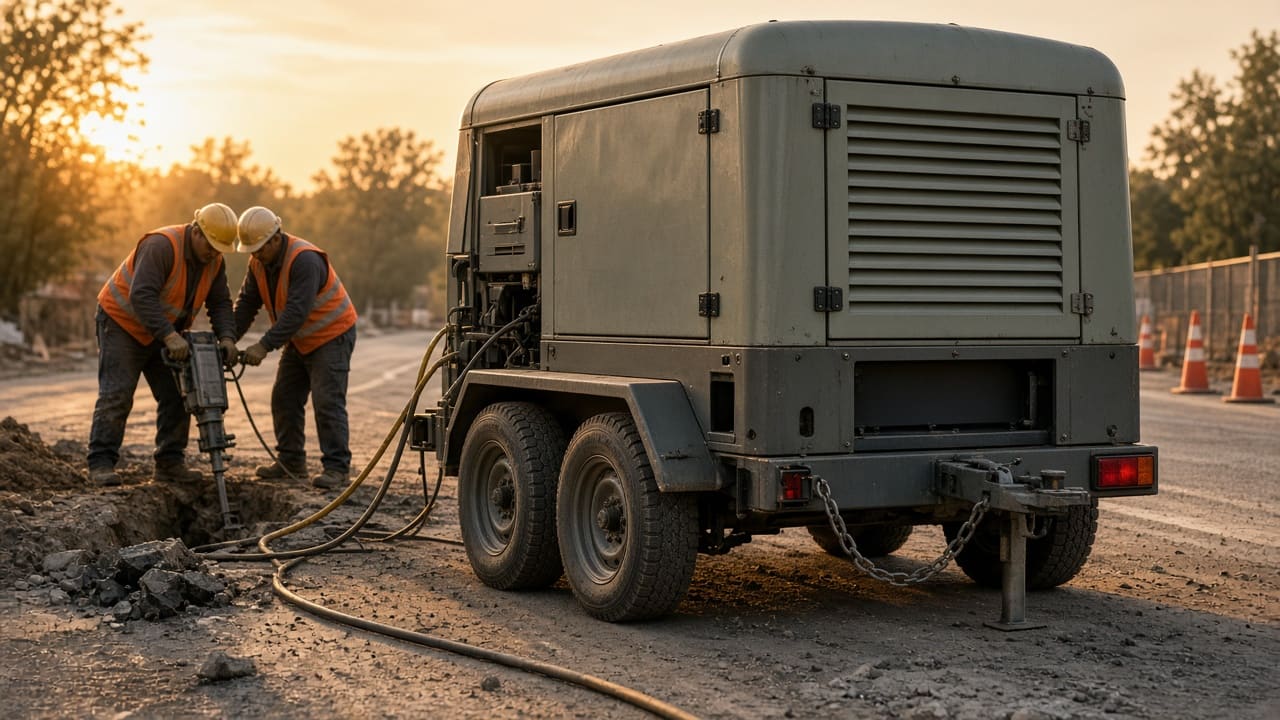
A towable compressor goes in a 40 ft high cube with the drawbar turned in, often two to a box. Large skid-mounted and containerized compressors ship in a high cube, on a flat rack or as their own container.
Overview
Portable compressors on wheels are among the easiest machines to containerize: most pass the 2.34 m by 2.58 m door of a 40 ft high cube, which is 12.03 m long inside, and two or more share a box with the drawbars turned in. They are chocked and lashed through their tie-down points.
Industrial skid-mounted compressors for plants and mines ship on their skids in high cubes where they fit, or on a 40 ft flat rack, which carries about 39,000 kg, when the package is wider or taller than the door. Compressors already built into an ISO enclosure ship as their own container if the enclosure carries a valid CSC plate.
Fuel tanks are drained to the level the carrier allows, batteries are disconnected, and the separator and coolers are drained where the maker requires it. Hoses and tools ride in the same box.
We have no compressors in our own loading records, so this page sets out the method rather than a past plan. They often ship with generators and light towers from the same fleet. Containers sail from Houston, Savannah, Miami and most US ports. We confirm the plan with photos before booking.
Send the make, model, serial number and say whether the compressor is portable on wheels or stationary on a skid. Portable compressors share boxes well. Drain fuel to the carrier's limit and disconnect batteries before shipping.
Cost depends on how many compressors share a box. Several portable compressors fit one 40 ft high cube or flat rack, priced per box, which lowers the cost per unit. Large stationary compressors on skids go on flat racks.
Typical Specifications
| Output | 185 - 1,600+ CFM (portable) |
|---|---|
| Mount | Towable trailer or skid |
| Weight | 1.5 - 20+ metric tons |
| Transport | Container, flat rack, or breakbulk |
Recommended Shipping Methods
Worked example
Sullair 375H towable diesel (375 cfm): 13 ft 4 in / 4.06 m long, 5 ft 9 in / 1.75 m wide, 5 ft 8 in / 1.73 m high, 3,970 lb / 1,800 kg.
The ladder below is worked out from these figures. Larger or smaller units of the same type can land on a different rung.
Cheapest first: the shipping cost ladder
We price every machine from the bottom rung up. A machine only moves up a rung when a measurement rules out the cheaper method.
Sullair 375H towable diesel (375 cfm) fits a container in one piece, the cheapest way to ship it.
- Rung 1
Container
Lowest cost
Best fit for Sullair 375H towable diesel (375 cfm)
When: Fits through a 7 ft 8 in / 2.34 m × 8 ft 6 in / 2.58 m door and under 59,500 lb / 27,000 kg, whole or after we take off the bucket, boom, cab or wheels.
- Rung 2
Flat rack
Mid cost
When: Too wide or tall for a container door, but within 14 ft 9 in / 4.5 m wide, 13 ft 1 in / 4 m tall and 86,000 lb / 39,000 kg on one rack.
- Rung 3
RoRo
Mid cost
When: Drives or tows aboard, under 19 ft 8 in / 6 m tall and 110 US tons / 100,000 kg, going to a port with regular RoRo sailings.
- Rung 4
Breakbulk
Highest cost
When: Past flat-rack and roll-trailer limits, or shipped as modules lifted aboard piece by piece.
Container Shipping
RecommendedPortable and small skid compressors consolidate in containers.
Flat Rack Container
RecommendedFor larger skid-mounted packages.
Breakbulk / Heavy Lift
For the largest industrial packages.
Heavy Haul Trucking
RecommendedInland transport to the port.
Container, flat rack, RoRo or breakbulk?
01Container
- Work needed
- We partially disassemble when needed (bucket, boom, cab, wheels), or take larger machines further apart across several high-cubes and open-tops, then crate, block and lash every part.
- Destinations
- Widest: almost every port worldwide, plus inland delivery by rail.
- Typical cost
- Usually the lowest, with no out-of-gauge surcharges.
- Protection
- Sealed steel box; loose parts and attachments travel locked inside.
- Best for
- Most machines: compact ones as they are, others after partial disassembly, and large ones split across several containers.
02Flat rack
- Work needed
- Ships assembled, blocked and lashed. Surcharges apply when wider than 2.4 m or taller than about 1.95 m.
- Destinations
- Most container ports, on the same vessels as containers.
- Typical cost
- Moderate; rises with every centimetre out of gauge.
- Protection
- Open to the weather; we protect cabs, electronics and hydraulics.
- Best for
- Excavators, dozers and loaders too wide for a container door.
03RoRo
- Work needed
- Drives on assembled; non-runners go on a roll trailer.
- Destinations
- Fewer destinations: regular lanes to Europe, West Africa, the Middle East, Oceania and parts of Latin America.
- Typical cost
- Often competitive for large self-propelled machines where a lane exists.
- Protection
- Below deck, but loose items and attachments cannot ride inside the cab.
- Best for
- Running machines going to a port with regular RoRo sailings.
04Breakbulk
- Work needed
- Lifted aboard piece by piece by ship’s or shore cranes, on its own skids or cradle, then stowed and lashed in the hold or on deck.
- Destinations
- Ports with breakbulk berths and heavy-lift cranes; sailings are booked voyage by voyage.
- Typical cost
- Usually the highest for a single small machine; often the only option for the largest pieces.
- Protection
- In the hold or lashed on deck; we crate, wrap and protect exposed parts.
- Best for
- Pieces too large or heavy for a flat rack or roll trailer: transformers, process modules, mining trucks, crane sections.
Handling & Preparation Requirements
- Secure the unit on its trailer or skid
- Protect coolers, receivers, and controls
- Drain/secure fuel and disconnect batteries for ocean shipment
- Plan lashing for skid-mounted packages
- Document output, hours, and condition
Common Models We Ship
- Atlas Copco XAS / XATS portables
- Ingersoll Rand / Doosan portables
- Sullair 375 / 750 / 1600
- Kaeser / Gardner Denver packages
Where air compressors shipments go wrong
Mistakes we see on air compressors bookings, and what avoids them.
- Drilling compressors in the 900 to 1,600 cfm range are far heavier and wider than 185 cfm towables, so a container quote based on small units will not hold for them.
- Receivers and dryers in a stationary package are pressure vessels, and destinations may require ASME or PED certificates and nameplates before the system can be commissioned.
- Loading towables nose-up to fit more units in a container can let separator oil run into the airend inlet, so drain or cap the system before tilting the unit.
Frequently Asked Questions
Do portable compressors ship in containers?
Yes, towable portable compressors consolidate well in containers; large packages use flat rack or breakbulk.
How is fuel handled?
Diesel is drained/reduced and batteries disconnected per carrier dangerous-goods rules.
Can you ship a complete air system?
Yes, compressors, dryers, and receivers can be shipped together as a package.
Sources
Every figure on this page comes from the documents below, each checked on the date shown. Carriers and authorities revise them, so we confirm the current figure when we book.
- [1]Seaway Project Cargo: about the company, checked October 22, 2026
- [2]Seaway Project Cargo country shipping guides, checked October 22, 2026
Plan your shipment
Import Duty & Tax Estimator
Estimate duty and VAT on the CIF value for 70+ destinations.
Dimensional Weight Calculator
Work out chargeable weight before you book.
Container Space Calculator
See how your cargo fits in 20ft, 40ft, and HC containers.
Route Finder
Load port, sailings, duty and rules for a machine and destination.
Ready to Ship Your Air Compressors?
Send the make, model and pickup location. We quote air compressors by container, flat rack or RoRo from the U.S. port that suits the machine.