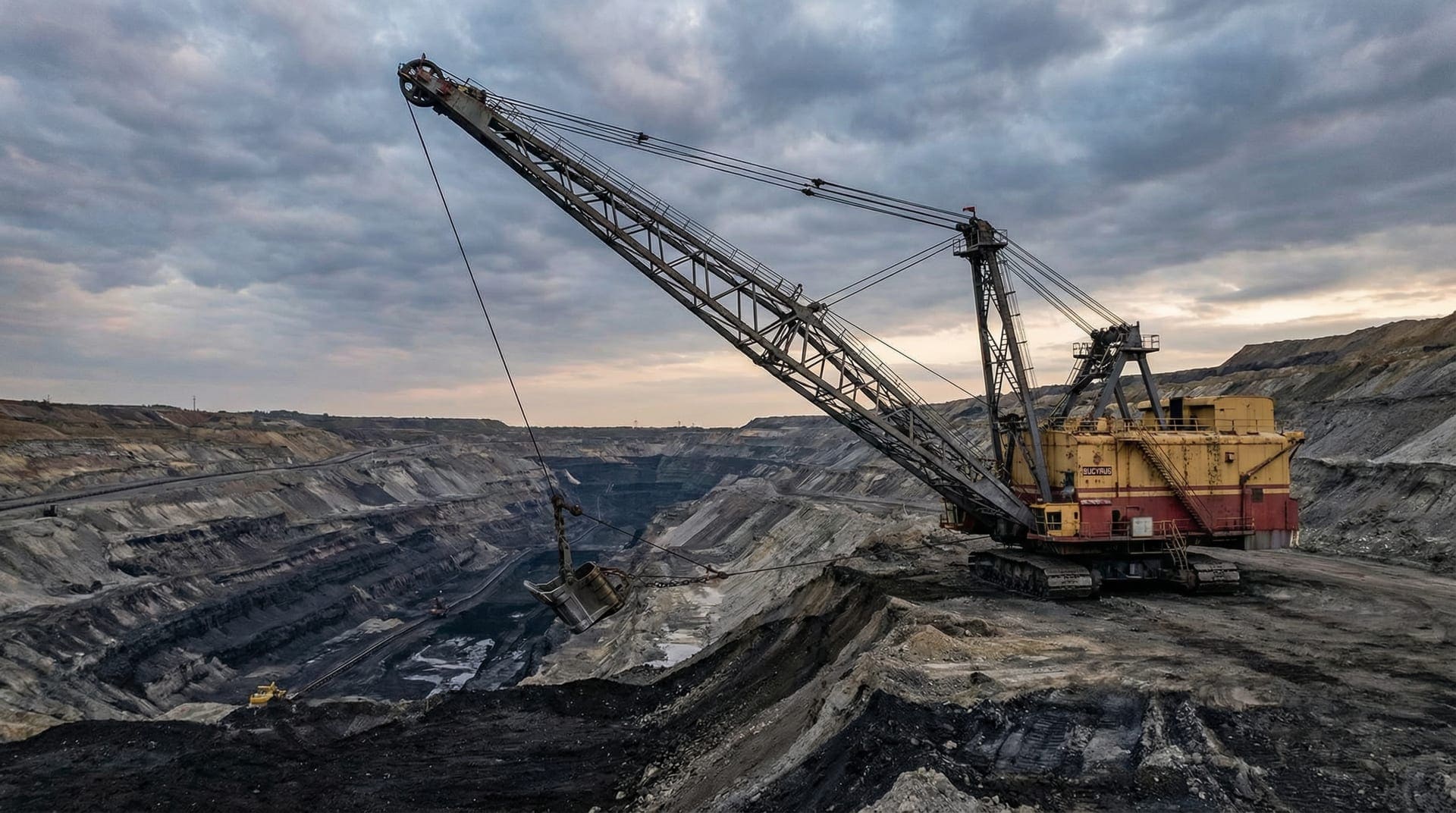
Draglines Shipping
A walking dragline is moved as hundreds of pieces and assembled at the mine. Every module is planned from the manufacturer's or the seller's piece list, with the heaviest as breakbulk and the rest in containers and on flat racks.
Overview
Draglines are the largest mobile machines on a mine, and none ships whole. Relocating one between countries means dismantling it into the boom sections, tub, revolving frame, machinery house, walking shoes, bucket, rigging and electrical systems, then shipping each piece by the method its size and weight allow.
The plan starts from the piece list. Small parts, electrical cabinets, motors and rigging go in 40 ft high cubes, whose door is 2.34 m wide and 2.58 m high. Boom chords and lattice sections go on 40 ft flat racks, which carry about 39,000 kg on a 12.06 m deck, or as breakbulk when longer. The tub and the revolving frame sections usually travel as breakbulk on a heavy-lift vessel.
We have no draglines in our own loading records, so this page sets out the method rather than a past plan. A relocation is a project with its own survey, lift plan and port handling at both ends.
Breakbulk and project sailings leave from Houston and other Gulf ports. We plan the vessel, the stowage and the inland legs with the mine's engineers and confirm every piece before booking.
Send the dragline model, boom length, bucket size and the seller's disassembly drawings if they exist. Draglines are moved as a project, and the plan depends on how far the seller will take the machine apart and who supervises it. We plan from the drawings rather than guess at part weights.
Cost depends on the number of pieces and the weight of the heaviest one. Dragline parts ship as breakbulk, priced by weight or volume, whichever is greater, with smaller parts in containers. The heaviest piece decides the crane and the ship.
Typical Specifications
| Operating Weight | 1,500 - 8,000+ metric tons |
|---|---|
| Bucket Capacity | 40 - 170 cubic meters |
| Boom Length | 80m - 130m |
| Walking Shoe Size | 15m - 25m |
Recommended Shipping Methods
Worked example
Walking dragline lattice boom section: 39 ft 4 in / 12 m long, 13 ft 1 in / 4 m wide, 12 ft 6 in / 3.8 m high, 55,100 lb / 25,000 kg.
The ladder below is worked out from these figures. Larger or smaller units of the same type can land on a different rung.
Cheapest first: the shipping cost ladder
We price every machine from the bottom rung up. A machine only moves up a rung when a measurement rules out the cheaper method.
Walking dragline lattice boom section is 13 ft 1 in / 4 m wide, over the 7 ft 8 in / 2.34 m container door, so shipping it whole starts on the next rung up.
- Rung 1
Container
Lowest cost
When: Fits through a 7 ft 8 in / 2.34 m × 8 ft 6 in / 2.58 m door and under 59,500 lb / 27,000 kg, whole or after we take off the bucket, boom, cab or wheels.
- Rung 2
Flat rack
Mid cost
Best fit for Walking dragline lattice boom section
When: Too wide or tall for a container door, but within 14 ft 9 in / 4.5 m wide, 13 ft 1 in / 4 m tall and 86,000 lb / 39,000 kg on one rack.
- Rung 3
RoRo
Mid cost
When: Drives or tows aboard, under 19 ft 8 in / 6 m tall and 110 US tons / 100,000 kg, going to a port with regular RoRo sailings.
- Rung 4
Breakbulk
Highest cost
When: Past flat-rack and roll-trailer limits, or shipped as modules lifted aboard piece by piece.
Breakbulk/Heavy Lift
RecommendedFor all major structural components.
Heavy Haul Trucking
RecommendedMulti-configuration for walking assemblies.
Barge
RecommendedOften used for waterway access to mining sites.
Walk
Short relocations may walk the machine.
Container, flat rack, RoRo or breakbulk?
01Container
- Work needed
- We partially disassemble when needed (bucket, boom, cab, wheels), or take larger machines further apart across several high-cubes and open-tops, then crate, block and lash every part.
- Destinations
- Widest: almost every port worldwide, plus inland delivery by rail.
- Typical cost
- Usually the lowest, with no out-of-gauge surcharges.
- Protection
- Sealed steel box; loose parts and attachments travel locked inside.
- Best for
- Most machines: compact ones as they are, others after partial disassembly, and large ones split across several containers.
02Flat rack
- Work needed
- Ships assembled, blocked and lashed. Surcharges apply when wider than 2.4 m or taller than about 1.95 m.
- Destinations
- Most container ports, on the same vessels as containers.
- Typical cost
- Moderate; rises with every centimetre out of gauge.
- Protection
- Open to the weather; we protect cabs, electronics and hydraulics.
- Best for
- Excavators, dozers and loaders too wide for a container door.
03RoRo
- Work needed
- Drives on assembled; non-runners go on a roll trailer.
- Destinations
- Fewer destinations: regular lanes to Europe, West Africa, the Middle East, Oceania and parts of Latin America.
- Typical cost
- Often competitive for large self-propelled machines where a lane exists.
- Protection
- Below deck, but loose items and attachments cannot ride inside the cab.
- Best for
- Running machines going to a port with regular RoRo sailings.
04Breakbulk
- Work needed
- Lifted aboard piece by piece by ship’s or shore cranes, on its own skids or cradle, then stowed and lashed in the hold or on deck.
- Destinations
- Ports with breakbulk berths and heavy-lift cranes; sailings are booked voyage by voyage.
- Typical cost
- Usually the highest for a single small machine; often the only option for the largest pieces.
- Protection
- In the hold or lashed on deck; we crate, wrap and protect exposed parts.
- Best for
- Pieces too large or heavy for a flat rack or roll trailer: transformers, process modules, mining trucks, crane sections.
Handling & Preparation Requirements
- Complete structural disassembly
- Boom section cutting and transport
- Tub and house separation
- Walking mechanism breakdown
- Electrical/mechanical systems
- Multi-year project planning
Auction yards that sell draglines
Yards whose published equipment categories include draglines. Each yard page lists its nearest export ports and how we collect from it.
- RB BillingsRitchie Bros. AuctioneersBillings, Montana
- Freije & Freije ClaytonJeff Martin AuctioneersClayton (Indianapolis), Indiana
- RB DenverRitchie Bros. AuctioneersDenver (Mead), Colorado
- RB Fort WorthRitchie Bros. AuctioneersFort Worth (Lake Worth), Texas
- RB Las VegasRitchie Bros. AuctioneersLas Vegas, Nevada
- RB PhoenixRitchie Bros. AuctioneersPhoenix, Arizona
Common Models We Ship
- Caterpillar 8750
- P&H 9020
- Marion 8750
- Bucyrus 2570WS, 8750
- BE 1370WS
Manufacturers We Ship
Brands that build draglines, the ones in our loading records first, with model dimensions and the shipping method each one fits.


Where draglines shipments go wrong
Mistakes we see on draglines bookings, and what avoids them.
- Boom sections cut for transport need a documented rejoining weld procedure and protected cut faces, otherwise the rejoint fails inspection and the boom cannot be re-erected.
- Walking shoe and tub ring components exceed most road permit envelopes, so the route from port to pit needs bridge and culvert surveys before anything leaves the origin site.
- Castings on older Marion and Bucyrus machines often have no surviving drawings, so a piece damaged in transit may have to be reverse-engineered and can halt reassembly for months.
Frequently Asked Questions
Are draglines ever shipped complete?
No, draglines are always assembled on-site. Relocation requires complete disassembly.
How long does a dragline relocation take?
Full relocation typically takes 12-24 months from planning through reassembly and commissioning.
Can draglines walk to new locations?
Yes, for short distances (a few kilometers), draglines can walk at about 200 meters per hour.
Sources
Every figure on this page comes from the documents below, each checked on the date shown. Carriers and authorities revise them, so we confirm the current figure when we book.
- [1]Seaway Project Cargo: about the company, checked October 22, 2026
- [2]Seaway Project Cargo country shipping guides, checked October 22, 2026
Plan your shipment
Import Duty & Tax Estimator
Estimate duty and VAT on the CIF value for 70+ destinations.
Dimensional Weight Calculator
Work out chargeable weight before you book.
Container Space Calculator
See how your cargo fits in 20ft, 40ft, and HC containers.
Route Finder
Load port, sailings, duty and rules for a machine and destination.
Ready to Ship Your Draglines?
Send the make, model and pickup location. We quote draglines by container, flat rack or RoRo from the U.S. port that suits the machine.