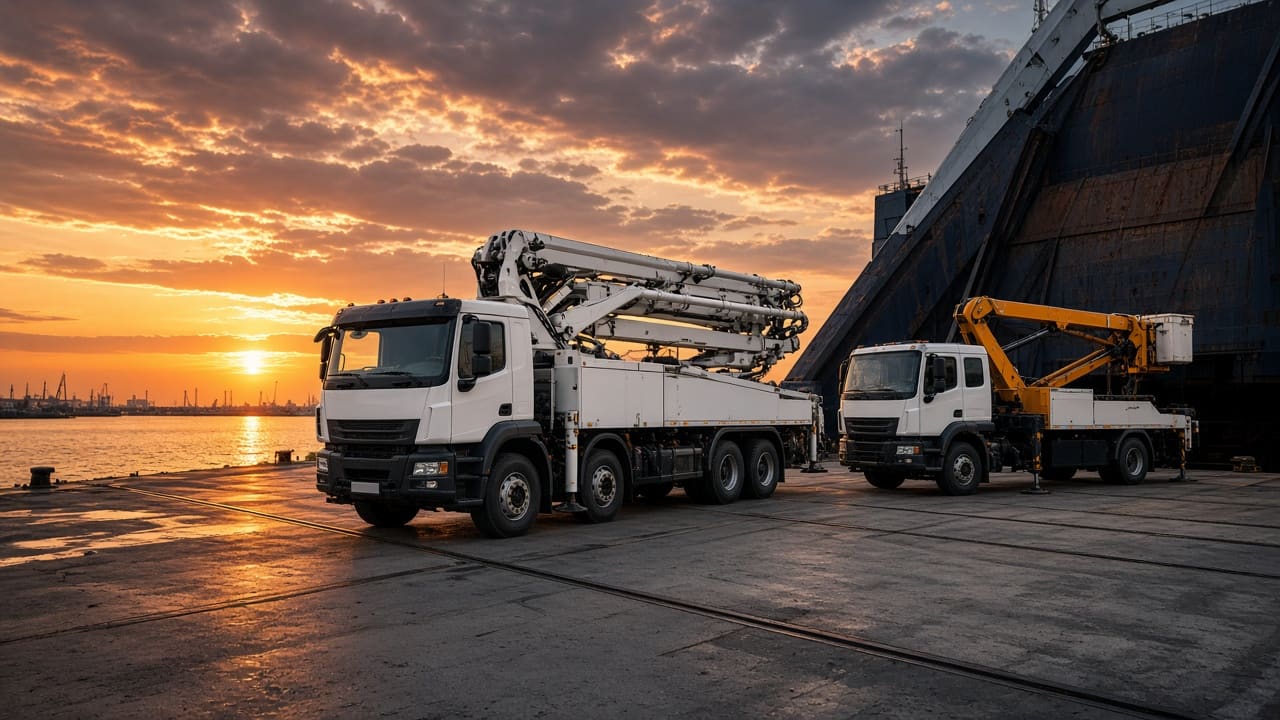
Specialty Trucks Shipping
Concrete Pump, Bucket & Specialty Truck Shipping
On This Page
Ship Your Specialty Trucks
Get expert advice on the best shipping solution for your equipment.
Related Equipment
Overview
Specialty trucks are built on standard chassis, so most of them drive aboard a RoRo vessel: the lowest-cost rung after a container for anything that runs. Booms, derricks and outriggers are stowed and locked in the road position, and the truck is measured that way.
Where no RoRo lane serves the destination, the truck ships on a flat rack, almost always out of gauge on width or height. Non-running trucks go on a MAFI roll trailer on RoRo, or on a flat rack.
Many countries limit the age of imported used trucks or require type approval. We check the destination rules for the chassis year before you buy, as well as the paperwork for the body and boom.
Typical Specifications
| Weight Range | 10 - 45 metric tons |
| Length | 8m - 16m |
| Height | 3.5m - 4.2m with boom stowed |
| Types | Concrete pumps, bucket trucks, refuse, drilling, vacuum |
Recommended Shipping Methods
Worked example
Putzmeister 38Z-Meter concrete pump truck: 37 ft 1 in / 11.3 m long, 8 ft 2 in / 2.5 m wide, 13 ft / 3.95 m high, 57,300 lb / 26,000 kg.
The ladder below is worked out from these figures. Larger or smaller units of the same type can land on a different rung.
Cheapest first: the shipping cost ladder
We price every machine from the bottom rung up. A machine only moves up a rung when a measurement rules out the cheaper method.
Putzmeister 38Z-Meter concrete pump truck is 8 ft 2 in / 2.5 m wide, over the 7 ft 8 in / 2.34 m container door, so shipping it whole starts on the next rung up.
- Rung 1
Container
Lowest cost
When: Fits through a 7 ft 8 in / 2.34 m × 8 ft 6 in / 2.58 m door and under 59,500 lb / 27,000 kg, whole or after we take off the bucket, boom, cab or wheels.
- Rung 2
Flat rack
Mid cost
Best fit for Putzmeister 38Z-Meter concrete pump truck
When: Too wide or tall for a container door, but within 14 ft 9 in / 4.5 m wide, 13 ft 1 in / 4 m tall and 86,000 lb / 39,000 kg on one rack.
- Rung 3
RoRo
Mid cost
When: Drives or tows aboard, under 19 ft 8 in / 6 m tall and 110 US tons / 100,000 kg, going to a port with regular RoRo sailings.
- Rung 4
Breakbulk
Highest cost
When: Past flat-rack and roll-trailer limits, or shipped as modules lifted aboard piece by piece.
RoRo (Roll-on/Roll-off)
RecommendedRunning trucks driven aboard with booms stowed; the usual method where a lane exists.
Flat Rack Container
RecommendedWhere no RoRo lane serves the destination; most trucks ship out of gauge.
Container
Only small body-built trucks under the container door height and width.
Breakbulk
Oversize drilling and crane trucks past roll trailer and flat rack limits.
Container, flat rack, RoRo or breakbulk?
01Container
- Work needed
- We partially disassemble when needed (bucket, boom, cab, wheels), or take larger machines further apart across several high-cubes and open-tops, then crate, block and lash every part.
- Destinations
- Widest: almost every port worldwide, plus inland delivery by rail.
- Typical cost
- Usually the lowest, with no out-of-gauge surcharges.
- Protection
- Sealed steel box; loose parts and attachments travel locked inside.
- Best for
- Most machines: compact ones as they are, others after partial disassembly, and large ones split across several containers.
02Flat rack
- Work needed
- Ships assembled, blocked and lashed. Surcharges apply when wider than 2.4 m or taller than about 1.95 m.
- Destinations
- Most container ports, on the same vessels as containers.
- Typical cost
- Moderate; rises with every centimetre out of gauge.
- Protection
- Open to the weather; we protect cabs, electronics and hydraulics.
- Best for
- Excavators, dozers and loaders too wide for a container door.
03RoRo
- Work needed
- Drives on assembled; non-runners go on a roll trailer.
- Destinations
- Fewer destinations: regular lanes to Europe, West Africa, the Middle East, Oceania and parts of Latin America.
- Typical cost
- Often competitive for large self-propelled machines where a lane exists.
- Protection
- Below deck, but loose items and attachments cannot ride inside the cab.
- Best for
- Running machines going to a port with regular RoRo sailings.
04Breakbulk
- Work needed
- Lifted aboard piece by piece by ship’s or shore cranes, on its own skids or cradle, then stowed and lashed in the hold or on deck.
- Destinations
- Ports with breakbulk berths and heavy-lift cranes; sailings are booked voyage by voyage.
- Typical cost
- Usually the highest for a single small machine; often the only option for the largest pieces.
- Protection
- In the hold or lashed on deck; we crate, wrap and protect exposed parts.
- Best for
- Pieces too large or heavy for a flat rack or roll trailer: transformers, process modules, mining trucks, crane sections.
Handling & Preparation Requirements
- Boom, derrick and outriggers stowed and pinned
- Fuel at carrier limits; batteries per RoRo rules
- Concrete hopper and pipeline washed out
- Loose tools and attachments locked in body compartments
- Measured height with boom in road position
- Destination age and type-approval rules checked
Common Models We Ship
Where specialty trucks shipments go wrong
Mistakes we see on specialty trucks bookings, and what avoids them.
- A concrete pump boom folded but not seated on its boom rest bounces on the slewing ring at sea, so both the boom rest contact and the slew lock are checked before lashing.
- Insulated aerial devices on utility trucks lose their dielectric certification once moved, so the boom must be retested to ANSI A92.2 or the local standard before it works near live lines.
- Refuse trucks shipped with leachate in the body or packer sump drip and smell on the vessel deck, and terminals turn them away until they have been steam cleaned.
Frequently Asked Questions
How is a concrete pump truck shipped?
Usually by RoRo, driven aboard with the boom folded and locked and the hopper washed out. Without a RoRo lane it ships on a flat rack.
Can a used bucket truck be imported anywhere?
Not always. Some countries limit the age of imported used trucks or require type approval; we check before you commit to a truck.
What if the truck does not run?
It rides a MAFI roll trailer on a RoRo vessel, or ships on a flat rack, loaded by crane.
Plan your shipment
Import Duty & Tax Estimator
Estimate duty and VAT on the CIF value for 70+ destinations.
Dimensional Weight Calculator
Work out chargeable weight before you book.
Container Space Calculator
See how your cargo fits in 20ft, 40ft, and HC containers.
Route Finder
Load port, sailings, duty and rules for a machine and destination.
Ready to Ship Your Specialty Trucks?
Get a customized quote for your equipment. Our experts handle specialty trucks shipments worldwide.