Yachts Shipping
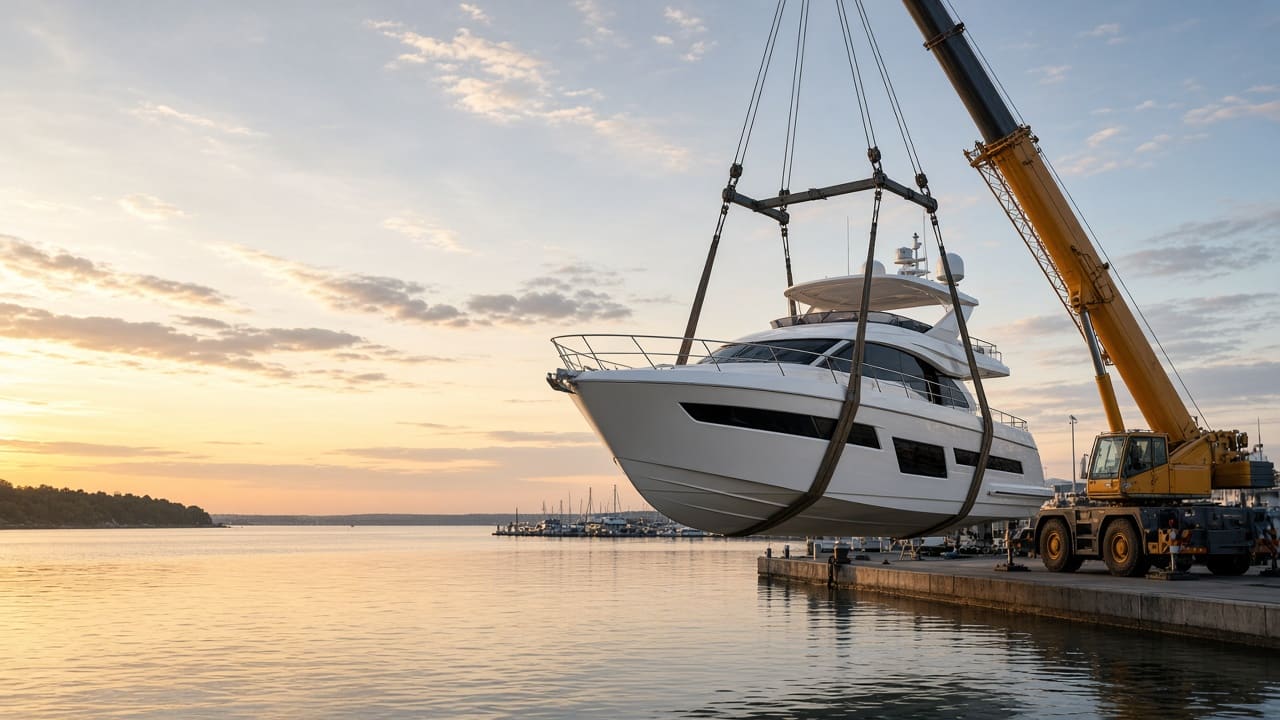
A yacht ships on deck on a cradle, lifted by crane, or by float-on/float-off on a semi-submersible ship. Small boats on trailers go by RoRo.
Overview
Yachts ship as deck cargo. Lift-on/lift-off is the most common method: the yacht is lifted by its slings at the marked points onto a cradle on the ship's deck, and lashed for the voyage. The surveyor confirms the cradle, the sling positions and the weight before loading.
Float-on/float-off ships ballast down so yachts can motor into a flooded deck, then rise with the yachts on cradles. Those sailings run on fixed routes and dates, mostly between yachting regions.
Smaller yachts and boats on road trailers can go by RoRo, towed aboard, where the combined height fits the ship's deck, or in a 40 ft flat rack or open top when their beam and height fit.
Masts are unstepped or secured, tenders and loose gear stowed, tanks drained to the carrier's level, and the hull protected. We have no yachts in our own loading records, so this page sets out the method rather than a past plan. We confirm the method from the yacht's length, beam, height and weight before booking.
Send the builder, model, length, beam, draft, air draft and weight, and say whether the yacht is on a cradle or trailer. Documented US vessels need deletion from documentation for export, and state-titled boats need the title. We check whether the destination charges import duty on the yacht's value before you buy.
Cost depends on the yacht's length, beam and weight, and on the method. Deck cargo on a cradle is priced by weight or volume, whichever is greater, and float-on/float-off sailings run on set routes and dates. A yacht near Fort Lauderdale or Miami usually has more sailings to choose from.
Typical Specifications
| Length | Up to 30m+ (method varies by size) |
|---|---|
| Cradle | Custom-built to hull form |
| Methods | LoLo, flat rack, RoRo, float-on/float-off |
| Protection | Shrink-wrap, padding, keel support |
Recommended Shipping Methods
Worked example
15 m flybridge motor yacht on steel cradle: 49 ft 10 in / 15.2 m long, 14 ft 5 in / 4.4 m wide, 17 ft 1 in / 5.2 m high, 44,100 lb / 20,000 kg.
The ladder below is worked out from these figures. Larger or smaller units of the same type can land on a different rung.
Cheapest first: the shipping cost ladder
We price every machine from the bottom rung up. A machine only moves up a rung when a measurement rules out the cheaper method.
15 m flybridge motor yacht on steel cradle is 49 ft 10 in / 15.2 m long, more than a 39 ft 7 in / 12.06 m flat rack deck, so it ships breakbulk.
- Rung 1
Container
Lowest cost
When: Fits through a 7 ft 8 in / 2.34 m × 8 ft 6 in / 2.58 m door and under 59,500 lb / 27,000 kg, whole or after we take off the bucket, boom, cab or wheels.
- Rung 2
Flat rack
Mid cost
When: Too wide or tall for a container door, but within 14 ft 9 in / 4.5 m wide, 13 ft 1 in / 4 m tall and 86,000 lb / 39,000 kg on one rack.
- Rung 3
RoRo
Mid cost
When: Drives or tows aboard, under 19 ft 8 in / 6 m tall and 110 US tons / 100,000 kg, going to a port with regular RoRo sailings.
- Rung 4
Breakbulk
Highest cost
Best fit for 15 m flybridge motor yacht on steel cradle
When: Past flat-rack and roll-trailer limits, or shipped as modules lifted aboard piece by piece.
Lift-on/Lift-off (LoLo)
RecommendedCrane-loaded onto deck or flat rack with a custom cradle.
Flat Rack Container
RecommendedFor smaller boats and yachts within flat-rack limits.
RoRo (Roll-on/Roll-off)
On a cradle/trailer for suitable vessels.
Float-on/Float-off
For the largest yachts on semi-submersible vessels.
Container, flat rack, RoRo or breakbulk?
01Container
- Work needed
- We partially disassemble when needed (bucket, boom, cab, wheels), or take larger machines further apart across several high-cubes and open-tops, then crate, block and lash every part.
- Destinations
- Widest: almost every port worldwide, plus inland delivery by rail.
- Typical cost
- Usually the lowest, with no out-of-gauge surcharges.
- Protection
- Sealed steel box; loose parts and attachments travel locked inside.
- Best for
- Most machines: compact ones as they are, others after partial disassembly, and large ones split across several containers.
02Flat rack
- Work needed
- Ships assembled, blocked and lashed. Surcharges apply when wider than 2.4 m or taller than about 1.95 m.
- Destinations
- Most container ports, on the same vessels as containers.
- Typical cost
- Moderate; rises with every centimetre out of gauge.
- Protection
- Open to the weather; we protect cabs, electronics and hydraulics.
- Best for
- Excavators, dozers and loaders too wide for a container door.
03RoRo
- Work needed
- Drives on assembled; non-runners go on a roll trailer.
- Destinations
- Fewer destinations: regular lanes to Europe, West Africa, the Middle East, Oceania and parts of Latin America.
- Typical cost
- Often competitive for large self-propelled machines where a lane exists.
- Protection
- Below deck, but loose items and attachments cannot ride inside the cab.
- Best for
- Running machines going to a port with regular RoRo sailings.
04Breakbulk
- Work needed
- Lifted aboard piece by piece by ship’s or shore cranes, on its own skids or cradle, then stowed and lashed in the hold or on deck.
- Destinations
- Ports with breakbulk berths and heavy-lift cranes; sailings are booked voyage by voyage.
- Typical cost
- Usually the highest for a single small machine; often the only option for the largest pieces.
- Protection
- In the hold or lashed on deck; we crate, wrap and protect exposed parts.
- Best for
- Pieces too large or heavy for a flat rack or roll trailer: transformers, process modules, mining trucks, crane sections.
Handling & Preparation Requirements
- Build a custom cradle to the hull form
- Protect hull, keel, propellers, and superstructure
- Remove or secure masts/antennas (sailing yachts)
- Drain/secure fuel and systems per carrier rules
- Document condition with a pre-shipment survey
Common Models We Ship
- Sport fishers, motor yachts, catamarans
- Sailing yachts (mast unstepped)
- Center consoles and cabin cruisers
Where yachts shipments go wrong
Mistakes we see on yachts bookings, and what avoids them.
- Flybridge heights quoted to the hardtop miss the radar arch and antennas, so fold or remove them first or the lift-on height and freight rate change at the quay.
- Yachts going to Australia or New Zealand need a clean hull and documented antifouling, because biofouling rules allow a fouled hull to be refused or cleaned at the owner's cost.
- Slings placed by guesswork can crush stabiliser fins, bow thrusters, and transducers, so we mark sling points from the builder's lifting plan before the crane hooks on.
Frequently Asked Questions
How are yachts shipped overseas?
By lift-on/lift-off on a custom cradle, flat rack, RoRo, or float-on for the largest vessels - chosen by size and route.
Do you build cradles?
Yes, we arrange custom cradles built to the hull form to protect the vessel.
Is a survey recommended?
Yes, we recommend a pre-shipment condition survey for high-value yachts.
Sources
Every figure on this page comes from the documents below, each checked on the date shown. Carriers and authorities revise them, so we confirm the current figure when we book.
- [1]Seaway Project Cargo: about the company, checked October 22, 2026
- [2]Seaway Project Cargo country shipping guides, checked October 22, 2026
Plan your shipment
Import Duty & Tax Estimator
Estimate duty and VAT on the CIF value for 70+ destinations.
Dimensional Weight Calculator
Work out chargeable weight before you book.
Container Space Calculator
See how your cargo fits in 20ft, 40ft, and HC containers.
Route Finder
Load port, sailings, duty and rules for a machine and destination.
Ready to Ship Your Yachts?
Send the make, model and pickup location. We quote yachts by container, flat rack or RoRo from the U.S. port that suits the machine.