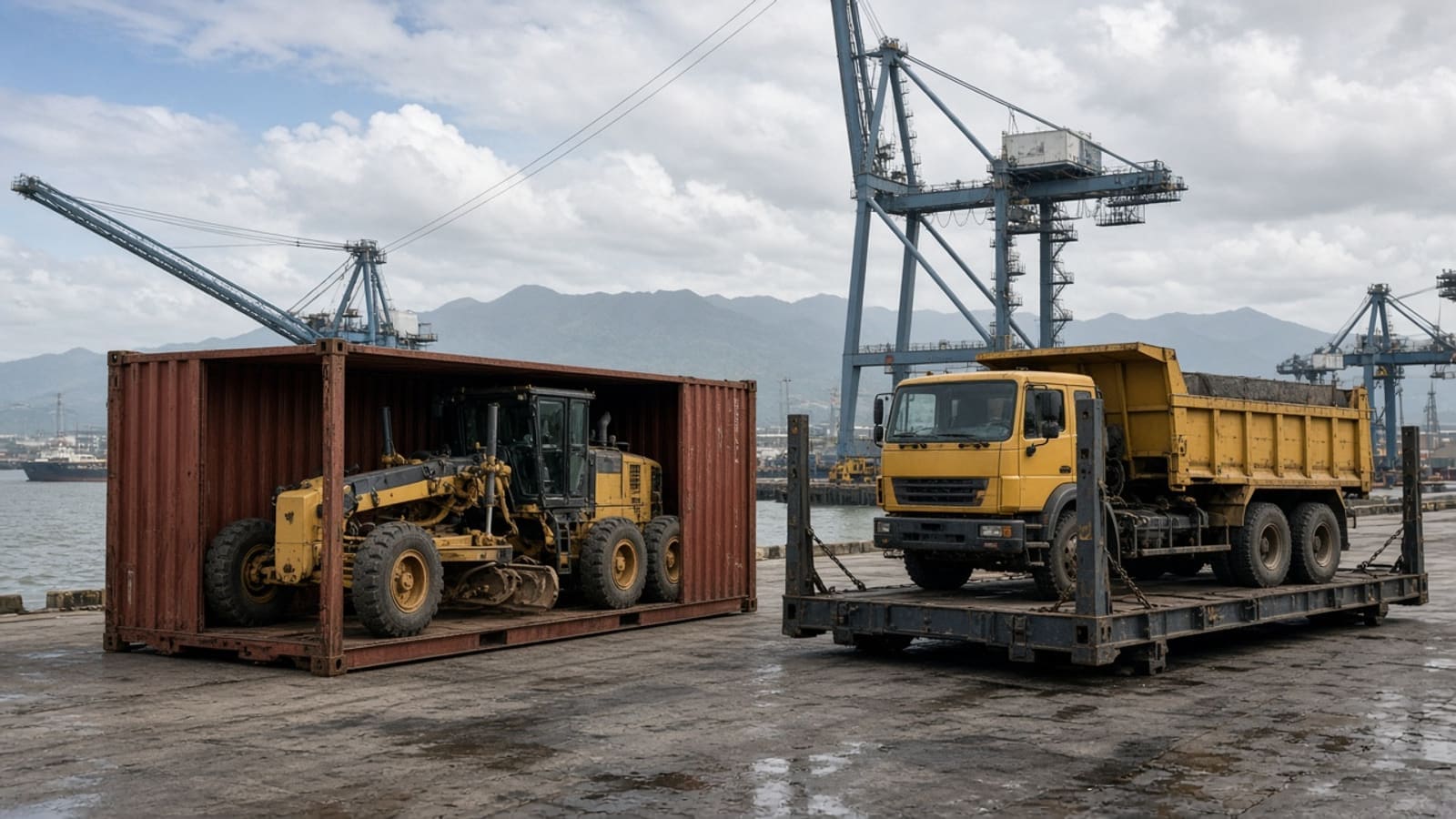
Shipping heavy equipment and trucks from the United States to Ecuador (2026)
Used machinery up to 15 years old can enter Ecuador; on-road trucks must be new. Ports, sailings, licences, taxes and the inland leg, verified October 2026.
Seaway Project Cargo Team
Project Cargo & Heavy-Lift Specialists
Yes, in most cases: used construction and agricultural machinery up to 15 years old can enter Ecuador, while on-road trucks and tractors of Chapter 87 must be new. There is no direct US roll-on/roll-off call to Ecuador, so used machines almost always travel in containers or on flat racks to Guayaquil, with the 7-day Miami sailing and the 22-day Houston sailing at opposite ends of the schedule.
Everything below was verified in October 2026 against Ecuadorian and US primary sources. Where we could not confirm something, we say so instead of guessing.
Can you import it?
The answer depends on how Ecuador classifies the unit, not on how the auction listed it. COMEX Resolution 51 splits the question in three. Article 1 allows vehicles of Chapter 87 (on-road trucks, road tractors) to enter only if new. Article 3 allows used road and agricultural machinery and equipment up to 15 years old. Article 6 treats used special vehicles that cannot circulate on public roads like machinery.
That 15-year figure matters, because many guides still repeat a "five years" rule. We found no basis for it in the resolution text. Our own earlier country summary carried it, and it was wrong.
In practice this changes how you bid. Before you buy at an auction, read the manufacture year from the serial number or the maker's plate, not from the listing headline, and subtract it from the year of arrival. A machine built in 2011 that is on the water in 2026 sits at the limit, and a delay of a few weeks can push a borderline unit over it. Keep a margin, and keep the evidence of the manufacture date in the file.
| Machine class | Used allowed? | What decides it |
|---|---|---|
| Crawler excavators, wheel loaders, dozers, graders | Yes, up to 15 years | Article 3 age limit, counted from manufacture |
| Compactors, pavers, off-road cranes | Yes, up to 15 years | Same, plus subheading check for the licence |
| Aerial work platforms, telehandlers | Yes, if classed as equipment | Classification declared by the broker |
| Road tractors (semi-trailer trucks) | No, new only | Article 1, Chapter 87 |
| Dump trucks and on-road vehicles | No, new only | Article 1, Chapter 87 |
| Special vehicles that cannot use public roads | Yes, as machinery | Article 6 |
| Trailers and semi-trailers | Check first | Classification under 8716, rules not confirmed for used units |
For the age and duty logic in more depth, see how to import a used excavator: duty, VAT and age limits.
Which licence applies
Resolution 009-2022 of COMEX, Annex I, lists subheadings that need a pre-shipment licence from the Ministry of Transport (MTOP, now MIT) when gross vehicle weight is 3.5 tonnes or more. The listed lines we confirmed include mobile cranes on tyres (8426.41), other cranes (8426.19), road tractors (8701.20) and dumpers (8704.10).
Earthmoving machines under heading 8429 are not on the Annex I list as published. The MIT's own page, however, speaks of machinery in general. So whether a particular excavator or dozer needs the licence is not something we can confirm from the text. Your customs broker confirms the exact subheading before the unit ships, because the licence is requested before shipment and cannot be fixed afterwards.
Keep the licence number, the broker's subheading and the invoice description consistent. Ecuador's customs system compares them, and a mismatch between the machine described on the licence and the machine in the box is the kind of error that holds a unit at the terminal while storage days accumulate.
The four ways to ship
Every machine reaching Ecuador fits one of four methods. The mix differs from Peru or Chile because the service pattern differs.
The practical consequence is simple. Where a Pacific-coast neighbour often offers a drive-on option, Ecuador asks for a plan made of boxes from the start. That plan decides how much of the machine is removed, which pieces share a box, and which of them must be lashed to a rack, so it is worth settling before the machine is bought rather than after it has been collected from the yard.
| Method | Works for Ecuador? | Best for |
|---|---|---|
| Roll-on/roll-off | Not direct from the US | Running wheeled units, only through a transshipment |
| Container | Yes, the main route | Machines that fit after disassembly |
| Flat rack or open top | Yes | Over-height and over-width machines |
| Breakbulk | On request | Machines too large for any box |
Container: the main route
We found no direct US roll-on/roll-off call to Ecuador. The published Seaboard Marine service guide for August 2026 shows lift-on/lift-off services only. That is why a loading plan for Ecuador is built around boxes. For the trade-offs between the methods, read RoRo, container or flat rack and our page on RoRo shipping.
Flat rack and open top
A machine that stands taller or wider than a high-cube box goes on an open top or a flat rack. Our note on containerizing oversized machinery explains where the dividing line sits and why disassembly often moves a unit from a flat rack into a standard box.
Breakbulk
Breakbulk exists for the heaviest or widest pieces, but it is a charter-style conversation, priced per voyage. Ask for it only when no box plan works.
From your US port
Seaboard Marine's August 2026 guide lists four weekly services to Guayaquil. Transit is the total published time from sailing day to arrival, not a promise.
| US port | Weekly service | Published transit | Our use |
|---|---|---|---|
| Miami | Yes | 7 days | Fastest, Florida and Southeast cargo |
| Newark / Brooklyn | Yes | 15 days | Northeast and Midwest cargo |
| Philadelphia (Gloucester) | Yes | 18 days | Mid-Atlantic cargo |
| Houston | Yes | 22 days | Texas and Gulf cargo |
Houston is slowest on paper, yet it is where many machines start. A unit in Fort Worth rarely saves money by trucking to Miami once inland haulage is counted. We look at the whole door-to-port cost, not only the ocean days.
Choosing the destination port
Three ports matter. Guayaquil is where almost all of this cargo goes.
- Guayaquil, Contecon. The main container terminal on the Guayas river. The channel is about 12.5 m deep, so large container ships often arrive part-loaded or use a feeder.
- Posorja, DP World. A deep-water port built outside the river, with a channel of about 16.5 m. Useful when a shipping line calls there.
- Manta, TPM. A multipurpose terminal on the Pacific coast, closer to Quito's northern corridor, but with fewer lines.
When you ask for a quote, name the destination terminal. Ocean carriers publish different rates and free time for each, and a machine discharged at the wrong terminal costs more to move.
Heavy lifts are the other reason to choose early. The Guayaquil multipurpose terminal's published service manual describes an operations meeting before each ship call, where cranes, crews and special considerations are agreed, so an unusual lift is best flagged early. Tell us the heaviest single piece of the plan, and we confirm the lift with the terminal before the booking is made.
What we have loaded
Our loading records show how real machines go into real boxes. Each model page has a pictorial of the actual pieces after disassembly, not a generic drawing. These are some that move often to South America:
- CAT 345 excavator: one open top and one high cube.
- Hitachi ZX450LC-3 excavator: one open top and two high cubes.
- CAT D9 dozer: one open top.
- Komatsu D41E-6 dozer: one high cube, with the cab and blade removed, driven into the box.
- Komatsu GD825A-2 motor grader: one high cube, with the drive shaft removed.
- Volvo L120H wheel loader: one high cube, flagged overweight.
- JLG 600S boom lift: one high cube.
- Genie S-60 boom lift: one high cube.
If your machine is not listed, we build the plan from the maker's published dimensions before quoting.
Trucks and trailers
The rule for Chapter 87 is the one that surprises buyers. A used on-road truck or road tractor cannot be imported. Only new units clear, and a new unit typically ships by container or flat rack from a US dealer or factory.
For trailers we could not confirm the rule for used units, so we do not state one. The classification sits under 8716, where the duty ranges from 0% to 20% depending on the type. Ask your broker to confirm both the classification and the age position before you buy a used trailer.
If your project needs a truck and you are tempted to buy used in the United States, stop before the purchase. The better path is usually a new unit from a dealer, shipped as a single piece, or a locally supplied truck in Ecuador, with the used machinery from the United States doing the earthmoving. We can combine both on one booking when the dates line up.
Special-purpose vehicles that cannot use public roads, such as certain crane carriers, fall under Article 6 and follow the machinery rules instead.
Preparation and compliance
Verified October 2026.
On the US side
- Title. For used self-propelled vehicles, CBP expects the title or equivalent documents at least 72 hours before export, under 19 CFR 192. A machine without a title is the single most common cause of delay.
- Export filing. An EEI filing in the Automated Export System is required above US$2,500 per Schedule B number (15 CFR 30). The forwarder files it from your invoice and title.
- Fluids and fuel. Carriers limit fuel in the tank and require leak-free hydraulics. We drain and tag to the line's rule.
- Cleaning. Soil on tracks and buckets delays inspection. Wash the undercarriage before loading.
- Photos and weights. We photograph each piece as it is removed and loaded, and record its weight, so the packing list that Ecuador's broker declares matches what is in the box. A declaration that disagrees with the cargo is the quickest way to an inspection.
On the Ecuador side
- Importer. The importer registers with the customs system (ECUAPASS, VUE) and holds an RUC. A broker with that access is not optional.
- Licence. If the subheading is on the MIT list, the licence is requested before shipment and is valid for 90 days.
- Age. The 15-year limit applies to used road and agricultural machinery under Article 3. Keep the manufacture date on the invoice.
- Valuation. Ecuador applies the customs value on a CIF basis, so freight and insurance enter the tax base.
- Trade agreement. The United States and Ecuador signed an Agreement on Reciprocal Trade on 13 March 2026. It is not in force. Under Article 7.7 it enters into force 30 days after both parties notify each other that their legal procedures are complete. Do not plan around its tariff cuts yet.
The inland leg
Most machines go from Guayaquil to a site in the Costa or in the Sierra. Quito sits at about 2,850 m above sea level, so engines lose some power compared with the figures on the spec sheet.
Oversize loads on public roads need a special transport certificate (COE) from the Ministry of Transport, under Ministerial Agreement 032-2020. There are three types, by dimensions and weight. Movement is only in daylight, from 06:00 to 18:00. Types II and III need a guide vehicle within 100 m, and a single-event certificate is valid for 8 days.
The route also changes the plan. Quito is reached by climbing from the coast, so a long, heavy trailer faces the same bends and grades as any truck, only with less room for error. Ask the inland carrier for the exact route and permit before the machine sails, not when it arrives, because waiting for a certificate at the port means paying storage while you wait.
An undisassembled machine on a lowboy often needs a certificate, whereas the same machine in two boxes may not. We therefore ask the site address before we choose the loading plan.
What it costs
We do not publish a price for Ecuador because it moves with the port, the week and the plan. These are the lines on every invoice, in the order they occur:
- US inland haul from the yard or auction to the port.
- Preparation and loading, including disassembly, lashing and the loading crew.
- Ocean freight per box or per flat rack, plus carrier surcharges.
- Insurance on the cargo.
- Terminal charges at Guayaquil, Posorja or Manta.
- Broker, licence and inspection fees in Ecuador.
- Duty and taxes on the CIF value.
- Inland haul and any COE.
Duty depends on the subheading. In the tariff we read, tracked dozers (8429.11), graders (8429.20) and excavators and loaders (8429.5x) are at 0%, while other dozers (8429.19), scrapers (8429.30) and compactors (8429.40) are at 5%. Road tractors that are allowed are at 5%.
On top of duty come FODINFA at 0.5% and IVA at 15%. For a unit at 0% duty, that adds about 15.6% of the CIF value. For a unit at 5%, it adds about 21.3%. Payments abroad can also bear the ISD, which is 5% in general and 2.5% on the productive-sector list.
A worked example makes the arithmetic plain. For a CIF value of US$100,000 at 0% duty, FODINFA is US$500 and IVA is 15% of US$100,500, or US$15,075, so taxes total US$15,575. At 5% duty the duty is US$5,000, FODINFA is US$500 and IVA is 15% of US$105,500, or US$15,825, so the total is US$21,325. Freight and insurance sit inside the CIF value, so a cheaper ocean quote also lowers the taxes.
For the wider picture, read what it costs to ship heavy equipment overseas in 2026. To price your own unit, request a quote for Ecuador.
Frequently asked questions
Can I ship a used excavator to Ecuador?
Yes, if it is no more than 15 years old under Article 3 of COMEX Resolution 51. Confirm the subheading with your broker, because some listed subheadings need a pre-shipment licence.
Can I import a used semi truck?
No. Vehicles of Chapter 87, including road tractors and on-road trucks, are allowed only when new under Article 1.
How long does the sailing take?
Seaboard Marine's August 2026 guide shows 7 days from Miami, 15 from Newark or Brooklyn, 18 from Philadelphia and 22 from Houston, all weekly. Add time for cargo cut-off, discharge and clearance.
Is there a RoRo service?
We found no direct US roll-on/roll-off call to Ecuador. Plan on containers or flat racks.
Which taxes will I pay?
Duty by subheading, FODINFA at 0.5%, IVA at 15% and, on listed goods, ICE. The ISD at 5% applies to payments abroad.
Is the US–Ecuador trade agreement in force?
No. It was signed on 13 March 2026 and enters into force 30 days after both countries notify completion of their procedures.
Do I pay in dollars?
Yes. Ecuador has used the US dollar since 2000, so duties and local charges are quoted in dollars.
Quote checklist
Send these items and we can return a plan and a quote quickly:
- Make, model and year of manufacture, with the plate or serial number.
- Dimensions and weight as the machine will actually ship.
- Pickup location in the United States, and the title status.
- Destination terminal in Ecuador and the final site address.
- Whether the unit runs, and what attachments travel with it.
- The subheading your Ecuadorian broker will declare.
Our Ecuador country guide keeps the checklist and the current rules in one place, and you can start your quote now.
Related Articles
Shipping heavy equipment and trucks from the United States to Chile (2026)
Used excavators and dozers can go to Chile if clean; used on-road trucks cannot. SAG wash rule, 0% FTA duty, NYK RoRo, ports and the inland leg, verified October 2026.
Shipping heavy equipment and trucks from the United States to Guyana (2026)
Verified October 2026: GRA duty-free codes, the vehicle inspection rule, the left-hand-drive ban, Georgetown port limits and the US ports that actually serve Guyana.
Shipping Heavy Equipment and Trucks from the US to Peru (2026)
Used machinery has no age limit in Peru, but on-road diesel trucks do. Verified SUNAT rules, NYK USCX transit times, ports, permits and the quote checklist.