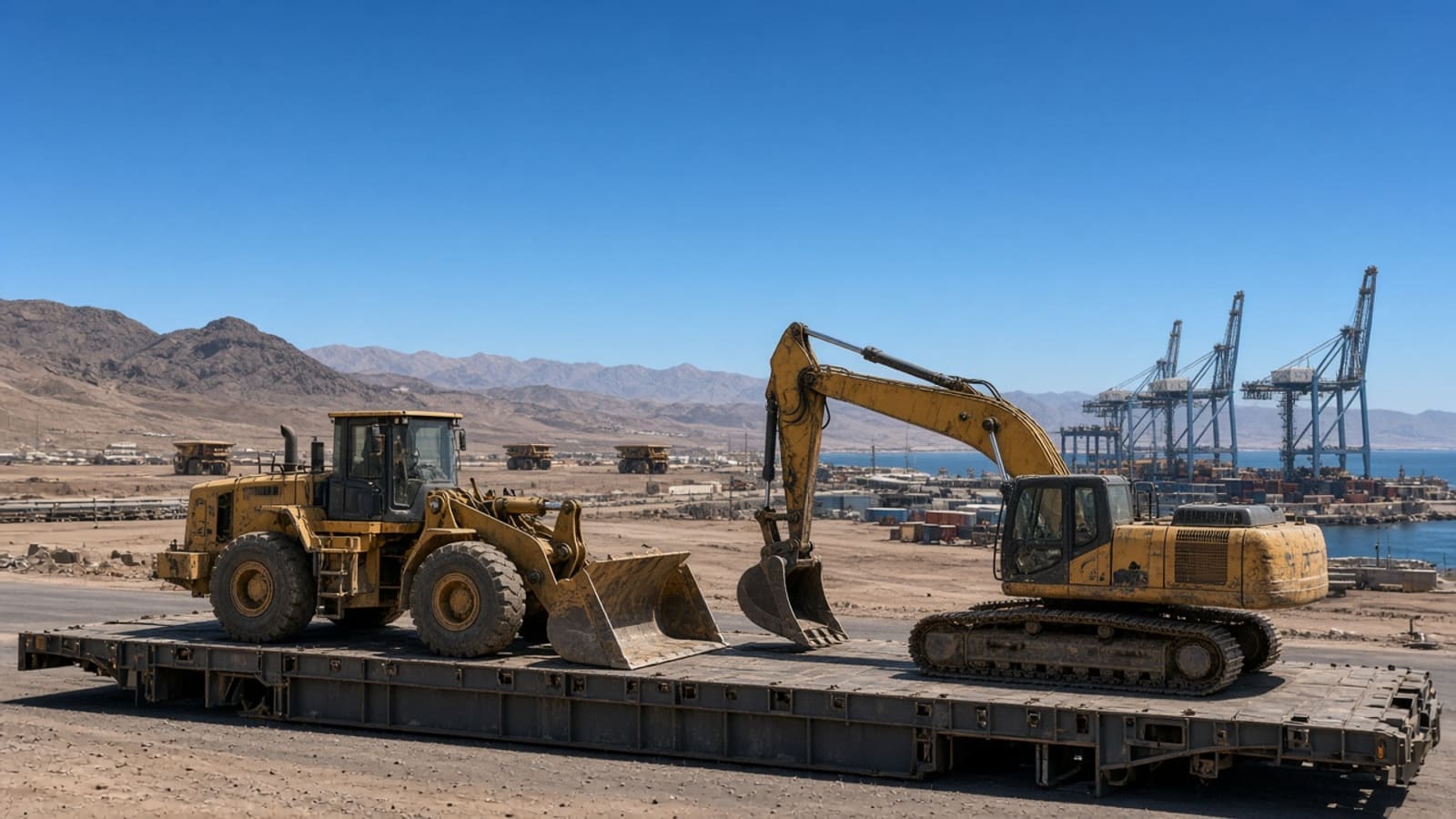
Shipping heavy equipment and trucks from the United States to Chile (2026)
Used excavators and dozers can go to Chile if clean; used on-road trucks cannot. SAG wash rule, 0% FTA duty, NYK RoRo, ports and the inland leg, verified October 2026.
Seaway Project Cargo Team
Project Cargo & Heavy-Lift Specialists
Used excavators, dozers, graders, wheel loaders and off-highway mining trucks can be shipped from the United States to Chile if they arrive clean, but used on-road trucks cannot, because Article 21 of Ley 18.483 bans used vehicles. We load RoRo at Jacksonville and Baltimore for the NYK ships to San Antonio and Iquique, build container, flat rack and open-top plans for machines that must be taken apart, and send heavy lots to Antofagasta and Mejillones for the Atacama copper belt.
Can you import it?
Chile decides on what the machine is built to do. Article 21 of Ley 18.483 allows only unused vehicles, and Aduanas (the national customs service) reads "vehicle" as a self-propelled vehicle that carries people or goods. A tracked excavator is not that, so used earthmoving machinery is governed by the Servicio Agrícola y Ganadero (SAG) cleanliness rule, Resolución Exenta 3.103 of 2016. We found no customs ruling that names each machine type, so your customs agent (agente de aduanas) confirms the classification on the declaration before you buy anything near the line. Every regulatory statement in this guide was verified against the issuing authority in October 2026.
| Machine class | New | Used | What decides it |
|---|---|---|---|
| Excavators, dozers, graders, wheel loaders, backhoes | Yes | Yes, if clean | SAG Res. 3.103 wash rule; tariff line |
| Off-highway mining haul trucks (rigid) | Yes | Yes, named exception | Art. 21 lists off-highway transport vehicles |
| Drill rigs, crushers, screening plants | Yes | Yes, if clean | SAG decides what else counts as used machinery |
| Crawler cranes | Yes | Yes, if clean | SAG wash rule; confirm tariff line |
| Truck-mounted cranes, utility bodies | Yes | Confirm first | Depends on classification as special-use |
| Concrete mixers, sweepers, workshop and fire trucks | Yes | Yes, named exceptions | Art. 21 second paragraph |
| Farm tractors, combines | Yes | Yes, if clean | SAG wash rule |
| Pickups, vans, tractor-trucks, highway dump trucks, buses | Yes | No | Art. 21 ban; free-zone residents only |
Duty and tax in one minute
The general duty is 6% of the CIF value (cost, insurance and freight), and IVA of 19% is charged on the CIF value plus the duty, according to Aduanas. Under the US-Chile Free Trade Agreement, goods that originate in the United States have entered Chile duty free since 1 January 2015, per the US Trade Representative. Origin follows where a machine was made, not where it was bought: a machine built in another country and bought at a US auction is not a US-origin good, so it pays the 6%. For preference, the importer must be able to present a certificate of origin (issued by the importer, exporter or producer, with the data of Aduanas Resolución 342/2015) if Aduanas asks for it.
Used goods normally pay a 50% surcharge on the duty (Regla General Complementaria 3 of the tariff), but that rule excludes capital goods, and Article 3.4 of the FTA removes it for originating goods that receive the preference. Because freight and insurance sit inside the CIF value, every dollar of ocean freight also raises the IVA base. Run your own numbers in the Import Duty & Tax Estimator. See also our duty, FTA and free zone explainer and the South America duty guide.
The four ways to ship
For the general trade-offs, see RoRo vs container vs flat rack. What follows is how each method behaves on this lane.
Containerization
Most mid-size machines in our loading records travel in standard boxes after disassembly: bucket, stick or boom, counterweight, cab or blade come off as that model's record says, and the pieces share the box. Containers reach Chile's container terminals, for example STI at San Antonio and TPS at Valparaíso. The cost of the method is work at the far end: someone in Chile has to put the machine back together, so line up the dealer or fitter before the box sails. The wash happens before the pieces are lifted in, and wood blocking inside the box must carry the ISPM 15 mark that SAG demands.
Flat rack and open top
When a piece is too tall for a high cube, a 40 ft open top takes it under a tarp (our CAT 320EL record uses one with 12 inches of over-height), and a flat rack takes the pieces that are too wide or too long for either. The trade-off is exposure: an open frame spends the whole voyage in the weather, so a machine washed in Texas can collect dust before Chile. We wash as close to loading as the yard allows and photograph the finished unit. For the method itself, read flat racks and containerizing oversized machinery.
RoRo
On NYK RORO's MSX and USCX services the machine drives, or is lifted on a roll trailer, onto the ship. On the week 42 schedule (16 October 2026) the ships list a ramp rated 150 t and a maximum height of 5.00 to 5.15 m, and 6.30 m on Vela Leader, the USCX ship. Two limits matter for Chile: Davisville and both Newark terminals (FAPS and Red Hook) cannot accept used cargo to Chile, and Graceful Leader and Guardian Leader take no US cargo for the west coast of South America. NYK Chile lists Puerto Central at San Antonio and EPI at Iquique as the arrival terminals, with free storage of up to 24 hours at San Antonio and one shift at Iquique, so the customs agent and the SAG inspection need to be booked before the ship arrives.
Breakbulk
Pieces of 30 t or more, or 40 m³ or more, count as project cargo in the ATI terminal manual at Antofagasta, and haul-truck modules, large crawler cranes and processing equipment belong to that class. They go on multipurpose and heavy-lift ships to Antofagasta, Mejillones, Valparaíso or Coquimbo. Breakbulk is also the answer when a RoRo carrier will not take the piece: on NYK's North-South loop, for example, no cargo above 30 t is accepted for west coast destinations. See our project cargo service.
From your US port
The best US port is the one that fits both where the machine sits and how it ships. A machine that can roll goes to Jacksonville or Baltimore on a lowboy for RoRo, a machine that has to come apart goes to a box port, and the quote ranks the options. Days below come only from NYK's week 42 schedule and count from the listed departure to arrival at San Antonio; every other port is quoted per sailing. The 16 to 17 day Panama Canal routing is one USCX voyage on that schedule, so confirm space before you plan around it.
| US port | Boxes, flat racks, open tops | RoRo to Chile | Notes |
|---|---|---|---|
| Jacksonville | Yes | NYK: 16 to 17 days on USCX, 28 to 32 days on MSX | RoRo for used machines that roll |
| Baltimore | Yes | NYK: 17 days on USCX, 30 to 35 days on MSX | Same ships as Jacksonville, calls before it |
| New York and New Jersey | Yes | NYK calls Newark, but not for used cargo to Chile | Used units truck to Baltimore or Jacksonville |
| Houston and Galveston | Houston yes, Galveston no | No NYK call to Chile listed | Boxes and breakbulk; Galveston is RoRo only |
| Freeport, Texas | No | NYK North-South: up to 30 t, west coast connection at Manzanillo | Nothing above 30 t |
| Savannah, Charleston, Norfolk | Yes | No NYK call to Chile listed | Boxes and flat racks; Savannah has no RoRo |
| Miami and Port Everglades | Yes | No NYK call to Chile listed | Boxes and flat racks |
| Los Angeles and Long Beach, Oakland, Tacoma, Seattle | Yes | No Chile RoRo service verified | Boxes, flat racks and open tops |
| Chicago, Kansas City, Dallas, Denver and Salt Lake City rail ramps | Yes | Not applicable | Boxes rail to a coastal port |
Use the Route Finder to see which port is closest to your pickup. If you are buying at an auction, shipping from a US auction overseas explains how the yard, the title and the port fit together.
Choosing the destination port
The destination port decides your inland leg more than anything else, so pick it for where the machine will work. On NYK's October 2026 schedule the only Chilean calls are San Antonio and Iquique, and we found no verified current direct RoRo call at Antofagasta or Mejillones. Cargo for those two ports travels in boxes, on flat racks or as breakbulk, or discharges at Iquique or San Antonio and is trucked.
| Port | Best for | What the operator publishes |
|---|---|---|
| Iquique (EPI) | Tarapacá mines, the free zone | NYK RoRo call; Collahuasi is 261 km away |
| Mejillones (Puerto Angamos) | Antofagasta region mines, heavy lots | Four berths, drafts to 13.7 m, vessels to 155,000 t displacement, rail and roads B-262 and B-400 |
| Antofagasta (ATI) | Mining equipment, project cargo | 445 m quay, 12.2 m dredged depth, project cargo from 30 t or 40 m³ |
| San Antonio (Puerto Central, STI) | Santiago and the centre, RoRo | NYK RoRo call; STI also handles vehicles, project cargo and heavy lifts |
| Valparaíso (TPS, TPV) | The centre, multipurpose cargo | TPS is Terminal 1; TPV is the multipurpose Terminal 2 for general and breakbulk cargo |
| San Vicente (SVTI) | Biobío and the south | Multipurpose concession at Talcahuano |
| Coquimbo (TPC) | Coquimbo region mines | Multipurpose berth 3 open since October 2023, ships to 300 m and 14 m draft |
For the Atacama copper belt, price both Mejillones and Antofagasta: Angamos sits 65 km from Antofagasta city and has rail and road links toward the mines, and ATI is the port with a published project-cargo definition. For the centre, San Antonio is the RoRo port and Valparaíso is the alternative when a multipurpose berth suits the piece better. SAG inspects at the point of entry, so confirm with your agent that the chosen port can clear used machinery. The Chile country guide has the overview.
What we have loaded
We cite only machines with a loading record in our yard sheet, last confirmed in July 2026, and this table is not a list of Chile shipments. Each model page carries a loading pictorial that shows the actual pieces of that machine in each box, not a generic drawing.
| Model | Boxes in the plan | What to know |
|---|---|---|
| CAT 320EL | One 40 ft open top and one 40 ft high cube | Open top carries 12 in of over-height under a tarp |
| CAT 336E | One 40 ft open top and one 40 ft high cube | Same plan as the 320EL, larger pieces |
| CAT D8T | One 40 ft open top and four 40 ft high cubes | A dozer that size is a multi-box job |
| CAT 140M | One 40 ft high cube | A motor grader in a single box |
| CAT 966H | One 40 ft high cube, flagged overweight | Needs an overweight-rated box and a heavy-haul road leg |
For scale, the United States reported exports to Chile in 2025 of US$543.5 million of off-highway dump trucks (137 units), US$112.3 million of excavators (113 units) and US$70.0 million of self-propelled boring and sinking machinery (356 units), according to UN Comtrade through the World Bank's WITS. They cover new and used machines and show the market, not our volume. The copper-mine project plan shows how we would plan a haul-truck and drill-rig move; it is a plan built from published data, not a completed job.
Trucks and trailers
Used on-road trucks cannot be imported into mainland Chile. Article 21 of Ley 18.483 says that only vehicles "sin uso" (unused) may be imported, and Aduanas lists used vehicles among prohibited imports. A used pickup, a used tractor-truck or a used highway dump truck is therefore a no, whatever the price.
The exceptions are narrow and each one has to be proven:
- Named special-use vehicles, including ambulances, fire and rescue trucks, street sweepers, snow ploughs, workshop trucks, concrete mixers, motorhomes and "vehicles for off-highway transport", plus analogous vehicles for special uses other than transport proper.
- Vehicles imported under the special regimes of Section 0 of the customs tariff, and vehicles with a full or partial exemption of import charges.
- Free-zone residents. Residents of the Iquique and Punta Arenas free zones and their extension zones can acquire used vehicles, but the vehicle's use is restricted to those regions. A vehicle bought under the free-zone regime may enter the rest of the country with a pasavante from Aduanas, for up to 90 days per calendar year.
New trucks are different. An unused US-made truck enters at 0% duty with proof of origin, plus 19% IVA, and Aduanas notes that some goods pay additional taxes by their nature, so ask the agent about the tariff line. Have your agent confirm that a demonstration or low-mileage unit counts as unused before you commit. We found no source on used highway trailers, lowboys or dry vans, so treat them as unconfirmed and ask before buying. For the rest of the picture see our Chile explainer on duty and the free zone.
Preparation and compliance
US export side
Most self-propelled used machines count as used self-propelled vehicles under 19 CFR 192.1, which names self-propelled construction and agricultural equipment. That means the Electronic Export Information goes into AES at least 72 hours before export, and CBP needs the machine's serial number (VIN or product identification number) and proof of ownership: the original or a certified copy of the title plus two complete copies, and a letter from the lienholder or lessor if one exists. Wooden blocking and dunnage need the ISPM 15 mark for Chile.
Chile side
SAG Resolución Exenta 3.103 of 2016 defines used machinery as machinery, equipment, implements and parts for agricultural, forestry, gardening and earthmoving use, garbage compactors and anything else SAG decides on risk. It must arrive clean and free of soil, plant debris and regulated pests, and SAG inspectors check the shipment physically at the point of entry. If it fails, the importer pays for the phytosanitary measures SAG orders and for re-shipping a rejected machine. Wood packaging has its own rule, SAG Resolución 133 of 2005 as amended in 2023: heat, dielectric heat, methyl bromide or sulfuryl fluoride treatment, a legible mark on at least two sides, and treatment or removal of the whole shipment if the mark is missing or bark or live insects are found. Aduanas then collects duty and IVA before release. Sources: Aduanas, SAG, USTR and the Chilean Congress library (BCN), verified October 2026.
The wash we arrange before loading
SAG names the methods: hydrowash, steam, forced air, vacuum "or another suitable method", inside and outside, with disassembly of parts if necessary. We arrange the wash at a yard with a wash pad before the machine is loaded, and we open the places where soil hides: track frames, the area under the cab, the engine bay and cooling packs, tool boxes and the cab floor. Where a part cannot be cleaned in place, disassembly is the fix. SAG's rule names no certificate, so we give you a dated wash record and photographs of the finished machine, which is evidence for the inspector rather than a document the rule requires. SAG's test is a clean machine on arrival, wherever the dirt came from.
The inland leg
The ship is only part of the trip. Chuquicamata sits at 2,870 m according to Codelco, and Collahuasi at 4,400 m according to the mine, and 261 km from Iquique according to Anglo American, with rainy summers and occasional winter snow. Ask the engine and machine dealer for the altitude derate of your specific model; we do not quote a number.
On Chilean roads the baseline limits come from Resolución 1 of 1995: 2.60 m wide and 4.20 m high, and 18.60 m for a tractor with a semitrailer. The Dirección de Vialidad of the Ministry of Public Works (MOP) requires a special permit when an indivisible load exceeds 11 m in length, 2.6 m in width or 4.2 m in height, or when the transport goes over 45 t gross vehicle weight or the axle limits. The permit is requested online only, through the SPSI system at spsi.mop.gob.cl, and Vialidad reviews in order of arrival: five working days without supplementary documents, ten with them. As an example, Caterpillar's published specification for the 320 Next Gen is 2.98 m wide with 600 mm shoes, so it needs a permit before it moves on a lowboy.
Rail and road links help: Puerto Angamos publishes rail links to the main mining operations of Argentina and Bolivia and paved roads to the Jama, Sico and Peine passes, and ATI reaches the Antofagasta and Atacama regions, northwest Argentina and southwest Bolivia.
What it costs
We do not publish prices here because they depend on the machine, the sailing and the date. What we can give you is the anatomy of the bill, so you can compare quotes line by line.
| Cost line | What drives it | Who normally pays |
|---|---|---|
| US pickup and haul | Distance, permits, machine size and weight | Shipper |
| Wash, disassembly and loading | Machine type, number of pieces, yard time | Shipper |
| Export filing and documents | AES filing, title and ownership paperwork | Shipper |
| Ocean freight | Method, box count or revenue tons, port pair, season | Shipper or importer, by Incoterm |
| Cargo insurance | Declared value, method | Shipper or importer, by Incoterm |
| Destination terminal charges | Terminal tariff, storage after the free period | Importer |
| Chilean duty and IVA | CIF value, origin, tariff line | Importer |
| Agent, SAG inspection and any treatment | Port, findings at inspection, re-shipment if rejected | Importer |
| Inland leg and permits | Distance, altitude, oversize permit, escort | Importer |
Two items surprise first-time buyers. The CIF value includes freight and insurance, so a higher freight bill raises both the duty base and the IVA base. And the free storage windows at San Antonio and Iquique are short, so a missing document becomes a storage bill. Send the machine details through our quote request for Chile and we will return the lines above with real numbers.
Frequently asked questions
Can I ship a used excavator to Chile?
Yes, if it arrives clean. SAG Resolución 3.103 allows used earthmoving machinery that has been cleaned inside and out at origin, and SAG inspects it on arrival. Your customs agent confirms the tariff line on the declaration.
Is the 0% duty automatic on equipment bought in the US?
No. The free trade agreement gives 0% to goods that originate in the United States. A machine built elsewhere and bought in the US pays the general 6% of CIF. Keep the manufacturer's plate and serial number so origin can be documented.
Do I need a SAG cleanliness certificate?
The SAG resolution names no certificate. It requires the machine to be clean, and SAG verifies that physically at the port. We give you a wash record and photographs so you can show what state the machine left in.
Can I import a used pickup or truck?
Not into mainland Chile. Article 21 bans used vehicles, with exceptions for special-use and off-highway vehicles and for free-zone residents. A used on-road truck does not qualify under any of them for a normal importer.
Antofagasta, Mejillones or San Antonio?
Choose by where the machine will work. Mejillones and Antofagasta serve the Atacama copper belt, but the NYK RoRo ships call San Antonio and Iquique. Heavy lots go breakbulk to the northern ports; a machine for Santiago goes to San Antonio.
How long does RoRo take?
On NYK's week 42 schedule, Jacksonville to San Antonio takes 16 to 17 days on the Panama Canal service (one voyage listed) and 28 to 32 days on the service that calls the east coast of South America first.
What happens if SAG rejects a machine?
SAG applies phytosanitary measures proportionate to what it finds, or the machine is re-shipped. The importer pays for the treatment and for the re-shipment, so a proper wash before loading costs far less than a failed inspection.
Do I need a permit to drive it to the mine?
Probably. A load wider than 2.6 m, taller than 4.2 m or longer than 11 m (indivisible), or a transport over 45 t gross, needs a Vialidad permit requested online. A CAT 320 at 2.98 m wide is already over the width limit on its own.
Can used machines ship through Newark?
NYK's schedule marks Newark (FAPS), Newark (Red Hook) and Davisville as unable to accept used cargo to Chile. We load used machines at Jacksonville or Baltimore instead, or move them in boxes from another port.
Quote checklist
Send these items with your request and we can return a complete quote without a second round of questions:
- Make, model, year and serial number of each machine
- Whether it is new or used, and the country where it was manufactured
- Transport length, width, height and weight, with attachments you want to ship
- The pickup address in the United States
- The Chilean port or the mine site where the machine will work
- Photos of the machine and its manufacturer's plate
- US title or other proof of ownership, and any lien or lease letter
- The name of your Chilean importer and customs agent
- Your target sailing date and any altitude or permit constraints
Start with the quote request for Chile or download the Chile export checklist as a PDF.
Related Articles
Shipping heavy equipment and trucks from the United States to Ecuador (2026)
Used machinery up to 15 years old can enter Ecuador; on-road trucks must be new. Ports, sailings, licences, taxes and the inland leg, verified October 2026.
Shipping heavy equipment and trucks from the United States to Guyana (2026)
Verified October 2026: GRA duty-free codes, the vehicle inspection rule, the left-hand-drive ban, Georgetown port limits and the US ports that actually serve Guyana.
Shipping Heavy Equipment and Trucks from the US to Peru (2026)
Used machinery has no age limit in Peru, but on-road diesel trucks do. Verified SUNAT rules, NYK USCX transit times, ports, permits and the quote checklist.