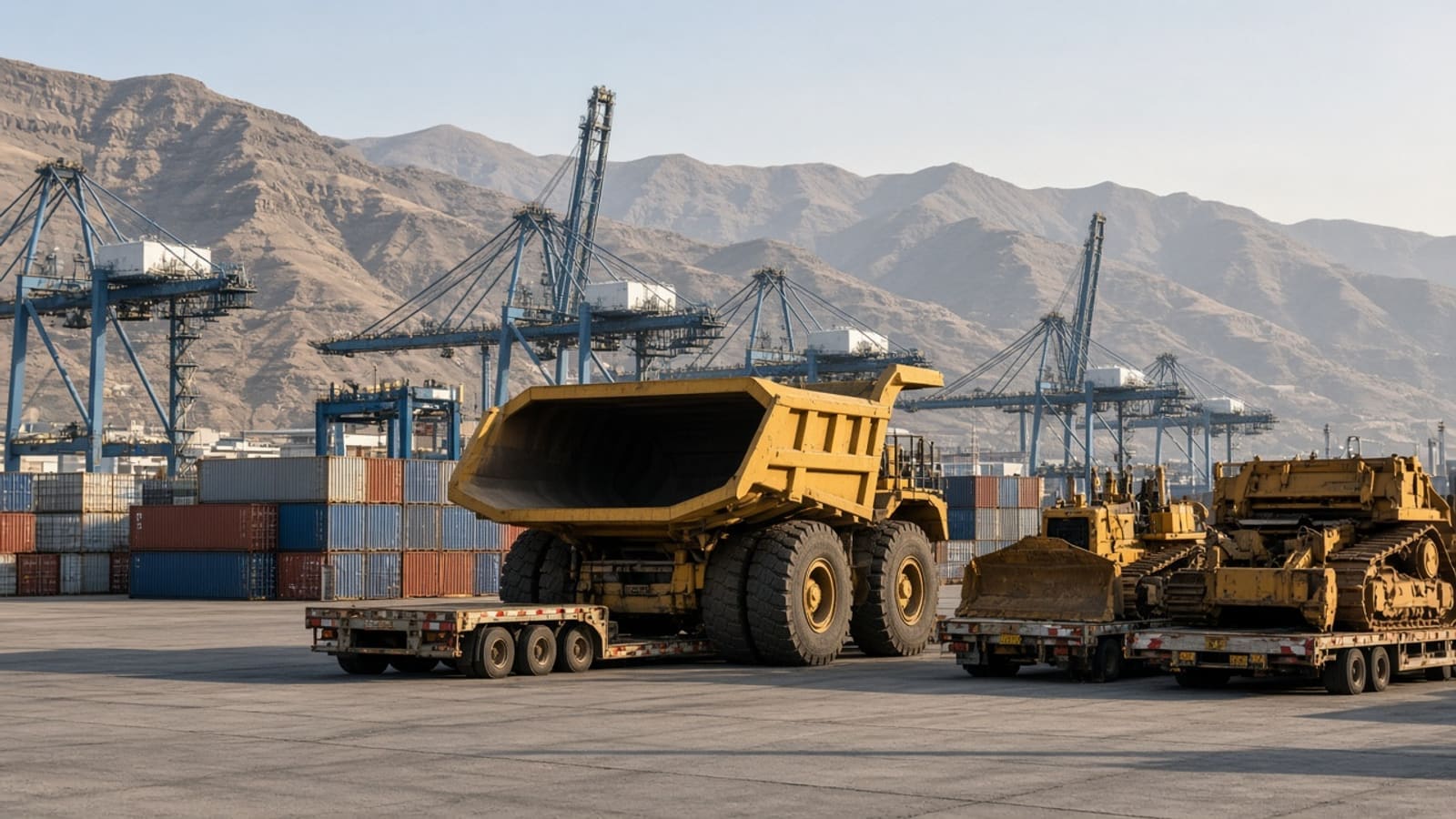
Shipping Heavy Equipment and Trucks from the US to Peru (2026)
Used machinery has no age limit in Peru, but on-road diesel trucks do. Verified SUNAT rules, NYK USCX transit times, ports, permits and the quote checklist.
Seaway Project Cargo Team
Project Cargo & Heavy-Lift Specialists
Peru takes used heavy equipment with no age limit on off-road earthmoving, mining and farm machines, and goods of US origin can enter duty-free under the US-Peru trade agreement, but used on-road diesel trucks face a hard rule: only tractor units and heavy trucks (category N3), no more than two model years old and under 240,000 km. The fastest sea route is NYK's USCX service through the Panama Canal, which put Jacksonville cargo in Callao in 10 to 12 days on the two voyages we checked, against 34 to 40 days on the east-coast MSX loop.
Every Peruvian rule below was read on the SUNAT, MTC, SENASA, Ositran or terminal-operator page that publishes it, and checked in October 2026. For the tax stack on cars and pickups, see our earlier article on the duty, IGV and used-vehicle rules for Peru; the used-vehicle limits here are the current SUNAT text and replace the older figures there.
Can you import it?
The test Peru applies is design, not age. Decreto Legislativo 843, the law that sets minimum quality standards for used vehicles, covers goods classified as motor vehicles. SUNAT states that it does not reach machines and equipment designed and built exclusively for use outside the national road network in construction, mining and agriculture, the "yellow machines and green machines". That carve-out is why an eighteen-year-old excavator can clear customs while a three-year-old diesel pickup cannot.
| Machine class | Used import verdict | What the rule says (verified October 2026) |
|---|---|---|
| Excavators, dozers, wheel loaders, graders, off-road haul trucks | Allowed, no age or mileage gate | Outside DL 843 when built exclusively for off-road use (SUNAT) |
| Farm tractors, combines and implements | Allowed, with cleaning and a phytosanitary certificate | Outside DL 843; SENASA Resolución Directoral 027-2024 sets the cleaning rules |
| Drilling trucks and crane trucks built for off-road use | Allowed when designed to run off the road network | SUNAT lists subheadings 8705.10 (off-road crane trucks) and 8705.20 (drilling trucks) as outside DL 843 |
| Road-going crane trucks and concrete mixers | Treated as motor vehicles, so the used-vehicle limits apply | SUNAT places on-road 8705.10 crane trucks and 8705.40 mixers inside DL 843 |
| Used diesel tractor units and heavy trucks (N3) | Allowed within limits | Model year no more than 2 years old, under 240,000 km, factory left-hand drive, no major accident |
| Used diesel pickups and light or medium trucks (N1, N2) | Not allowed | Used diesel is banned in categories L, M and N except M3 and N3 |
Two cautions. SUNAT's carve-out turns on how the machine was designed, not on a chapter number, so your customs agent should confirm the subheading before you buy. And one older SUNAT page still prints a five-year table for used vehicles; the current requirements page, citing Decreto Supremo 005-2020-MTC, counts two years from the model year.
The four ways to ship
Containerization
Most excavators, loaders, dozers and graders up to mid-size travel in 40 ft high cubes, open tops and flat racks once prepared for the box. Containers are the one method that reaches every Peruvian port through feeders and transshipment, and Callao is where the volume is: DP World reports that Callao handles more than 90% of Peru's containerised cargo, with 60% through its South Terminal.
Flat rack and open top
Anything that stands taller or wider than a high cube goes on a flat rack or open top, and Peru prices that differently. DP World's Callao tariff bills services for containers with out-of-gauge cargo at the standard price plus 40%. Our guide to flat racks and containerizing oversized machinery explains the fit rules, and the flat rack service page covers booking.
RoRo
Roll-on, roll-off is the shortest path to Callao, thanks to NYK's USCX, and the rules are strict. NYK's North America acceptance standards require high-and-heavy units to start and run under their own power, with working brakes, steering, transmission and hydraulics, no leaks, fuel under one-quarter of a tank and licence plates removed. NYK's published general limits are 12.5 m long, 5 m wide, 5 m high and under 75 t, with larger units by consultation. If a unit arrives stripped down, with the cab or equipment shipped separately, NYK asks you to contact it first. See RoRo shipping and our comparison of RoRo, container and flat rack.
Breakbulk
Breakbulk is for pieces that exceed RoRo limits or ultra-class machines supplied in modules. Peru's terminals do handle it: Callao's multipurpose Berth 11 is 280 m long with 15.5 m of draft, and Matarani has cranes up to 100 t. We found no published liner schedule for breakbulk from the US to Peru, so these moves are quoted per cargo. Details are on the breakbulk service page.
From your US port
NYK lists only four US load ports for the west coast of South America in its October 2026 schedule: Baltimore, Davisville, Newark and Jacksonville. The USCX voyage that crosses the canal omits Davisville and Newark Red Hook. Cut-off falls six to seven days before sailing, so the truck has to be at the terminal a week early.
| Your US port | NYK service for Peru (October 2026 schedule) | Days to Callao | What it means for you |
|---|---|---|---|
| Jacksonville (Blount Island) | USCX via Panama, sailing 20 Nov, cut-off 13 Nov | 10 days (12 on the July voyage) | The fastest verified route; see Port of Jacksonville |
| Baltimore (Dundalk) | USCX via Panama, sailing 17 Nov, cut-off 10 Nov | 13 days (15 on the July voyage) | Best for Midwest and Mid-Atlantic units; see Port of Baltimore |
| Newark (FAPS) | USCX via Panama, sailing 15 Nov, cut-off 9 Nov | 15 days (17 on the July voyage) | Northeast gateway; see Port of New York and New Jersey |
| Any of the three on MSX | East-coast South America first, then Chile and Peru | 34 to 40 days from Jacksonville, 36 to 43 from Baltimore | Two of the four MSX ships in the October schedule take no US cargo for the west coast |
| Brunswick, Savannah, Charleston | Not a load port on the MSX or USCX schedule | Not published | Truck to a NYK port, or ship in containers on carrier rotations |
| Houston, Galveston, Freeport | Not a load port on the MSX or USCX schedule | Not published | Container or flat rack by carrier rotation; quoted per sailing |
| Miami, Port Everglades | Not a load port on the MSX or USCX schedule | Not published | Container or flat rack by carrier rotation; quoted per sailing |
| Los Angeles, Oakland, Tacoma | Not a load port on the MSX or USCX schedule | Not published | Container or flat rack; quoted per sailing |
The USCX also serves Chile; see our Chile guide. Route Finder matches your pickup location to the nearest port that runs the service you need.
Choosing the destination port
Five Peruvian ports matter for heavy cargo, and they are not interchangeable.
| Port | Operator | What we verified for non-containerised cargo | Watch-outs |
|---|---|---|---|
| Callao | DP World (South Terminal), APM Terminals (North Terminal) | APM Terminals moved 278,000 t of rolling cargo in 2024 and handled breakbulk at 158 to 188 t per hour; DP World bills project, rolling and breakbulk cargo per freight ton | Free yard time on rolling cargo is only 2 to 3 days |
| Chancay | COSCO Shipping Ports Chancay | Two berths for general and RoRo cargo, 275 m each; project cargo defined as over 35 t or 50 m³ | Opened November 2024; we found no direct US call |
| Matarani | TISUR | Ro-ro pier 36 m by 24 m; cranes of 63 t and 100 t | Zero rolling cargo moved in 2023 and 2024 |
| Ilo | ENAPU | Multipurpose pier 302 m by 27 m, about 36 ft of depth | Swell closed the port for 75 days in 2024 |
| Paita | Terminales Portuarios Euroandinos | Spur pier 365 m by 53 m takes four vessels at once; multipurpose berth with 12 m of draft | Small breakbulk volume, 38,900 t in 2024 |
What we have loaded
Our yard has loaded these Caterpillar models, and the boxes below are the plans we recorded. Each model has a page you can open from the last column.
| Model | Loading plan on record | Model page |
|---|---|---|
| CAT 320EL excavator | One 40 ft open top (load 12 in above the side walls, under a tarp) and one 40 ft high cube | CAT 320 |
| CAT 336EL excavator | One 40 ft open top (12 in over height) and one 40 ft high cube | CAT 336 |
| CAT D8T dozer | One 40 ft open top and four 40 ft high cubes | CAT D8 |
| CAT 966F wheel loader | One 40 ft high cube | CAT 966 |
| CAT 140M motor grader | One 40 ft high cube | CAT 140 |
| CAT 950K wheel loader | One overweight-rated 40 ft high cube | CAT 950 |
The last row matters in Peru. An overweight box needs a heavy-lift road leg, and Peruvian roads cap a vehicle combination at 48 t, so the trucker and the permit come into the plan before booking.
Demand explains why Peru is worth planning for. In the US export data published in our Seaway Atlas, Peru took 330 excavators in 2025 (HS 842952), up from 123 the year before, worth US$41.9 million. Source: World Bank WITS and UN Comtrade, exports reported by the US, verified October 2026.
Trucks and trailers
Trucks are where Peru deals go wrong, because buyers assume the machinery rule applies. It does not.
- Diesel N3 tractor units and heavy trucks: model year no more than 2 years old, counted from the model year, not the build date; no more than 240,000 km; factory left-hand drive (converted right-hand-drive units are refused); no major accident, fire or flood; emissions within Peruvian limits.
- Diesel pickups and N2 trucks: banned used. Gasoline vehicles face the same two-year limit and the category mileage caps, such as 36,000 km for N1.
- Paperwork: a technical import sheet signed by the importer and an MTC-accredited mechanical engineer, plus an inspection report from an MTC-authorised verifier, both filed with the declaration.
- Verifier: SUNAT and MTC publish the requirement but we found no official text that accepts a US-side inspection as a substitute, so treat the verifier as a Peruvian step arranged by your customs agent.
For a truck quote, start from this pre-filled request.
Preparation and compliance
All statements in this section were verified in October 2026.
US export side
- Title and lien documents. US Customs and Border Protection treats trucks, tractors, self-propelled farm machinery and self-propelled construction equipment as used self-propelled vehicles once title has passed from a dealer to a customer. For export by vessel, present the original or certified title and two complete copies at least 72 hours before export. A leased or liened unit also needs a written release from the third party.
- EEI in AES. Electronic Export Information for used self-propelled vehicles must be filed 72 hours before export, whatever the destination, value or condition.
- Terminal receiving rules. For RoRo, follow NYK's standards on fuel, plates and running condition, and declare the cargo as used.
- Washing. Wash every machine. For farm equipment, cleaning at origin is mandatory; for other machines we found no equivalent published rule, but a clean machine is easier to inspect.
- Wood. For used farm machinery, dunnage and blocking must be free of bark and meet SENASA's wood-packaging rules.
Peru side
- Customs agent. For goods above US$2,000 FOB, a licensed customs agent is mandatory, and the importer grants the mandate before the declaration is numbered.
- Duty. Ad valorem duty is 0%, 4%, 6% or 11% by tariff subheading. Under the US-Peru Trade Promotion Agreement, goods that originate in the US are duty-free when the importer claims preference code 802 with a certificate of origin. The certificate has no fixed format, may be in English, and may be issued by the producer, exporter or importer.
- Origin is not the shipping port. The preference follows where the goods originate. A used Japanese-built machine shipped from Houston is not of US origin.
- IGV. For 2026 IGV is 18% (15.5% plus 2.5% municipal promotion tax), under Law 32387, which raises the municipal part gradually. It applies to customs value plus duties.
- Perception. SUNAT collects an advance perception of 3.5%, or 5% when you clear used goods, or 10% in special cases, including a first-ever import. It is collected at clearance as an advance payment of IGV.
- SENASA. Used farm machinery needs a phytosanitary certificate stating it is clean inside and out. SENASA inspects at entry, and where it suspects soil it can order a partial or total disassembly at the importer's cost, with rejection and re-shipment for non-compliance.
Model the arithmetic in the Import Duty & Tax Estimator. For a one-page version of these steps, see the Peru shipping guide.
The inland leg
The road rules decide how pieces travel. Peru's vehicle regulation caps a combination at 48 t gross, 2.60 m wide (excluding mirrors) and 4.10 m high for freight vehicles, or 4.30 m for vehicles designed to carry containers. Beyond those limits you need a special authorization:
- PVN-007 for loads that exceed maximum dimensions.
- PVN-005 for gross weight above 48 t and up to 60 t.
- PVN-006 for gross weight above 60 t.
Each authorization is valid for a single trip on the requested route and requires the vehicle's circulation card, insurance covering third-party damage and an axle-weight diagram. Indivisible cargo needs MTC authorization unless it travels on a special vehicle within its approved limits. The application is part of heavy-haul permitting and the trucks run through heavy-haul trucking. For the lane overview, see our South America trade lane.
We did not verify distances, permit processing times or escort rules for specific corridors, so we do not quote them. Ask for the route to be surveyed before you commit.
What it costs
This is the anatomy of the bill, not a price list. Each line is a separate charge.
| Cost line | What drives it |
|---|---|
| US inland to port | Pickup location, weight, permits for oversize loads |
| US terminal and export filing | Terminal receiving, title review, EEI filing |
| Ocean freight | The method (RoRo, container, flat rack, breakbulk) and the number of boxes in the loading plan |
| Peruvian terminal handling | Billed per container, or per tonne or cubic metre (whichever is greater) for rolling, project and breakbulk cargo; 40% added at DP World for out-of-gauge containers; daily yard charges after the free days |
| Duties and taxes | Duty by subheading (0% under the trade agreement for US origin), 18% IGV, advance perception |
| Agent, verifier and permits | Customs agent fee, MTC verifier for used trucks, PVN permit per trip |
| Inland haul and insurance | Distance, altitude, oversize permits, cargo insurance |
The biggest lever is the loading plan. A model that fits one high cube needs fewer boxes, and so costs less to ship, than one that needs an open top plus four high cubes, which is why the plans above come first. To price your machine, start from this pre-filled quote and change the model, or request breakbulk for mining units with this request. The tax stack for cars and pickups is in our earlier Peru duty article.
Frequently asked questions
Is there an age limit for used excavators and loaders going to Peru?
No age or mileage gate applies to machines built exclusively for off-road use in construction, mining or agriculture, because they fall outside DL 843, according to SUNAT. Farm machines still need to arrive clean and with a phytosanitary certificate. Your customs agent confirms the subheading.
Can I ship a used diesel truck to Peru?
Only a diesel tractor unit or heavy truck of category N3. It must be no more than two model years old, under 240,000 km, factory left-hand drive and free of major accident history. Used diesel pickups and N2 trucks are banned.
Do I pay duty on US-made equipment?
Goods that originate in the US enter duty-free under the Trade Promotion Agreement when you claim preference code 802 with a certificate of origin. You still pay 18% IGV in 2026 and the advance perception. A used machine built elsewhere is not eligible, even if it ships from the US.
How long does it take from Jacksonville to Callao?
On NYK's USCX through the Panama Canal, the sailings we checked took 10 days (October 2026 schedule) and 12 days (July 2026 schedule). On the east-coast MSX loop the October voyages took 34 to 40 days. Schedules change, and cut-off is about a week before sailing.
Why not ship to Chancay instead of Callao?
Chancay opened in November 2024 and has berths for general cargo and RoRo, but we found no direct US call. For US cargo, Callao is the practical choice today. Ask us if your consignee is north of Lima and a Chancay routing could work.
Does my machine need to be washed or inspected by SENASA?
Used farm machinery must be cleaned inside and out at origin and carry a phytosanitary certificate; SENASA inspects at entry and can order disassembly at your cost. We found no equivalent published rule for earthmoving machines, but we wash every unit anyway.
Quote checklist
Send these for a Peru quote that holds:
- Make, model, year and serial or VIN, with photos of every side.
- Transport length, width, height and weight, with attachments removed or installed as they will ship.
- Whether the unit runs and drives, for RoRo eligibility.
- For trucks: model year, odometer reading, engine type, steering side and accident history.
- US pickup address and the nearest port, or tell us the port you prefer.
- Title copy and lien release, for any self-propelled unit.
- Country of origin of the machine, for the preference claim.
- Destination: Callao or the mine, the altitude of the site, and the road access.
- Your Peruvian importer's RUC and customs agent contact.
- Target sailing month, so we can work back from the NYK cut-off.
Download the Peru export checklist (PDF) and send it with your request.
Related Articles
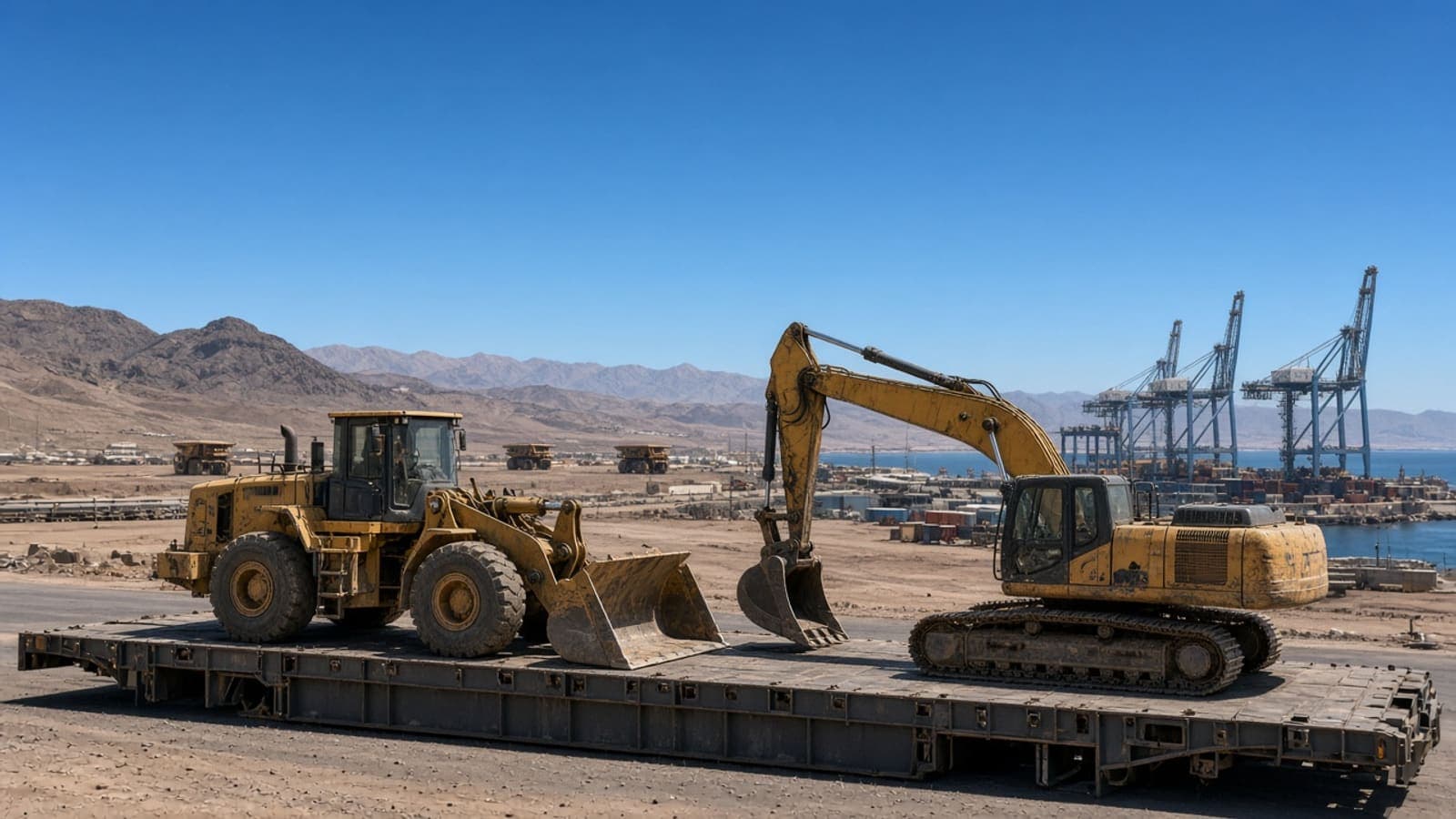
Shipping heavy equipment and trucks from the United States to Chile (2026)
Used excavators and dozers can go to Chile if clean; used on-road trucks cannot. SAG wash rule, 0% FTA duty, NYK RoRo, ports and the inland leg, verified October 2026.
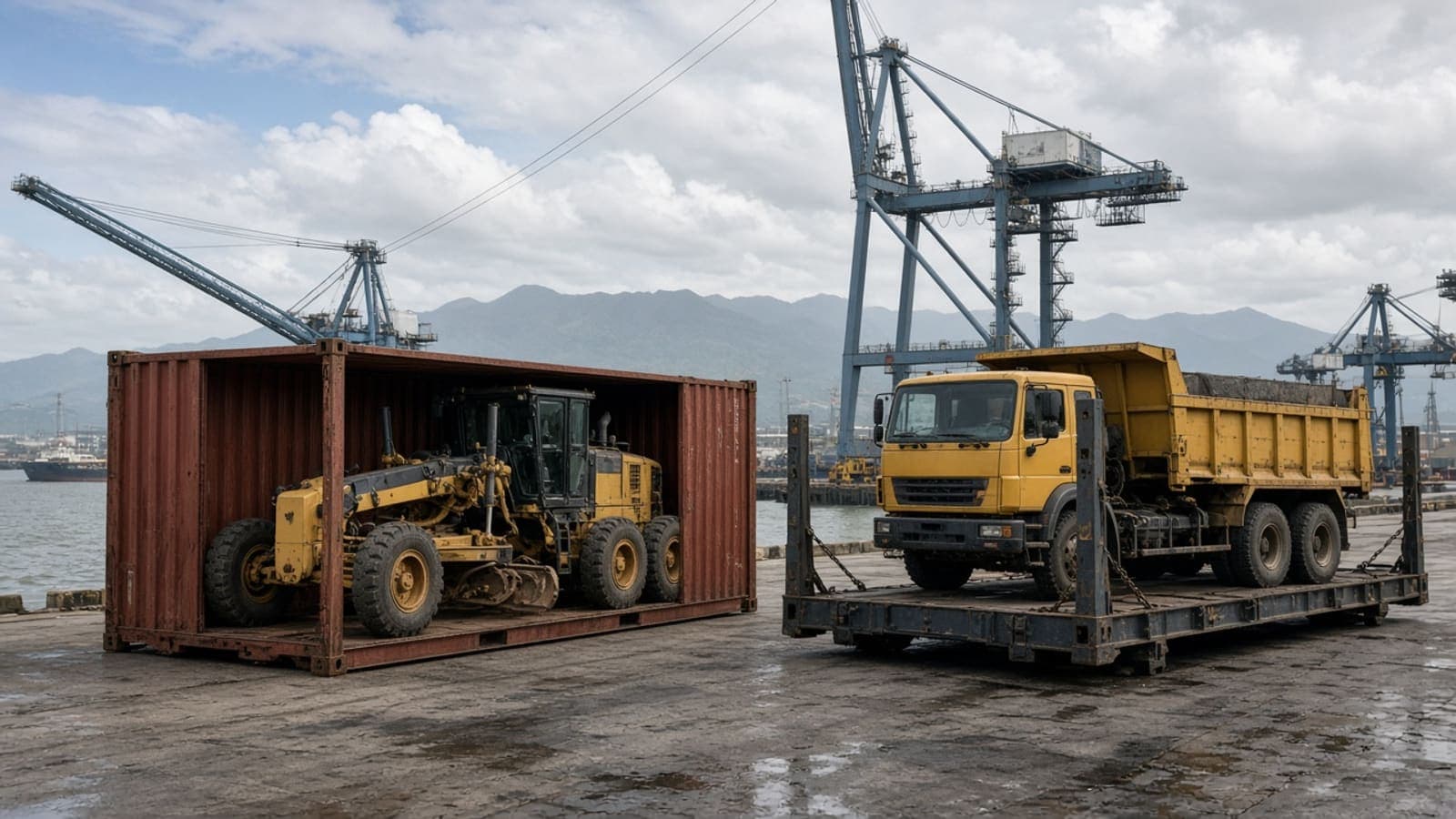
Shipping heavy equipment and trucks from the United States to Ecuador (2026)
Used machinery up to 15 years old can enter Ecuador; on-road trucks must be new. Ports, sailings, licences, taxes and the inland leg, verified October 2026.
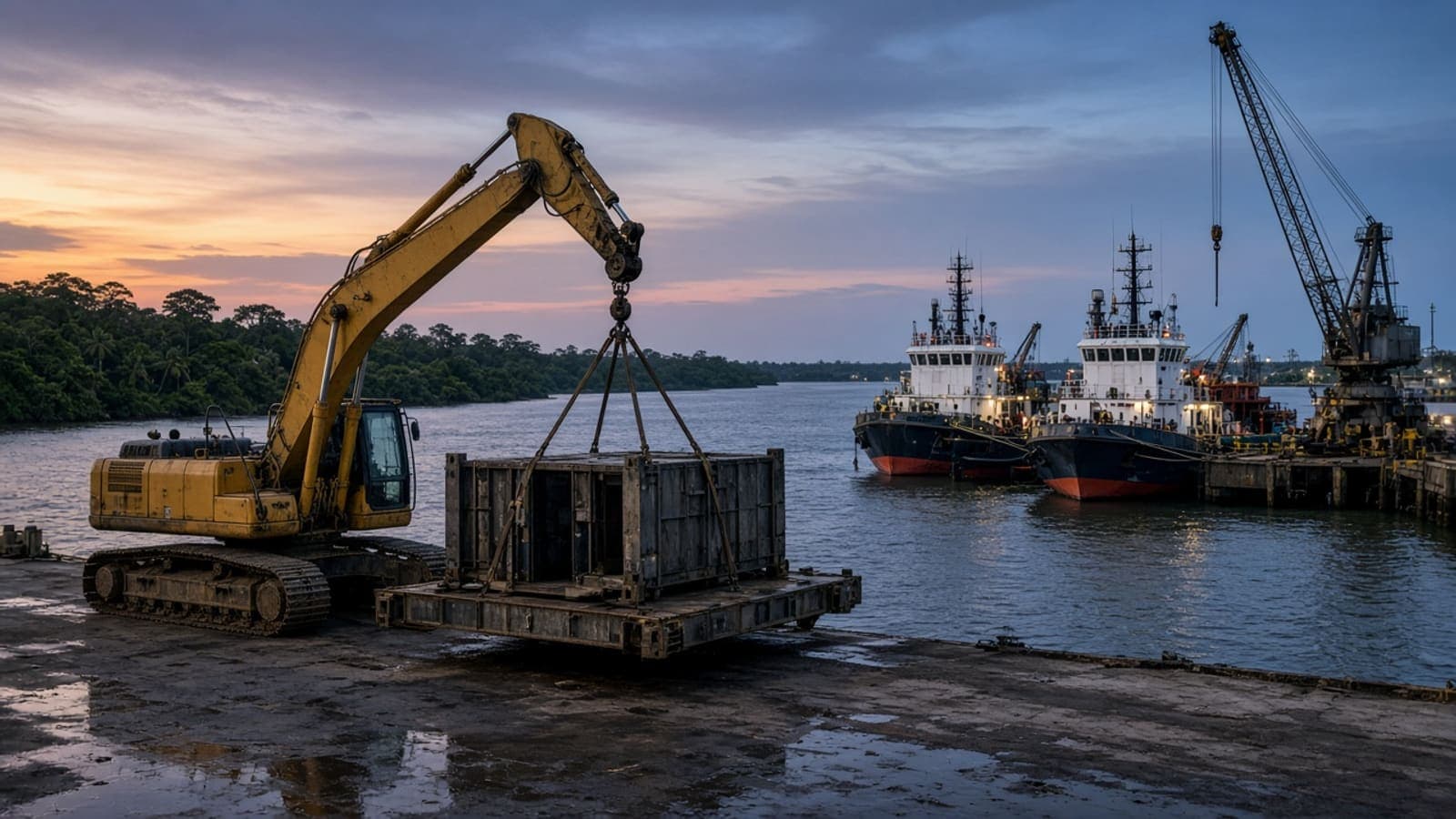
Shipping heavy equipment and trucks from the United States to Guyana (2026)
Verified October 2026: GRA duty-free codes, the vehicle inspection rule, the left-hand-drive ban, Georgetown port limits and the US ports that actually serve Guyana.