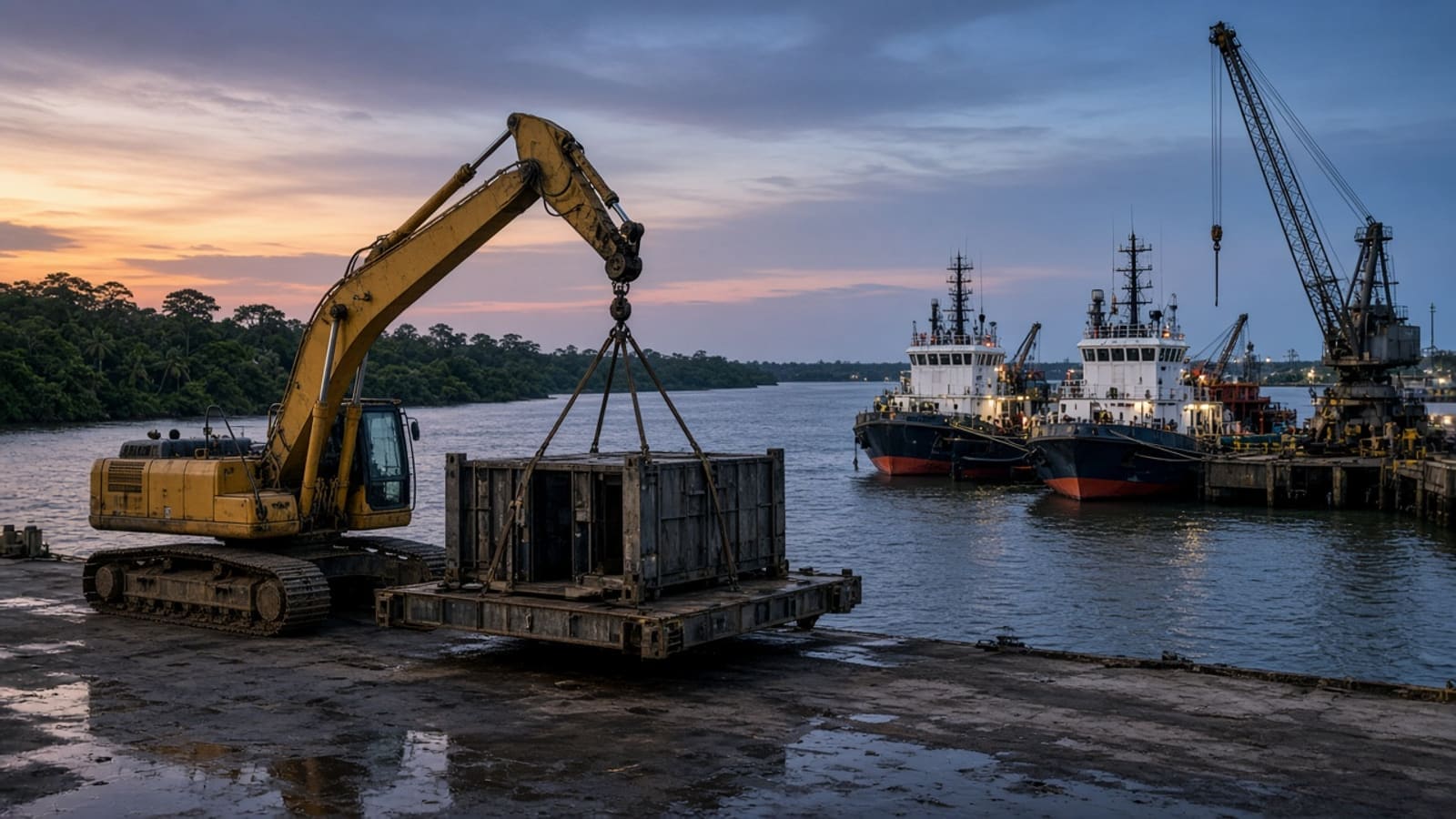
Shipping heavy equipment and trucks from the United States to Guyana (2026)
Verified October 2026: GRA duty-free codes, the vehicle inspection rule, the left-hand-drive ban, Georgetown port limits and the US ports that actually serve Guyana.
Seaway Project Cargo Team
Project Cargo & Heavy-Lift Specialists
Yes, you can ship used excavators, loaders, dozers and cranes from the United States to Guyana, and most of the work is picking the right box or deck, the right port and the right paperwork for the machine class. Used trucks are the hard part: Guyana does not register left-hand-drive trucks, and a 2025 GRA rule adds a pre-shipment inspection for used vehicles. This playbook covers what we know as of October 2026, with the source of each rule, and the country summary lives on our Guyana shipping page.
Can you import it?
Guyana is a CARICOM member and applies the Common External Tariff, with VAT at 14%. For most earthmoving and lifting machinery the tariff is low or zero, and the Guyana Revenue Authority (GRA) publishes a list of capital-equipment codes that are duty free and VAT zero-rated. The table gives our verdict by machine class. Verified October 2026.
| Machine class | Verdict | What decides it |
|---|---|---|
| Excavators, wheel loaders, dozers, graders (HS 8429) | Yes, routinely | Use a code from the GRA zero-rating list and no exemption letter is needed (GRA, capital-equipment list) |
| Mobile and crawler cranes (HS 8426) | Yes | CARICOM CET shows 0-5% for the chapter 8426 and 8429 codes; zero-rated codes are on the GRA list |
| Road trucks and tractor units (HS 8701, 8704) | Only if right-hand drive | The Motor Vehicles and Road Traffic Act bars registering left-hand-drive vehicles; duty on used heavy trucks is not published in a source we could verify |
| Off-highway and articulated haul trucks | Case by case | Classification, and whether Guyana treats it as a vehicle needing registration, is for your customs broker to confirm before booking |
| Trailers and lowboys | Ask first | Treated as vehicles when plated; confirm classification and inspection need with your broker |
| Used cars and pickups | Yes, with inspection | Pre-shipment inspection certificate required since 1 February 2025 (GRA); age bands drive duty |
Two things are not on the table. There is no longer an age cap on used vehicles: the eight-year limit was removed on 1 October 2020 (Department of Public Information). And we found no official source that applies the vehicle inspection certificate to excavators or cranes, so we treat that as a question to put to your broker, not an assumption.
The four ways to ship
1. Container (LoLo)
Anything that fits goes in a box. Seaboard Marine and Tropical Shipping run lift-on/lift-off services from Florida, Georgia, Texas and the New York area to Georgetown. A compact excavator or a skid steer in a 40 ft high cube is the cheapest and best-protected route, and the container is also your answer to theft and weather.
2. Flat rack and open top
For anything above roughly 2.6 m wide or 2.6 m tall, an open top or flat rack removes the roof or the sides from the problem. Our heavy equipment in containers calculator shows what fits before you book. Our 345-class excavator record, for example, uses one open top plus one high cube.
3. RoRo
Driving a machine on its own tracks or wheels is the fastest handling. The catch for Guyana is service: Höegh Autoliners calls at Georgetown with the Höegh Caribia on a Caribbean and Guianas loop (calls published for 23-24 October, 15-16 November and 11-13 December 2026), but that loop does not include a US port, and we have not confirmed a direct US-Georgetown RoRo sailing. Read our RoRo shipping guide and ask us for a current routing. Verified October 2026 from the carrier schedule.
4. Breakbulk
For pieces that are too heavy or too long for any box, breakbulk on a conventional or multipurpose vessel is the answer, and project cargo planning covers lifting plans, lashing and discharge. Georgetown has two 125 t mobile harbour cranes, so single lifts up to that rating are possible at the quay, subject to the vessel and the discharge plan.
From your US port
Which US port you use matters more for Guyana than for most destinations, because direct services are thin and depend on a few carriers. The table uses published carrier guides; transit times are carrier estimates, not commitments.
| US port | Container | RoRo | Our read for Guyana |
|---|---|---|---|
| Port of Miami | Yes | Yes | Seaboard Marine publishes a weekly Miami to Georgetown service, about 10 days |
| Port Everglades | Yes | Yes | Close to Miami; we verified no direct Georgetown sailing, so cargo is usually trucked to Miami |
| Port of Jacksonville | Yes | Yes | Good for Southeast inland loads; consolidate through Miami or a published service |
| Port of Savannah | Yes | No | Seaboard publishes Savannah to Georgetown, about 11 days |
| Port of Houston | Yes | Yes | Tropical Shipping lists Houston to Georgetown at about 15 days, FCL only (March 2025 schedule) |
| Port of New York and New Jersey | Yes | Yes | Seaboard lists Newark and Brooklyn to Georgetown at about 19 days |
| Port of Baltimore | Yes | Yes | RoRo and breakbulk gateway for mid-Atlantic machines; no direct Georgetown service verified |
| Port of Brunswick | No | Yes | RoRo hub; no direct Georgetown RoRo verified, so check the routing first |
Tropical Shipping also lists Palm Beach to Georgetown at about seven days on a Thursday sailing. Seaboard's published cut-off is Tuesday and sailing Wednesday from Miami, with cargo available on Monday. Breakbulk documents are due Tuesday at 5 pm Central.
Choosing the destination port
Almost everything goes to Georgetown, on the Demerara River. The Demerara main ships' channel is shallow by world standards. The Maritime Administration Department (MARAD) Notice to Mariners 48/2023 gives a minimum of 5.7 m chart datum in the main channel and 9.0 m in the outer extended section, and the Department of Public Information has described the channel as 100 m wide and 9 m deep after dredging. We could not verify a maximum vessel draft or length from an official source, so we do not quote one: your carrier and the port authority confirm the vessel. Verified October 2026.
Dredging continues. In May 2026 DPI announced a US$11.2 million MARAD contract with Boskalis for the Demerara channel between Houston and Golden Grove, about 9 km at 100 m wide and 5 m deep, planned over two months. It is a Demerara maintenance contract, not a Berbice project.
Other terminals are growing but not yet the main route for machines:
- TriStar, West Bank Demerara. Phase 1 is operating with a 320 m quay at 7 m draft and 450 t crane capacity, per DPI in February 2026. A planned container terminal and a RoRo terminal (early 2027) are still planned, not operating, so do not book machines there today.
- Vreed-en-Hoop. Commissioned in January 2025 as a shore base for the offshore oil operator. It is an energy base, not a public cargo port.
- Berbice. A deep-water port study by Bechtel is due about November 2026, with no construction model or date announced. Do not plan a 2026 shipment around it.
What we have loaded
We cite only machines for which we hold a loading record. Each model page shows the loading pictorial with the actual machine pieces in every box; here is the box plan for each. Where a record is not listed here, we do not claim it.
| Machine | Loading plan on record | Note from the record |
|---|---|---|
| Caterpillar 345 | 1 open top + 1 high cube | Open top loads at 12 in over-height |
| Caterpillar 950 | 1 high cube | Whole machine in a single box |
| Caterpillar D7 | 2 high cubes | Dozer split across two boxes |
| Komatsu PC490LC-11 | 1 open top + 3 high cubes | Open top loads at 12 in over-height |
| Komatsu WA450-3 | 2 high cubes | Alternative of 1 high cube + 1 twenty-foot box on record |
| Komatsu GD825A-2 | 1 high cube | Drive shaft prepared for transport |
| Volvo L150H | 2 high cubes | Alternative of 1 high cube + 1 twenty-foot box on record |
| Hitachi ZX450LC-3 | 1 open top + 2 high cubes | Open top loads at 12 in over-height |
For machines like these, the best entry point is our quote form with the plan pre-filled; see the cost section. Larger machines go with disassembly into several pieces, and the sequence is planned before the machine leaves the yard.
Trucks and trailers
Be careful here. Guyana's Motor Vehicles and Road Traffic Act (Cap. 51:02, section 6(2)) says that a motor vehicle other than a tractor with the steering on the left, imported after 31 December 1932, cannot be registered unless the Minister directs otherwise. That is the 2012 consolidated text; we did not verify later amendments. Almost every US-built highway truck is left-hand drive. In practice that means a used US-market Class 8 tractor or dump truck is not a safe purchase for road use in Guyana unless you have written ministerial direction or the vehicle is not for road registration. For a site-only machine on a private concession, ask your broker how it is classified.
The GRA inspection rule is the second hurdle. Since 1 February 2025, every used vehicle other than a brand-new one needs a Vehicle Inspection Certificate from a competent authority in the country of export, uploaded to ASYCUDA. ATJ is, in GRA's words, the first and presently the only authorised agency, and GRA says others may follow. ATJ lists partner inspection sites in the US, including Fort Lauderdale, Jacksonville, Atlanta, Brooklyn, Philadelphia, Houston, Dallas, Baltimore and Chicago. Vehicles bought and shipped before that date are exempt. Verified October 2026 from GRA, last updated 2 February 2026.
The open question is machinery. The GRA text says "used vehicles" and we found no official statement whether it covers earthmoving machines or cranes. We list it as unconfirmed. Ask your Guyanese broker in writing before you decide.
For new vehicles, a 2022 GRA measure removed VAT on new trucks of any tonnage and on new container haulers, and set the excise on new trucks to zero. That helps new-truck buyers, not used.
Preparation and compliance
On the US side
- Title. For a used vehicle, US Customs requires the original title or a certified copy, plus two copies, at least 72 hours before export by vessel (19 CFR 192.2).
- AES filing. Used self-propelled vehicles always need an Electronic Export Information (EEI) filing (15 CFR 30.2). Other goods need one when the Schedule B value goes above US$2,500.
- Inspection. For a used vehicle, book the ATJ inspection at a US partner site before the machine moves, so the certificate is ready for ASYCUDA.
- Cleaning. Pressure-wash tracks, buckets and undercarriage until no soil or plant material remains. The next section explains why.
- Fluids and batteries. Drain or limit fuel to the carrier's limit and disconnect batteries.
- Disassembly. Take off booms, counterweights and attachments where the dimensions require it, and photograph every step.
On the Guyana side
- Broker and TIN. Declarations are filed in ASYCUDA World through a licensed customs broker, and the importer needs a GRA taxpayer identification number.
- Duty and VAT. For listed capital-equipment HS codes, customs duty is free and VAT is zero-rated, with no exemption letter if you use the listed code (GRA list; VAT zero-rating effective 1 October 2020). The standard VAT is 14%.
- Petroleum contractors. Contractors and sub-contractors importing petroleum-operations equipment and vehicles under the Stabroek Petroleum Agreement (Article 21.1) are exempt from duty, VAT and other taxes (GRA notice, 2 February 2026). Your client should confirm with GRA that your shipment is covered, and we could not verify any general exemption in the Petroleum Activities Act 2023.
- Government projects. Exemptions for government contracts go through the Ministry of Finance to GRA.
- Soil and plant health. Under the Plant Protection Act 2011, the National Plant Protection Organisation in the National Agricultural Research and Extension Institute (NAREI) requires imports to be free of soil and organic matter, with a permit, a phytosanitary certificate and inspection. We found no machinery-specific notice, so treat a clean machine as mandatory.
- Documents. Bill of lading, commercial invoice, packing list with serial numbers, title and inspection certificate for used vehicles, and the broker's TIN-based declaration.
Verified October 2026. Rules change by notice, so ask your broker to confirm the current GRA circular on the day you book.
The inland leg
Most work sites are not in Georgetown. Roads and crossings carry weight limits that decide how a machine is moved, and these change often:
- The new Bharrat Jagdeo Demerara River Bridge was commissioned on 5 October 2025.
- The Berbice Bridge limit is 18 tonnes (Ministry of Public Works, July 2026).
- Parika and Supenaam ferries limit loads to 20, 18 or 15 tonnes depending on the vessel. DPI reported on 13 October 2026 that over-20-tonne cargo was restored through a diversion route.
- The Linden to Mabura road is reported about 79-80% complete, and the Soesdyke to Linden Highway paving is about 90% complete, as of mid-2026.
A heavy excavator therefore often moves in pieces, or on a lowboy via a route cleared in advance. The coastal wet seasons run roughly May to July and mid-November to mid-January or February, and heavy loads are better scheduled outside them (Caribbean Institute for Meteorology and Hydrology). Note the interior has one wet season, May to August.
Energy projects add demand. Oil output was about 902,000 barrels a day in the first half of 2026 (DPI Mid-Year Report), and the 300 MW Wales gas-to-energy plant is due in phases through mid-2027. That is why equipment dealers and rental firms are importing at volume, and why lead times on port slots can stretch.
What it costs
We do not publish a price here, because the right number depends on the machine, the pieces and the port. The cost has these parts:
- US inland haul from the yard to the export port, including permits for over-dimension moves.
- Terminal and port handling at the US port, including stuffing or loading on a flat rack or RoRo deck.
- Ocean freight, quoted per container, per flat rack, per RoRo unit or per revenue tonne on breakbulk.
- Export filing and, for used vehicles, the pre-shipment inspection at a partner site.
- Marine cargo insurance.
- Georgetown terminal charges, broker fee and the 14% VAT where it is not zero-rated.
- Inland delivery in Guyana, including ferry or bridge limits and escorts where required.
For a precise quote, start with the form already filled for a 345-class excavator: get a Guyana quote. Check duty and tax on our import duty calculator.
Frequently asked questions
Can I ship a used excavator to Guyana?
Yes. Excavators fall under the heading 8429 codes on the GRA zero-rating list, which are duty free and VAT zero-rated when you use the listed code. Whether the vehicle inspection certificate applies to excavators is unconfirmed, so your broker should answer that in writing.
Does Guyana have an age limit on used equipment?
No. The eight-year limit on used vehicles was removed on 1 October 2020. The four-year threshold in GRA's guide applies to the tax bands for cars, pickups, vans and buses, not to excavators or cranes.
Can I import a US left-hand-drive truck?
Not for registration. The Motor Vehicles and Road Traffic Act bars registering left-hand-drive vehicles other than tractors unless the Minister directs otherwise. Do not buy a used US highway truck for Guyanese roads without written clearance.
Which US port is best for Guyana?
Miami has the most frequent published service, a weekly sailing of about 10 days with Seaboard Marine. Savannah is about 11 days and New York about 19 days. Houston is about 15 days, FCL only, on Tropical Shipping's published schedule.
Is there a RoRo service to Georgetown?
We have not confirmed a direct US-to-Georgetown RoRo sailing. Höegh Autoliners calls at Georgetown on a Caribbean and Guianas loop with no US port, so ask us for current routing before you plan a drive-on shipment.
Can Georgetown handle heavy lifts?
Two 125 t mobile harbour cranes, Atlas and Hercules, were commissioned in February 2025 at Water Street. Individual lifts depend on the vessel, the radius and the discharge plan.
Do we need to clean the machine?
Yes. The Plant Protection Act 2011 requires imports free of soil and organic matter, with a permit and a phytosanitary certificate. Wash the machine before it reaches the port.
Is Berbice port open?
No. A deep-water port study is due about November 2026 and no model or date is announced. Georgetown remains the working port.
Quote checklist
Send us the following and we will return a routing, a loading plan and a price:
- Make, model, year and serial number, with the pieces after disassembly and their weights and dimensions.
- Whether it is new or used, and the title for any vehicle.
- Pickup location in the US and your preferred export port.
- Final delivery site in Guyana and its road or ferry access.
- Whether the work is petroleum-related or government-funded, and the HS code your broker will use.
- Target ship-by date, and whether a wet-season delivery matters.
Start your Guyana quote with these details, or check the country summary first.
Related Articles
Shipping heavy equipment and trucks from the United States to Chile (2026)
Used excavators and dozers can go to Chile if clean; used on-road trucks cannot. SAG wash rule, 0% FTA duty, NYK RoRo, ports and the inland leg, verified October 2026.
Shipping heavy equipment and trucks from the United States to Ecuador (2026)
Used machinery up to 15 years old can enter Ecuador; on-road trucks must be new. Ports, sailings, licences, taxes and the inland leg, verified October 2026.
Shipping Heavy Equipment and Trucks from the US to Peru (2026)
Used machinery has no age limit in Peru, but on-road diesel trucks do. Verified SUNAT rules, NYK USCX transit times, ports, permits and the quote checklist.