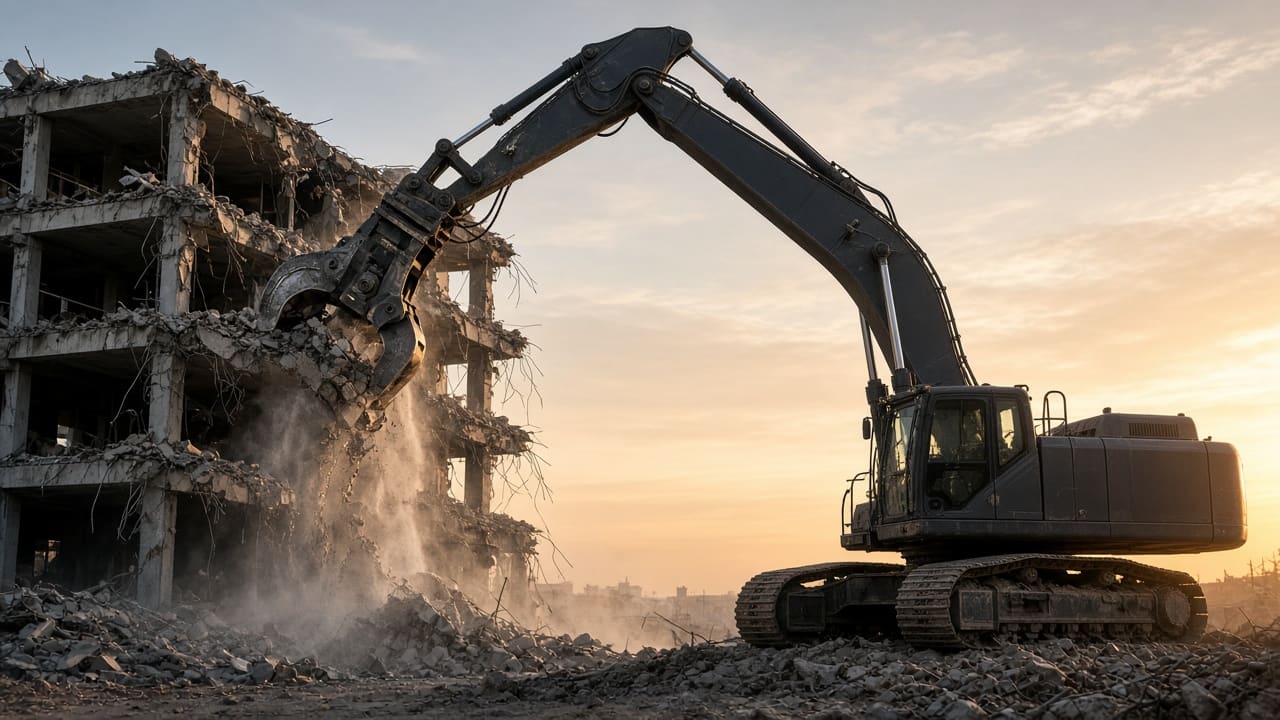
Demolition Excavators Shipping
A high-reach demolition excavator ships with its long front off, as a standard excavator plus a boom that needs its own deck. The base machine follows the excavator plans in our records; the front goes on a flat rack.
Overview
A demolition excavator is a standard crawler excavator with a long high-reach front, a reinforced cab and extra counterweight. For shipping it splits into two problems. The base machine follows the same plans as any excavator of its weight in our loading records: a 20-tonne machine such as a CAT 320C goes in a 40 ft open top and a 40 ft high cube, a CAT 365 CL in an open top and three high cubes.
The high-reach front is the hard part. Its sections are longer than the 12.03 m interior of a 40 ft high cube, so they go on a 40 ft flat rack or by RoRo on a trailer. The demolition tools, such as shears, pulverisers and hammers, are heavy for their size and go in an open top or a high cube, blocked to the floor.
Published sizes for the base machines are on our model pages: Kobelco prints the SK500LC-10 at 12.14 m long and 3.65 m wide, and Komatsu the PC650LC-11 at 3.49 m wide. A machine of that class ships by RoRo or as breakbulk rather than in containers.
We plan from the manufacturer's transport drawing for the high-reach front, the counterweight weight and photos of your machine. Containers sail from Houston and Savannah, and RoRo from Baltimore and Brunswick.
Send the model and serial number and say whether the high-reach front, the standard digging front or both are included. A demolition excavator sold with two fronts ships as two plans. Attachments such as shears and pulverisers are heavy for their size and usually go on a flat rack or in their own box.
Typical Specifications
| Base Weight | 40 - 120+ metric tons |
|---|---|
| Reach | Up to 60m+ high-reach front |
| Boom | Multi-section, shipped separately |
| Attachments | Shears, pulverizers, hammers |
Recommended Shipping Methods
Worked example
Cat 340 UHD base, high-reach front removed: 19 ft 8 in / 6 m long, 9 ft 10 in / 3 m wide, 10 ft 10 in / 3.3 m high, 88,200 lb / 40,000 kg.
The ladder below is worked out from these figures. Larger or smaller units of the same type can land on a different rung.
Cheapest first: the shipping cost ladder
We price every machine from the bottom rung up. A machine only moves up a rung when a measurement rules out the cheaper method.
Cat 340 UHD base, high-reach front removed weighs 88,200 lb / 40,000 kg, over a flat rack’s 86,000 lb / 39,000 kg payload, so it drives or tows aboard a RoRo vessel.
- Rung 1
Container
Lowest cost
When: Fits through a 7 ft 8 in / 2.34 m × 8 ft 6 in / 2.58 m door and under 59,500 lb / 27,000 kg, whole or after we take off the bucket, boom, cab or wheels.
- Rung 2
Flat rack
Mid cost
When: Too wide or tall for a container door, but within 14 ft 9 in / 4.5 m wide, 13 ft 1 in / 4 m tall and 86,000 lb / 39,000 kg on one rack.
- Rung 3
RoRo
Mid cost
Best fit for Cat 340 UHD base, high-reach front removed
When: Drives or tows aboard, under 19 ft 8 in / 6 m tall and 110 US tons / 100,000 kg, going to a port with regular RoRo sailings.
- Rung 4
Breakbulk
Highest cost
When: Past flat-rack and roll-trailer limits, or shipped as modules lifted aboard piece by piece.
Breakbulk / Heavy Lift
RecommendedFor the base machine and long boom sections.
Flat Rack Container
RecommendedFor boom sections and attachments.
RoRo (Roll-on/Roll-off)
For the base machine where it fits.
Heavy Haul Trucking
RecommendedPermitted inland transport to the port.
Container, flat rack, RoRo or breakbulk?
01Container
- Work needed
- We partially disassemble when needed (bucket, boom, cab, wheels), or take larger machines further apart across several high-cubes and open-tops, then crate, block and lash every part.
- Destinations
- Widest: almost every port worldwide, plus inland delivery by rail.
- Typical cost
- Usually the lowest, with no out-of-gauge surcharges.
- Protection
- Sealed steel box; loose parts and attachments travel locked inside.
- Best for
- Most machines: compact ones as they are, others after partial disassembly, and large ones split across several containers.
02Flat rack
- Work needed
- Ships assembled, blocked and lashed. Surcharges apply when wider than 2.4 m or taller than about 1.95 m.
- Destinations
- Most container ports, on the same vessels as containers.
- Typical cost
- Moderate; rises with every centimetre out of gauge.
- Protection
- Open to the weather; we protect cabs, electronics and hydraulics.
- Best for
- Excavators, dozers and loaders too wide for a container door.
03RoRo
- Work needed
- Drives on assembled; non-runners go on a roll trailer.
- Destinations
- Fewer destinations: regular lanes to Europe, West Africa, the Middle East, Oceania and parts of Latin America.
- Typical cost
- Often competitive for large self-propelled machines where a lane exists.
- Protection
- Below deck, but loose items and attachments cannot ride inside the cab.
- Best for
- Running machines going to a port with regular RoRo sailings.
04Breakbulk
- Work needed
- Lifted aboard piece by piece by ship’s or shore cranes, on its own skids or cradle, then stowed and lashed in the hold or on deck.
- Destinations
- Ports with breakbulk berths and heavy-lift cranes; sailings are booked voyage by voyage.
- Typical cost
- Usually the highest for a single small machine; often the only option for the largest pieces.
- Protection
- In the hold or lashed on deck; we crate, wrap and protect exposed parts.
- Best for
- Pieces too large or heavy for a flat rack or roll trailer: transformers, process modules, mining trucks, crane sections.
Handling & Preparation Requirements
- Remove and crate/secure the high-reach boom sections
- Secure the standard or demolition base machine
- Crate or secure shears, pulverizers, and hammers
- Reduce fluids and disconnect batteries for ocean shipment
- Plan reassembly support at destination
Demolition Excavators we have loaded in containers
A spread of machines from our dismantling and loading records, with the boxes each one went in. Open a brand to see every model and its plan.
Excavator
CAT 206B
1 × 45 ft high cube
Caterpillar loading plansExcavator
CAT 215
1 × 40 ft high cube
Caterpillar loading plansExcavator
Komatsu PC 250 LC-6
1 × 40 ft open top
Komatsu loading plansExcavator
Komatsu PC 270 LC-6
2 × 40 ft high cube
Komatsu loading plansExcavator
Hitachi EX 370-5
1 × 40 ft open top, 1 ft / 0.3 m over the side walls + 1 × 40 ft high cube
Hitachi Construction Machinery loading plansExcavator
Hitachi EX 550
1 × 40 ft open top, 1 ft / 0.3 m over the side walls + 3 × 40 ft high cube
Hitachi Construction Machinery loading plansExcavator
Volvo EC 480EL
1 × 40 ft open top, 1 ft / 0.3 m over the side walls + 2 × 40 ft high cube
Volvo Construction Equipment loading plansExcavator
CAT 214 Wheel Excavator
1 × 45 ft high cube
Caterpillar loading plansExcavator
Komatsu PC 138US LC-8
1 × 40 ft high cube
Komatsu loading plansExcavator
Hitachi EX 100WD-1
1 × 45 ft high cube
Hitachi Construction Machinery loading plansExcavator
Volvo EC 330BLC
1 × 40 ft open top, 1 ft / 0.3 m over the side walls + 1 × 40 ft high cube
Volvo Construction Equipment loading plansExcavator
Volvo EC290B LC
2 × 40 ft high cube
Volvo Construction Equipment loading plans
Transport dimensions by model
Published dimensions, a scale drawing and every way to ship each one.
- P&H 4100XPC AC (Komatsu)Electric rope shovel1,689 US tons (1,532,235 kg)
- Komatsu PC650LC-11Hydraulic excavator42 ft 8 in × 11 ft 5 in × 12 ft 5 in (13.01 × 3.49 × 3.79 m)72 US tons (65,480 kg)
- Kobelco SK500LC-10Hydraulic excavator39 ft 10 in × 12 ft × 11 ft 9 in (12.14 × 3.65 × 3.57 m)57 US tons (51,700 kg)
- Hitachi ZX490LC-7Hydraulic excavator39 ft 5 in × 12 ft 6 in × 12 ft 2 in (12.01 × 3.81 × 3.71 m)55 US tons (50,200 kg)
- Volvo EC480ECrawler excavator40 ft 1 in × 11 ft 11 in × 11 ft 7 in (12.22 × 3.64 × 3.53 m)54 US tons (49,381 kg)
- Komatsu PC490LC-11Hydraulic excavator39 ft 2 in × 11 ft 11 in × 11 ft 11 in (11.93 × 3.64 × 3.63 m)54 US tons (48,920 kg)
- Kobelco SK480LC-8Crawler excavator39 ft 6 in × 11 ft 8 in × 10 ft 10 in (12.03 × 3.55 × 3.31 m)54 US tons (48,800 kg)
- John Deere 450D LCHydraulic excavator39 ft 1 in × 11 ft 7 in × 11 ft 6 in (11.91 × 3.53 × 3.5 m)53 US tons (48,163 kg)
- Hitachi ZX450LC-3Hydraulic excavator39 ft 1 in × 12 ft 3 in × 11 ft 5 in (11.91 × 3.74 × 3.48 m)51 US tons (46,600 kg)
- CAT 350Hydraulic excavator39 ft × 10 ft 11 in × 11 ft 2 in (11.89 × 3.34 × 3.4 m)51 US tons (46,000 kg)
- Kobelco SK400LC Mark IVHydraulic excavator38 ft 6 in × 11 ft 8 in × 11 ft 3 in (11.73 × 3.55 × 3.43 m)99,400 lb (45,100 kg)
- Komatsu PC450-8RHydraulic excavator39 ft 6 in × 11 ft 3 in × 10 ft 9 in (12.04 × 3.43 × 3.29 m)95,500 lb (43,320 kg)
Common Models We Ship
- Caterpillar 340 UHD, 352 UHD
- Komatsu PC490HRD
- Hitachi ZX490H, ZX870
- Volvo EC480E HR, EC750
- Liebherr R 950 / R 960 Demolition
Manufacturers We Ship
Brands that build demolition excavators, the ones in our loading records first, with model dimensions and the shipping method each one fits.
- Caterpillar64 in our loading records

- Komatsu59 in our loading records

- Hitachi Construction Machinery57 in our loading records

- Doosan30 in our loading records

- Kobelco28 in our loading records

- Link-Belt13 in our loading records

- Hyundai12 in our loading records

- John Deere10 in our loading records

- Samsung8 in our loading records

- Volvo Construction Equipment7 in our loading records

- Sumitomo2 in our loading records

- CASE Construction Equipment1 in our loading records

- JCB1 in our loading records

- KATO1 in our loading records

- Terex1 in our loading records

Where demolition excavators shipments go wrong
Mistakes we see on demolition excavators bookings, and what avoids them.
- Each high-reach boom joint has hydraulic quick couplers that must be capped, because uncapped lines take in water and grit and the buyer then has to flush the whole circuit.
- UHD machines carry extra counterweight that is often removed for transport, and leaving it off the load list delivers a machine that is unstable at full reach.
- Many high-reach bases have a hydraulically extendable undercarriage, and shipping it extended adds about a metre of width and moves the base onto an overwidth rate.
Frequently Asked Questions
Is the demolition boom shipped separately?
Yes, high-reach booms are removed and shipped as breakbulk or on flat racks, with the base machine shipped separately.
Do you ship the demolition attachments?
Yes, shears, pulverizers, and hammers are crated or secured and shipped with the machine.
Can you coordinate reassembly?
Yes, we can arrange technical support for boom reassembly at the destination.
Sources
Every figure on this page comes from the documents below, each checked on the date shown. Carriers and authorities revise them, so we confirm the current figure when we book.
- [1]Seaway Export loading records: machines dismantled and loaded at U.S. yards, checked July 2026
- [2]P&H 4100XPC AC (Komatsu): manufacturer specification, checked October 2026
- [3]Hitachi ZX490LC-7: manufacturer specification, checked October 2026
- [4]Seaway Project Cargo brand and model guides, checked October 22, 2026
Plan your shipment
Import Duty & Tax Estimator
Estimate duty and VAT on the CIF value for 70+ destinations.
Dimensional Weight Calculator
Work out chargeable weight before you book.
Container Space Calculator
See how your cargo fits in 20ft, 40ft, and HC containers.
Route Finder
Load port, sailings, duty and rules for a machine and destination.
Ready to Ship Your Demolition Excavators?
Send the make, model and pickup location. We quote demolition excavators by container, flat rack or RoRo from the U.S. port that suits the machine.