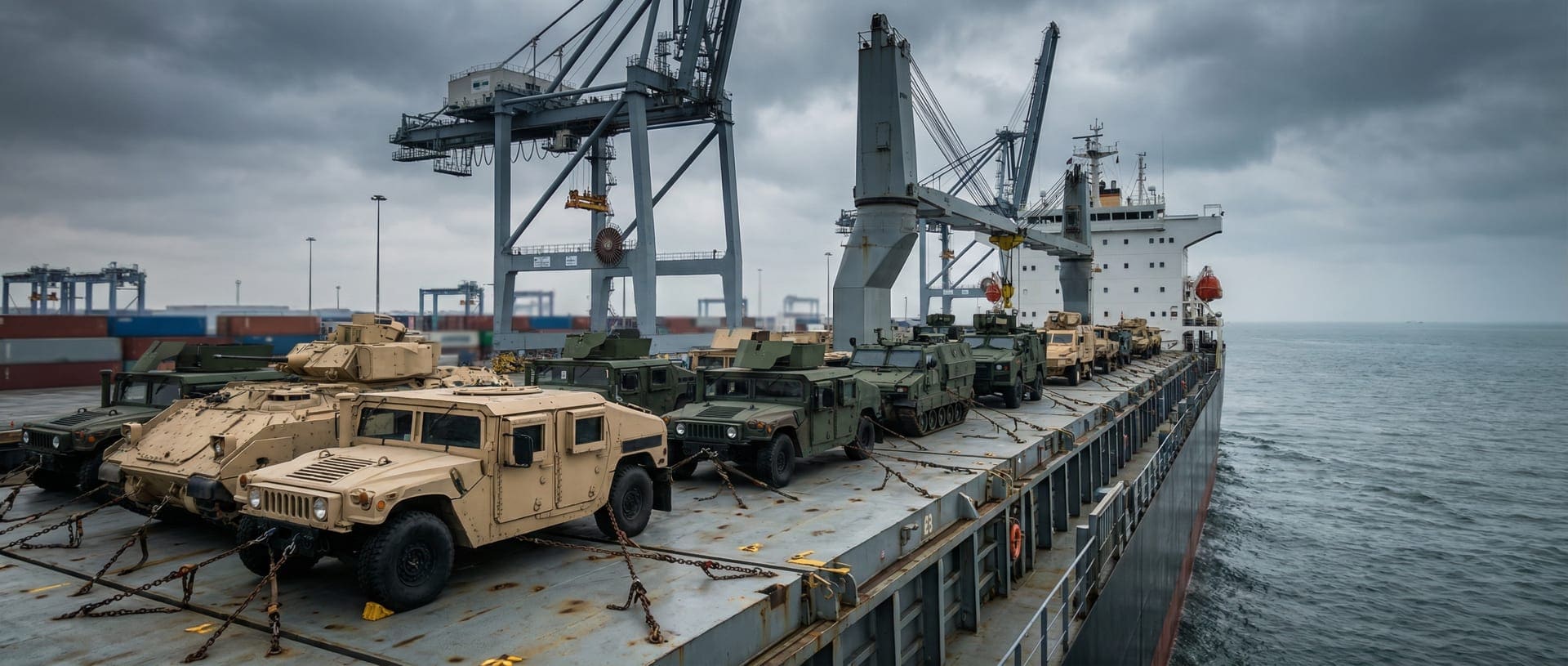
Military Vehicles Shipping
Demilitarised military trucks and vehicles ship by RoRo or on flat racks, after the export classification is confirmed. The licence question comes before the shipping plan.
Overview
Surplus military vehicles, such as tactical trucks and utility vehicles sold through government auctions, ship like any heavy truck once they are cleared for export. The first step is classification: a vehicle and its parts may be controlled under the export rules, and some need a licence or cannot go to certain destinations. The seller's demilitarisation certificate and the buyer's end-use details decide that.
Once cleared, a running vehicle drives aboard a RoRo ship where a lane serves the destination. Vehicles that are not running go on a flat rack or a MAFI trailer. Smaller vehicles that pass the 2.34 m by 2.58 m door of a 40 ft high cube can go in a container.
Fuel is kept to the level the carrier allows, batteries are disconnected, and the vehicle is cleaned underneath of soil.
We have no military vehicles in our own loading records, so this page sets out the method rather than a past plan. We do not ship controlled items without the licence in hand, and we confirm the classification and the method before booking.
Check the listing's export restrictions before bidding. Some surplus military vehicles carry export controls or end-use conditions, and some cannot be exported at all. Send the VIN or serial number and the sale documents, and we confirm what is needed before the vehicle leaves the yard.
Cost depends on the vehicle's size and the method. RoRo is priced by the cubic metres of the vehicle's length, width and height, and smaller vehicles fit containers at a per-box rate. Trucking from the government sale yard to the port is quoted on top.
Typical Specifications
| Weight Range | 5 - 70+ metric tons |
|---|---|
| Types | Wheeled, tracked, armored |
| Armor Level | Various classifications |
| Width | 2.5m - 4m+ |
Recommended Shipping Methods
Worked example
AM General HMMWV M1151, surplus: 16 ft 2 in / 4.93 m long, 7 ft 7 in / 2.3 m wide, 6 ft 6 in / 1.98 m high, 10,600 lb / 4,800 kg.
The ladder below is worked out from these figures. Larger or smaller units of the same type can land on a different rung.
Cheapest first: the shipping cost ladder
We price every machine from the bottom rung up. A machine only moves up a rung when a measurement rules out the cheaper method.
AM General HMMWV M1151, surplus fits a container in one piece, the cheapest way to ship it.
- Rung 1
Container
Lowest cost
Best fit for AM General HMMWV M1151, surplus
When: Fits through a 7 ft 8 in / 2.34 m × 8 ft 6 in / 2.58 m door and under 59,500 lb / 27,000 kg, whole or after we take off the bucket, boom, cab or wheels.
- Rung 2
Flat rack
Mid cost
When: Too wide or tall for a container door, but within 14 ft 9 in / 4.5 m wide, 13 ft 1 in / 4 m tall and 86,000 lb / 39,000 kg on one rack.
- Rung 3
RoRo
Mid cost
When: Drives or tows aboard, under 19 ft 8 in / 6 m tall and 110 US tons / 100,000 kg, going to a port with regular RoRo sailings.
- Rung 4
Breakbulk
Highest cost
When: Past flat-rack and roll-trailer limits, or shipped as modules lifted aboard piece by piece.
RoRo (Roll-on/Roll-off)
RecommendedFor wheeled military vehicles.
Breakbulk
RecommendedFor tracked/heavy armored.
Heavy Haul Trucking
RecommendedPermitted for military loads.
Air Charter
For urgent deployments.
Container, flat rack, RoRo or breakbulk?
01Container
- Work needed
- We partially disassemble when needed (bucket, boom, cab, wheels), or take larger machines further apart across several high-cubes and open-tops, then crate, block and lash every part.
- Destinations
- Widest: almost every port worldwide, plus inland delivery by rail.
- Typical cost
- Usually the lowest, with no out-of-gauge surcharges.
- Protection
- Sealed steel box; loose parts and attachments travel locked inside.
- Best for
- Most machines: compact ones as they are, others after partial disassembly, and large ones split across several containers.
02Flat rack
- Work needed
- Ships assembled, blocked and lashed. Surcharges apply when wider than 2.4 m or taller than about 1.95 m.
- Destinations
- Most container ports, on the same vessels as containers.
- Typical cost
- Moderate; rises with every centimetre out of gauge.
- Protection
- Open to the weather; we protect cabs, electronics and hydraulics.
- Best for
- Excavators, dozers and loaders too wide for a container door.
03RoRo
- Work needed
- Drives on assembled; non-runners go on a roll trailer.
- Destinations
- Fewer destinations: regular lanes to Europe, West Africa, the Middle East, Oceania and parts of Latin America.
- Typical cost
- Often competitive for large self-propelled machines where a lane exists.
- Protection
- Below deck, but loose items and attachments cannot ride inside the cab.
- Best for
- Running machines going to a port with regular RoRo sailings.
04Breakbulk
- Work needed
- Lifted aboard piece by piece by ship’s or shore cranes, on its own skids or cradle, then stowed and lashed in the hold or on deck.
- Destinations
- Ports with breakbulk berths and heavy-lift cranes; sailings are booked voyage by voyage.
- Typical cost
- Usually the highest for a single small machine; often the only option for the largest pieces.
- Protection
- In the hold or lashed on deck; we crate, wrap and protect exposed parts.
- Best for
- Pieces too large or heavy for a flat rack or roll trailer: transformers, process modules, mining trucks, crane sections.
Handling & Preparation Requirements
- Security clearance verification
- Export license (ITAR/EAR)
- Weapons demil if required
- Track pad protection
- Turret securing
- Classified component handling
Auction yards that sell military vehicles
Yards whose published equipment categories include military vehicles. Each yard page lists its nearest export ports and how we collect from it.
Common Models We Ship
- HMMWV, JLTV
- MRAP vehicles
- Stryker, Bradley
- M1 Abrams
- HEMTT trucks
Where military vehicles shipments go wrong
Mistakes we see on military vehicles bookings, and what avoids them.
- Surplus HMMWVs bought at government auction usually carry end-use restrictions, and exporting one without State or Commerce Department authorisation can lead to seizure at the US port of loading.
- Armoured vehicles weigh far more than soft-skinned versions of the same size, so lashing plans and RoRo ramp limits worked out from the base model weight can be exceeded on an MRAP.
- Central tyre inflation systems are often left at soft-sand pressure, which lets the vehicle squat and shift in its lashings at sea, so tyres are set to road pressure before loading.
Frequently Asked Questions
What licenses are required?
ITAR or EAR export licenses depending on equipment type. We coordinate with licensing specialists.
Is demilitarization required?
Depends on destination and equipment. Weapons systems and some components may require demil.
Do you have security clearances?
Our team includes cleared personnel for handling classified shipments.
Sources
Every figure on this page comes from the documents below, each checked on the date shown. Carriers and authorities revise them, so we confirm the current figure when we book.
- [1]Seaway Project Cargo: about the company, checked October 22, 2026
- [2]Seaway Project Cargo country shipping guides, checked October 22, 2026
Plan your shipment
Import Duty & Tax Estimator
Estimate duty and VAT on the CIF value for 70+ destinations.
Dimensional Weight Calculator
Work out chargeable weight before you book.
Container Space Calculator
See how your cargo fits in 20ft, 40ft, and HC containers.
Route Finder
Load port, sailings, duty and rules for a machine and destination.
Ready to Ship Your Military Vehicles?
Send the make, model and pickup location. We quote military vehicles by container, flat rack or RoRo from the U.S. port that suits the machine.