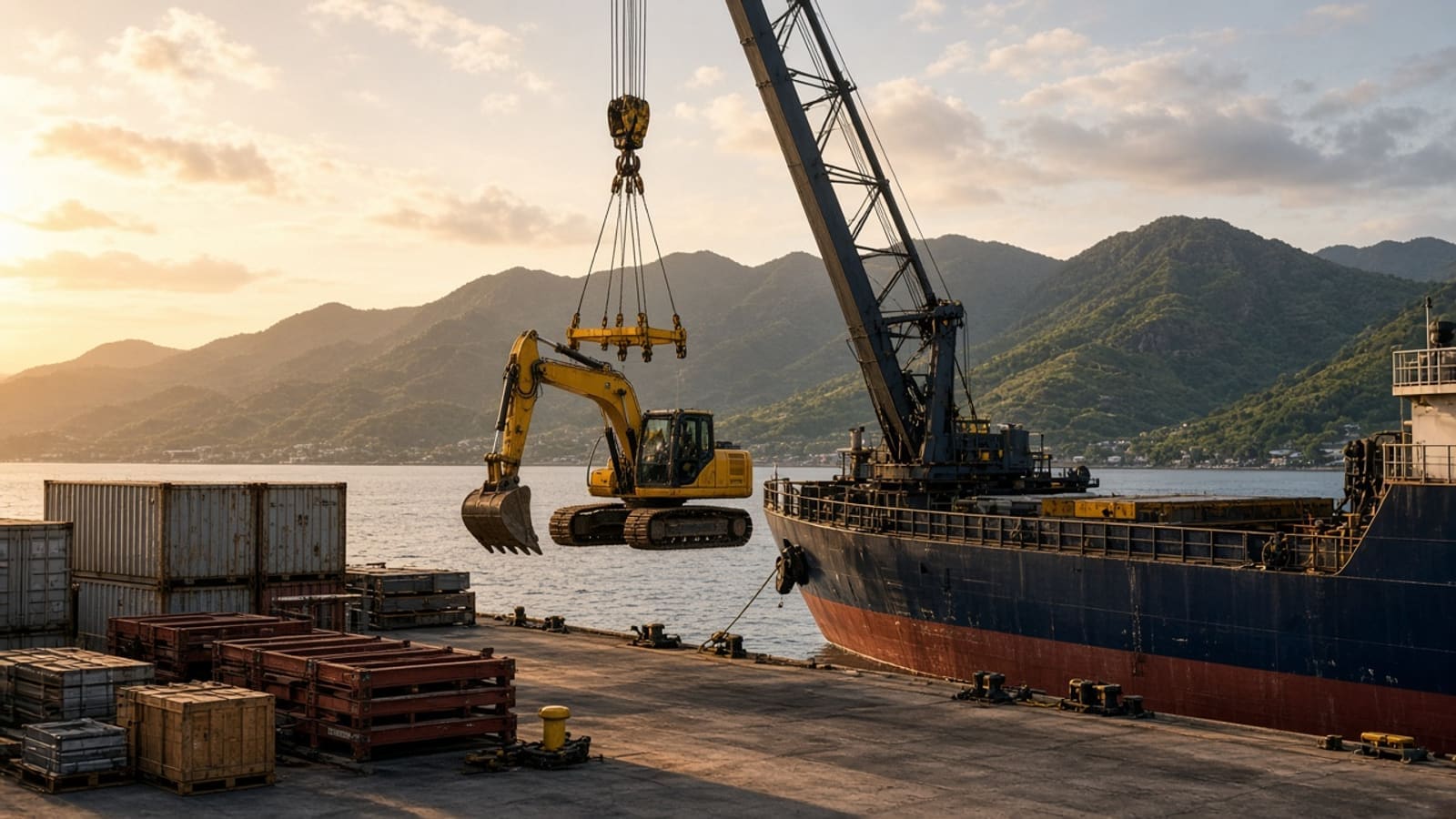
Shipping Heavy Equipment and Trucks from the United States to Venezuela (2026)
Sanctions, the Decreto 5.103 age rule, the 90% exoneration, container and RoRo reality, La Guaira and Puerto Cabello after the June 2026 earthquake. Verified October 2026.
Seaway Project Cargo Team
Project Cargo & Heavy-Lift Specialists
Venezuela will take used earthmoving machines, cranes, farm machinery and trucks from the United States in 2026, and US sanctions do not stop private-sector shipments of ordinary machinery as long as the buyer, the consignee and the end use clear a screening. The hard parts are elsewhere: no scheduled liner RoRo service that we could confirm, a Venezuelan age limit that applies to road vehicles but not to most off-road machines, and a port system that is still recovering from the 24 June 2026 earthquake.
This guide is the version we use internally when a Venezuelan buyer asks us for a quote. Every regulatory statement was read in the decree, the OFAC or BIS notice, the carrier or port bulletin that publishes it, and checked in October 2026. Where we could not confirm a figure with an official or carrier source, we left it out and say so. If you only need the short checklist, start with our Venezuela country page; for the container planning method used below, read how we containerize oversized machinery.
Can you import it?
Venezuelan customs law draws the line by tariff chapter, not by calling a machine "heavy" or "old". Decreto 5.103, the decree that sets the age rule, ties the maximum age to Chapter 87 (road vehicles). Machines classified in Chapter 84, such as excavators, loaders, dozers, graders and cranes, are not covered by that age rule in the decree text we read, and trailers under heading 87.16 are largely exempt from it. Self-propelled road vehicles are where the age limit bites.
| Machine class | Allowed from the US? | Age rule | Key condition |
|---|---|---|---|
| Excavators (HS 8429.52) | Yes | None found in Decreto 5.103 | Importer registered with SENIAT; counterparty screened |
| Wheel loaders and dozers (8429.11, 8429.51) | Yes | None found in Decreto 5.103 | Not on the 90% exoneration list for private importers |
| Motor graders (8429.20) | Yes | None found in Decreto 5.103 | Same as above; export title and EEI filed |
| Mobile cranes (8426.41) | Yes | None found in Decreto 5.103 | Confirm whether your unit is classed as a truck-mounted vehicle |
| Dump trucks and tractor units (Chapter 87) | Yes, with limits | Chapter 87 age cap applies | Check the current limit for your vehicle type before buying |
| Trailers and semi-trailers (8716) | Yes | Mostly exempt from the cap | Spanish-language documents; chassis numbers legible |
| Farm tractors and combines | Yes | Check the heading used | Tractors under 8701 fall in Chapter 87, so confirm the age rule |
| Forklifts (8427) | Yes | None found in Decreto 5.103 | Tariff is at the top of the range |
Two corrections to what circulates in forwarder circles. First, the 90% duty and VAT exoneration under Decreto 5.197 and the Gaceta Oficial 6.952 appendices, which needs a COMEX permit and runs to 31 December 2026, does not list the 84.29 earthmoving codes or the Chapter 87 vehicle codes for a private importer. Do not count on it for a used excavator. Second, tariff rates vary by tariff line. The simple averages for 2023 in the World Bank WITS series that our export atlas uses were 5.6% for excavators (range 0 to 14%), 6% for loaders, 5% for dozers, 7% for graders and mobile cranes, and 14% for backhoes and forklifts. Those are averages across lines, not the rate on your machine. Your customs broker should confirm the line and rate in the current Arancel before you buy.
Volumes show that the trade is real, if small. US customs data in the same series records 16 excavators worth about US$736,000, 24 wheel loaders worth about US$779,000, 7 dozers, 38 backhoes and 52 drill rigs worth about US$4.05 million exported to Venezuela in 2025.
The four ways to ship
We run four methods on every South American lane. Venezuela is the lane where honesty about availability matters most, because the choice is narrower than on the Pacific coast.
Containerization
Containers are the default and the most reliable option today. Boxes load at Port Everglades, Miami, Houston and other US ports on liner services that call at La Guaira and Puerto Cabello, and mid-size machines go in a 40-foot high-cube or an open-top. CMA CGM runs a weekly service out of Port Everglades that the port's September 2026 guide gives as 8 to 10 days to La Guaira and Puerto Cabello. After the earthquake, Maersk, ONE, MSC and Hapag-Lloyd resumed calls, and Seaboard continues to list Venezuela, though we could not confirm a 2026 schedule from Seaboard's own pages. Machines such as a CAT 315 fit a 40-foot high-cube whole; larger ones are broken down for the box. We use the word disassembly, never "major disassembly", because only the attachments, boom, stick or cab pieces that exceed the box come off.
Flat rack and open top
When a machine is too tall or wide for a high-cube, an open-top or a flat rack takes the overheight piece. Our loading plan for a CAT 345 uses one 40-foot open-top plus one 40-foot high-cube. Flat racks are the right answer for dozers and wide graders, and the carrier will charge for out-of-gauge space on the slot next to it. The planning logic is in our flat-rack shipping service.
RoRo
RoRo is the method buyers ask about first, and the one we cannot honestly promise. We found no scheduled liner RoRo service to Venezuela. The only RoRo offering we could document is a monthly service announced by Tech Cargo, and we have not seen a published sailing list. If a forwarder quotes you a weekly RoRo sailing to Puerto Cabello, ask for the vessel name and the cut-off date in writing. For more on the trade-offs, see RoRo vs container vs flat rack and our RoRo service page.
Breakbulk
Breakbulk is for the pieces that do not fit a container: large dozers, cranes, mining trucks, power equipment. It is chartered or space-booked per sailing, so the schedule is shorter than for container service and port calls depend on cargo volume. Berth and crane availability at Venezuelan ports has been changing since the earthquake, so we treat it as case-by-case and agree the discharge port, crane capacity and demurrage terms before we book. Read about breakbulk ocean shipping for how we structure it.
From your US port
The table below lists the US ports we load from, using the service flags in our own port data. It does not claim a Venezuelan sailing from every port: container service to Venezuela is concentrated in Florida and the Gulf, and cargo from other states usually rails or trucks to one of them. Transit days are given only where a carrier or port source published them.
| US port | Container service | RoRo service | Transit to Venezuela | Our page |
|---|---|---|---|---|
| Port Everglades, FL | Yes | Yes | 8 to 10 days (CMA CGM, port guide Sept 2026) | Port Everglades |
| Port of Miami, FL | Yes | Yes | Not sourced | Miami |
| Port of Houston, TX | Yes | Yes | Not sourced | Houston |
| Port of Jacksonville, FL | Yes | Yes | Not sourced | Jacksonville |
| Port of Savannah, GA | Yes | No | Not sourced | Savannah |
| Port of New Orleans, LA | Yes | No | Not sourced | New Orleans |
| Port of Baltimore, MD | Yes | Yes | Not sourced | Baltimore |
| Port of Brunswick, GA | No | Yes | Not sourced | Brunswick |
For a machine in the Midwest or the Northeast, the cheapest route is almost always trucking it to Florida or Houston and loading there, not to the nearest port. Use our route finder to compare a pickup address against these gateways.
Choosing the destination port
Venezuela has two main container gateways on the Caribbean coast and several smaller ports. Which one you choose depends on where the machine is going to work and on what the earthquake left standing.
| Port | Role | What we know |
|---|---|---|
| La Guaira | Main gateway for Caracas and the central region | Carriers resumed calls after the 24 June 2026 earthquake |
| Puerto Cabello | Container port; the alternative when La Guaira is limited | Served by CMA CGM and others; best for Valencia, Maracay and the west |
| Guanta | Eastern region, Barcelona and Puerto La Cruz | Confirm that the carrier calls before booking |
| Maracaibo and El Guamache | Oil region and the island of Margarita | Local services only; confirm with the carrier |
| Ciudad Guayana (Orinoco) | Mining and steel region in the south-east | Not a standard container lane; treat as a case-by-case quote |
If your machine ends up in Caracas, La Guaira saves a day of road but depends on the port's current capacity. If it goes west or to the industrial centre around Valencia, Puerto Cabello is the more practical discharge, subject to the carrier's rotation. We name the discharge port in the quote and confirm the carrier's actual rotation before we confirm a sailing date.
What we have loaded
We can only plan from what we have loaded. The model pages below are real records from our loading plans, each with the container plan we use, and each links to the page that shows the machine, its dimensions and the pieces that come off for the box. Lists of this kind are the best way for a buyer to check that a forwarder has done the work on the exact model.
| Model | Plan we use | Page |
|---|---|---|
| CAT 315 excavator | One 40-foot high-cube | CAT 315 |
| CAT 345 excavator | One 40-foot open-top plus one 40-foot high-cube | CAT 345 |
| CAT D9 dozer | One 40-foot open-top | CAT D9 |
| Komatsu GD825A-2 motor grader | One 40-foot high-cube, drive shaft removed | Komatsu GD825A-2 |
The loading pictorials on those pages show the actual machine pieces in the box. The data behind the lane is in our US heavy equipment exports atlas.
Trucks and trailers
Trucks are where Venezuela differs most from its neighbours, because the age cap applies to Chapter 87 and the road-vehicle authorities add their own requirements on top. Three things matter.
- Age: confirm the current limit for your vehicle type in Decreto 5.103 before you buy, since the limit differs by type. A truck that fails it cannot be released at customs, and the cost of returning it falls on the shipper.
- Condition: have the VIN, odometer and steering side on the invoice, and keep the original US title and lien release ready.
- Road registration: vehicles that will go on the road must clear the national transport institute (INTT). Your customs broker or importer should confirm the current homologation steps. We have not confirmed any general rule about right-hand drive and do not state one here.
Because there is no scheduled RoRo service, trucks and trailers normally travel by container or on flat racks. A tractor unit can be loaded on a flat rack with the trailer on a second one. Our commercial vehicle quote form lets you ask for RoRo anyway, and we will tell you whether a real sailing exists on the date you need.
Preparation and compliance
US export side
Every export starts with a screening. OFAC's Venezuela sanctions are targeted: the Specially Designated Nationals list and its 50% ownership rule, the Foreign Terrorist Organization designations that touch some Venezuelan entities, and the sector-specific general licences, such as GL 46E and GL 48D, that apply to oil, gas, electricity and state counterparties. A private buyer who is not a designated person or a majority-owned subsidiary of one is not blocked, but we screen the buyer, the consignee, the notify party and the end user, and we stop if a name matches.
The Bureau of Industry and Security adds export-control checks. The military end-user rule in EAR section 744.21 reaches certain items sent to military end users in Venezuela, so we ask what the machine will do and for whom.
On the paperwork side, an export of this value needs an Electronic Export Information filing in the Automated Export System. For used self-propelled vehicles, the US title or a certified copy has to reach CBP at least 72 hours before export. The scope of that rule for construction and farm machinery is not one we could confirm from the regulation, so we send the title for every self-propelled unit and let the filing agent confirm. Add a commercial invoice, packing list, bill of lading instructions, and a lien release.
Venezuela side
The importer must be registered with SENIAT, the customs and tax authority, which handles declarations through its SIDUNEA World system. The customs agent files the declaration. Documents should be in Spanish, or accompanied by a Spanish translation, and the commercial invoice must show the machine description, model, serial number and value. The tariff is applied by line, and we advise buyers to have the broker send us the line and rate in writing, because the exoneration decrees listed above do not reach most earthmoving machinery.
The earthquake of 24 June 2026 changed port operations. Every statement in this section was checked against the decree, the OFAC or BIS page, or the carrier bulletin in October 2026; we recommend you recheck before you sign a contract, because this is a lane where the rules move.
The inland leg
From the port to the job site, Venezuela relies on trucks. A low-bed trailer takes an excavator or a loader on a standard road permit when the machine stays under the legal width and height; anything wider needs an escort and a transport permit from the road authorities. Good road corridors link La Guaira to Caracas, Puerto Cabello to Valencia and Maracay, and the east to Barcelona. Mining and oil sites are another matter, with long runs on lower-grade roads, so we ask for the final address and road access in the quote request and price the inland leg with a Venezuelan trucking partner and not as an afterthought.
Plan for a day or two between discharge and release, and for storage charges at the terminal if customs or the importer's papers are late. We recommend that the consignee's customs agent is appointed before the machine sails and that the declaration is pre-filed where the system allows it. For the US side, our heavy-haul trucking service covers pickup and the run to the port, and heavy-haul permitting covers oversize permits.
What it costs
We do not publish a price for this lane, because any number we gave you today could be wrong by next month. What we can give you is the anatomy of the cost, so you can compare quotes line by line.
- US inland: pickup and trucking to the loading port, including permits for over-width units.
- Port of loading: terminal handling, lashing, blocking, and the cost of disassembly where it is needed.
- Ocean freight: a rate per container or flat rack, plus any out-of-gauge surcharge for open-top and flat-rack space.
- Carrier surcharges: bunker, security, and any post-earthquake congestion or emergency fee a carrier publishes for Venezuelan ports.
- Destination port: terminal handling, storage after the free time, and customs brokerage.
- Duties and taxes: tariff by line, VAT where it applies, and any customs fee, as confirmed by your broker.
- Inland delivery: low-bed or flat-bed trucking from the port to the site.
- Insurance: cargo cover, which we recommend for every unit.
To start with a real quote on a real model, use a prefilled form: CAT 345 from Port Everglades, or CAT 315 from Miami. To estimate duty on a line, use our import duty calculator as a starting point and confirm it with your broker.
Frequently asked questions
Do US sanctions prevent me from shipping machinery to Venezuela?
Not for a private buyer who is not on the SDN list and not majority-owned by someone who is. Sanctions on Venezuela are targeted, and several general licences have been issued or amended in 2026, though GL 46E and GL 48D are tied to specific sectors. We screen every party, and we cannot ship if a match appears.
Is there a RoRo service from the US to Venezuela?
We found no scheduled liner RoRo service. A monthly service has been announced by Tech Cargo, but we have not seen a published sailing schedule. Until one is confirmed, plan on container, flat rack or breakbulk.
Is there an age limit on used excavators and loaders?
Decreto 5.103 ties its age rule to Chapter 87 road vehicles. We found no age rule for Chapter 84 earthmoving machines in the decree text. Your broker should confirm that the tariff line for your machine is the one you expect.
Can I use the 90% customs exoneration?
Probably not for a used excavator or loader. The Decreto 5.197 appendices do not list the 84.29 machinery codes or the Chapter 87 vehicle codes for private importers, and the permit needs COMEX approval and runs to 31 December 2026.
How long does the sea voyage take?
The one source figure we can give is CMA CGM's weekly service from Port Everglades, listed at 8 to 10 days to La Guaira and Puerto Cabello in the port's September 2026 guide. From other ports, we do not quote a number until the carrier confirms one.
Which port should the machine go to?
Puerto Cabello for the west and the Valencia area, La Guaira for Caracas, and Guanta for the east. Because the earthquake disrupted port operations, we confirm the current carrier rotation before we name a port.
Does the earthquake still affect shipping?
Carriers resumed calls after 24 June 2026, but berth and storage capacity may be tighter than before. Expect surcharges and build-up time in your quote, and ask for the carrier's current advisory.
Quote checklist
Send us these items with your request and we will price the lane against a real sailing:
- Machine make, model, serial number and year, with photographs.
- Weight, length, width and height as configured, and any attachments.
- Whether it is self-propelled and, for trucks, VIN, odometer and steering side.
- Pickup address in the United States, or the port you prefer.
- Title copy and lien release for any self-propelled unit.
- Buyer, consignee and end-user names for screening.
- Venezuelan importer's SENIAT registration and the customs agent contact.
- Destination port or inland site, with road access.
- Target sailing month.
Download the Venezuela export checklist (PDF) and send it with your request, or start in the quote form.
Related Articles
Shipping heavy equipment and trucks from the United States to Chile (2026)
Used excavators and dozers can go to Chile if clean; used on-road trucks cannot. SAG wash rule, 0% FTA duty, NYK RoRo, ports and the inland leg, verified October 2026.
Shipping heavy equipment and trucks from the United States to Ecuador (2026)
Used machinery up to 15 years old can enter Ecuador; on-road trucks must be new. Ports, sailings, licences, taxes and the inland leg, verified October 2026.
Shipping heavy equipment and trucks from the United States to Guyana (2026)
Verified October 2026: GRA duty-free codes, the vehicle inspection rule, the left-hand-drive ban, Georgetown port limits and the US ports that actually serve Guyana.